
Make Texture a preferred source on Google to support us
Add Texture to GoogleThe Mystery of the Red Crown: When Rolex Set the Pace for Revolutions
There is a biting irony in the history of fine watchmaking—the kind that makes collectors smile and ideologues cringe. In 1956, the Geneva-based Rolex manufacture launched its now-legendary Day-Date with a slogan that would etch its reputation in steel and gold: “The men who shape the world’s destiny wear a Rolex.” At the time, the brand was ostensibly targeting the hushed offices of the White House or the diplomatic lounges of NATO. To cement this image as the “watch of presidents,” Hans Wilsdorf did not hesitate to present timepieces to Winston Churchill or Dwight Eisenhower. Yet, in a strange twist of fate, this message of power and reliability penetrated the Iron Curtain, appealing precisely to those who had sworn to bring down triumphant capitalism.
From Havana to Moscow, via Beijing and Bucharest, the communist leaders of the 20th century shared a common, almost paradoxical passion for Swiss precision. How did the ultimate symbol of bourgeois success become the indispensable tool—and sometimes the trophy of war—for the leading figures of Marxism-Leninism? This is a journey into a political landscape where luxury and necessity blur on the wrists of dictators and guerrilla fighters.
The Sierra Maestra: Rolex as a Tool for Survival
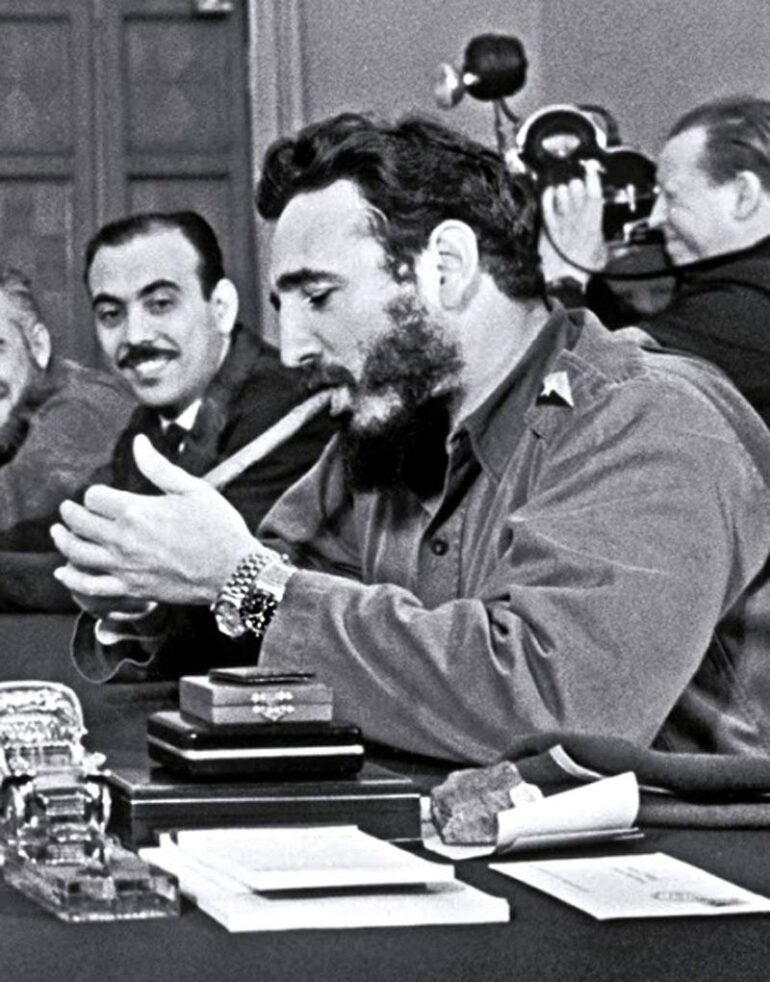
The image is etched into the collective unconscious: Fidel Castro, cigar in mouth, gesturing during a lengthy speech, wearing not one, but two Rolexes on the same wrist. This was not merely the vanity of a social climber. For the Líder Máximo, the Rolex was first and foremost a piece of military equipment. As early as 1956, when the Cuban Revolution was still just a spark in the humid jungle, Castro wore a Submariner, model 6536. In the green hell of the Sierra Maestra, where humidity saturates the air and shocks are constant, a watch was not an accessory, but a vital coordination tool for guerrilla operations.
His collection later expanded to include GMT-Master models (reference numbers 6542 and 1675), originally designed for Pan Am pilots, but whose ability to display two time zones—Moscow and Havana—became a geopolitical necessity. As for the famous pair of watches, the most likely explanation remains one of caution: in the absence of quartz, having two automatic movements made it possible to compensate for any mechanical failure or failure to wind the watch during prolonged campaigns.
Fidel Castro did not merely wear them; he made them a symbol of recognition. For a rebel officer, receiving a Rolex from the commander-in-chief marked entry into the inner circle. Ernesto “Che” Guevara was one such recipient. Promoted to Comandante in 1958, he received his first watch, which he later gave to his father. But it was his second Rolex—a GMT-Master 1675 given to him by Castro in 1966 just before his departure for Bolivia—that became part of watchmaking’s dark legend. On October 9, 1967, as Che was being executed at a school in La Higuera, CIA agent Félix Rodríguez retrieved the watch from his body. This trophy, a silent witness to the final minutes of the world’s most famous revolutionary, is said to still be in the former agent’s possession, making this piece one of the brand’s most historically significant timepieces.
The Red Olympus and the Radiance of Solid Gold
While for Cubans the Rolex retained the character of a “tool,” for the leaders of the Eastern Bloc it quickly became the scepter of a new kind of bureaucratic royalty. Far from the mud of the trenches, Soviet leaders and their satellite states succumbed to the charm of solid gold on a “President” bracelet. Leonid Brezhnev, who succeeded Khrushchev in 1964, was undoubtedly the most striking example of this nomenklatura enamored with Western luxury. While he imposed rigid stagnation on the USSR and suppressed any hint of individual originality among his fellow citizens, Brezhnev never parted with his gold Rolex Datejust. For him, the watch was a symbol of a status that transcended the boundaries of ideology: that of a member of the very exclusive club of the world’s rulers.
This was not an isolated phenomenon. In Beijing, Mao Zedong, the father of the Cultural Revolution—the very man who sent intellectuals to re-education camps for “bourgeois influence”—also sported a solid-gold Datejust. The contrast is striking: while the Red Guards were destroying the vestiges of the past and banning Western books, the Great Helmsman was checking the time on a Swiss watch. We find this same preference in Josip Broz Tito in Yugoslavia and Erich Honecker in the GDR. For these men, the Rolex represented the exception to the proletarian rule—the ultimate privilege of those who, in Orwell’s words, were “more equal than others.”
The OREX Affair: The Romanian Challenge Crushed by Geneva
The story of Nicolae Ceauşescu, the Romanian Conducător, provides an almost novelistic conclusion to this tumultuous relationship between Marxism and luxury watchmaking. A great admirer of the Datejust, Ceauşescu harbored a dream of total self-sufficiency for Romania. In 1977, he decided that his country must produce its own mechanical watches in order to end its dependence on imports. He thus founded the Entreprise de Mécanique Fine in Bucharest. But a name like that was impossible to fit on a 36-mm dial.
Romanian state marketing then came up with a short, catchy name: “OREX.” The concept was simple yet ambitious: “Ora” (the Romanian word for “hour”) combined with the suffix “EX” to symbolize Excellence. However, the phonetic and visual resemblance to the Geneva-based giant did not go unnoticed. Rolex, protective of its intellectual property and the exclusivity of its name, waged a ruthless legal battle. The Romanian David was no match for the Swiss Goliath: Rolex won the lawsuit, forcing OREX to cease operations and bringing a sudden end to the Bucharest regime’s watchmaking ambitions. Today, the few remaining OREX models have become curiosities on auction sites like eBay, symbols of a failed attempt to challenge the Swiss crown.
A Universality Beyond Dogmas
Ultimately, what drove these men—whose lives were dedicated to the abolition of social classes—toward these objects of supreme distinction? The answer may lie in the very essence of the object itself. The Rolex, through its technical robustness, offered certainty in a world of chronic political instability. But more than that, it served as a universal language. For a communist leader, wearing a Rolex signaled to his capitalist counterparts that he was playing in the same league, that he possessed the same mastery of time and, by extension, of power.
The 1956 slogan proved prophetic, though it exceeded even the expectations of its creators. Rolex did not merely adorn the wrists of the presidents of liberal democracies; it conquered the wrists of those who, in theory, despised it the most. In the silence of a self-winding movement, ideological divides fade away to make way for a simpler truth: the quest for eternity and distinction is a human driving force that no manifesto can ever fully extinguish.