
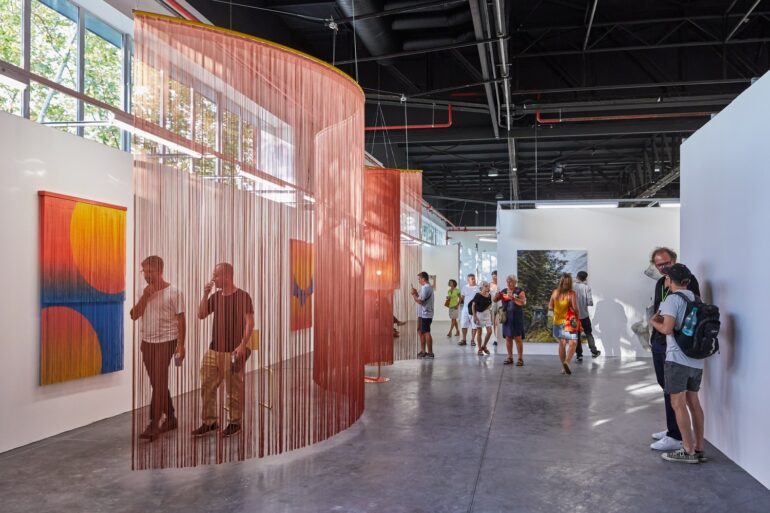
August is drawing to a close on the streets of Marseille with an intensity that has nothing to do with the beach season. As the Phocaean city prepares to wrap up its summer interlude, a special buzz takes hold of its industrial neighborhoods. This weekend, Marseille isn’t content with just its end-of-season glow; it once again becomes the epicenter of a certain aesthetic exhilaration. At the heart of this commotion lies a contemporary art fair that, despite its two decades of existence, seems to have vowed to remain eternally unruly. Reaching the age of twenty for an event of this magnitude is a critical milestone, a threshold where one typically slips into staid respectability and well-oiled market mechanisms. Yet the Marseille event persists in the opposite direction, cultivating an appetite for risk that stands out in an art scene often too concerned with its established achievements.
The Paradox of Turbulent Maturity
Twenty years. In the world of art fairs, this age often marks the transition toward a form of institutionalization. It is the moment when structures solidify, when gallery lineups become predictable, and when the initial boldness dissolves into a quest for secure profitability. This weekend in Marseille, the reality is radically different. The fair seems to have turned its own longevity into a tool of resistance. Instead of settling into a rut, it draws on its experience to refine what constitutes its DNA: a resolutely forward-looking vision and an ability to challenge the expectations of an increasingly demanding audience of collectors and art enthusiasts.
This persistence of a “youthful perspective” is not a marketing ploy. It manifests itself in a selection that rejects the obvious. While other international events rely on safe bets to ensure their commercial success, the Marseille fair continues to stake its claim on discovery. This appetite for risk—cited as a pillar of its identity—manifests as a commitment to showcasing still-fragile artistic approaches, emerging visual languages, and galleries unafraid to experiment. Twenty years after its inception, the fair retains that almost insolent freshness—the kind found in those who have nothing to lose and everything to invent—even as it has now become a firmly established fixture on the European cultural calendar.
Marseille: The Geography of Audacity
The choice of Marseille as its home is no coincidence when it comes to this freedom of expression. The city itself, with its ruggedness, its harsh light, and its refusal to settle for half-measures, provides a natural setting for a fair that rejects the homogenization of international standards. Organizing such an event in the south of France, far from the traditional financial hubs of the art world, inherently implies a form of dissent. This weekend, visitors aren’t just coming to see artworks; they’re coming to immerse themselves in an atmosphere where radicalism is permitted—even encouraged. The fair’s appetite for risk resonates with the raw energy of this Mediterranean metropolis.
This geographical location also offers a respite from the constant pressure of major capitals. In Marseille, the art world seems to operate by different rules. The fair takes advantage of this decentralization to offer a more human, more direct model, where dialogue between gallery owners, artists, and visitors isn’t stifled by sheer scale. It is an organization that has managed to remain agile, capable of adapting to the ups and downs of a rapidly changing art market while preserving its exploratory spirit. Here, “risk” is not just an empty phrase—it’s a way of working. It’s about giving visibility to what is not yet fully defined, leaving room for the unexpected in a sector that often seeks to map out every detail.
The success of this anniversary weekend rests on a complex blend: the rigor of a high-level professional art fair and the spirit of freedom inherent in an independent curatorial project. Over the past twenty years, Art-o-rama has succeeded in transforming Marseille into an open-air laboratory. The event has succeeded in convincing the most cutting-edge international galleries to come and put their proposals to the test against the high standards of the South. This blend of local roots and global ambition is the driving force behind its enduring vitality. Here, you’ll encounter emerging artists and experimental projects that find a unique space to flourish, far from the background noise of massive art fairs.

The Experience of the Gaze as an Act of Resistance
What stands out in this edition is the way the fair’s very format encourages a singular approach. The idea is not to line up interchangeable booths, but to present genuine exhibition projects. Each space becomes a territory for reflection, a microcosm where aesthetic risk is palpable. For the visitor, the experience is physical: it involves navigating a dense, sometimes unsettling environment that demands genuine engagement. In Marseille, you don’t just skim past the works; you engage with them. This intensity stems from a rigorous selection process that prioritizes the quality of the proposals over the number of participants.
By staying the course for two decades, the fair proves that taking risks is a viable model in the long term. It attracts a new generation of collectors seeking more than just speculative trophies: they are in search of meaning, narratives, and forms that question our times. The fair’s “youthfulness” lies in its ability to stay in tune with contemporary concerns without ever succumbing to cynicism. It is a celebration of creativity in its most vibrant and uncertain form.
As the doors open for this crucial weekend, the stakes go beyond mere commerce. It is about reaffirming that Marseille is, more than ever, fertile ground for the art of tomorrow. As the fair celebrates its twentieth anniversary, it is not looking back. It uses its past as a foundation to better project itself into the unknown. This appetite for risk, this refusal to ever settle into a cozy comfort zone, is undoubtedly the most beautiful lesson of its longevity. In an art world sometimes saturated with certainties, Marseille’s audacity serves as a necessary reminder: the true value of art is often measured by its ability to put us in danger, to shake up our perceptions, and to remain, against all odds, fiercely free.
The warehouses of the Friche la Belle de Mai, where the event is taking place, are already buzzing with the first exchanges. Amid the metal structures and industrial spaces, the works installed this week tell a story of perseverance and passion. This anniversary weekend does not mark the end of a cycle, but rather confirms a direction. In Marseille, contemporary art does not merely exist; it is on display with a vitality that suggests the next twenty years will be just as unpredictable.