
Make Texture a preferred source on Google to support us
Add Texture to GoogleThe Layers of Time Beneath a Lawn in Jutland
In the tranquility of Rebild, a small Danish town nestled amid a landscape of rolling hills and forests, a seemingly ordinary residential project took an unexpected turn. It all began with a simple, almost universal ambition: to extend the interior outward, to outline a new patio to enjoy the sunny days. But in Rebild, the subsoil seems to have a timeline of its own. By digging his shovel into the topsoil of his garden, a resident—whose anonymity has been preserved—did more than just move some dirt. He opened a breach in the continuity of time.
This act, begun to lay a few slabs and create a summer living space, quickly turned into an unintended exploration. What was supposed to be a routine excavation revealed an unusual concentration of materials. Very quickly, the truth became clear: the garden was not merely a recreational space, but the repository of a buried history. The man found himself face to face with a silent accumulation, a material trace of past lives that lay waiting, just a few dozen centimeters below the surface, for the chance occurrence of a landscaping project to bring them back to light.
The Astonishing Number: Seven Hundred Fragments of History
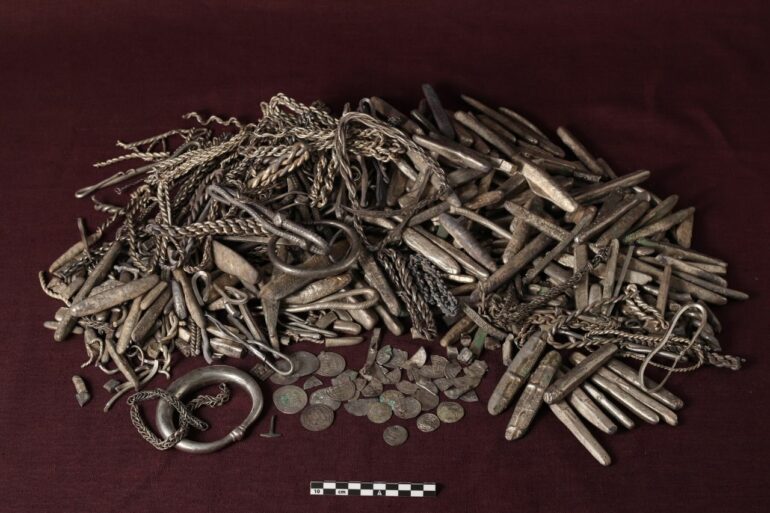
It is not the discovery of a single object that stands out in the account of this chance excavation, but the staggering density of the find. In total, seven hundred objects and fragments were unearthed from the depths of the garden. This figure alone radically changes the nature of the event. We are no longer talking about an accidental loss or a stray artifact, but rather a deposit, a collection that bears witness to intense human activity or an intentional placement whose reasons remain to be clarified.
Each fragment, no matter how tiny, is a piece of an immense puzzle. Can one imagine the patience required to extract, one by one, these seven hundred elements when the original intention was simply to level the ground? The terrace project took a back seat to the urgent need for preservation. The discovery of such a “trove”—a treasure, in the archaeological sense of the term—dictates a new pace, far removed from the hurried rhythm of construction sites. In Rebild, time has stood still to make way for the meticulous cataloging of this unexpected collection.
This accumulation of seven hundred pieces suggests a prolonged presence or a significant event that occurred precisely at this spot. In the tranquility of this private garden, the sheer number of artifacts challenges our certainties about what we believe we possess. The owner is no longer merely the holder of a land title; he becomes, despite himself, the guardian of a collective heritage that transcends him. The land he thought he knew, having walked upon it daily, has turned out to be an open-air archive.
From Landscaping to Reflections on Memory
The impact of such a discovery on our perception of our living environment is profound. Building a patio is an act oriented toward the future, toward moments of togetherness and rest yet to come. Yet the soil of Rebild has forced a sudden return to the past. This clash between the desire for modern comfort and the resurgence of ancient remains challenges our relationship with space. We live on layers of memories, on the remnants of cultures that, before us, also shaped, inhabited, and left their mark on this very ground.
The presence of these fragments—whose exact nature and precise origin will be the subject of analysis—reminds us that the boundary between our daily lives and history is sometimes disconcertingly thin. A single stroke of a spade is enough to break the barrier between eras. For the resident of Rebild, the experience is undoubtedly unsettling: his garden is no longer that private, neutral sanctuary, but a place of dialogue with anonymous predecessors. These seven hundred objects are all witnesses to a vanished reality that haunts—peacefully yet insistently—the original architectural project.
There is a certain nobility in this interruption of the work. Choosing to pay attention to these fragments, to recognize their value as historical evidence rather than ignoring them in order to finish the project, underscores a particular sensitivity to the memory of the place. Each fragment saved from oblivion is a piece of information recovered at the last moment, a voice that, through the material, begins to whisper once more.
Rebild, a Stage for Cultural Sedimentation
The town of Rebild should no longer be viewed merely as a picturesque green setting in the heart of Jutland. This discovery confirms that every plot of land in this region is likely to harbor treasures of knowledge. The fact that seven hundred objects were found in a single private garden gives one pause to wonder what the rest of the municipality might still be hiding beneath its lawns and walkways. Geology and archaeology converge here to transform a simple local curiosity into a broader reflection on the cultural sedimentation of our regions.
The fragments discovered serve as catalysts for curiosity. They compel us to view the landscape not as a flat surface, but as a rich and complex three-dimensional space. The anonymity of the person who made the discovery reinforces the universality of the story: this could happen to any gardening enthusiast, anywhere, provided the soil has preserved the memory of those who came before. It is an invitation to a form of humility in the face of the persistence of matter.
Beyond the sheer spectacle of the numbers, it is the potential diversity of these objects and fragments that sparks interest. Each piece is a potential clue to the techniques, customs, or rituals of days gone by. Until experts can make these seven hundred silent witnesses speak, the Rebild garden remains a place in limbo, suspended between the terrace that was meant to be built there and the history that emerged from it.
The man of Rebild may not yet have his terrace, but he now possesses an unbreakable bond with the past of his land. What was merely a pile of potential rubble to the untrained eye has become a national treasure—a collection that will undoubtedly find its way into museums to shed light on our understanding of this corner of the country. The terrace will have to wait; history, however, was no longer willing to be patient.