
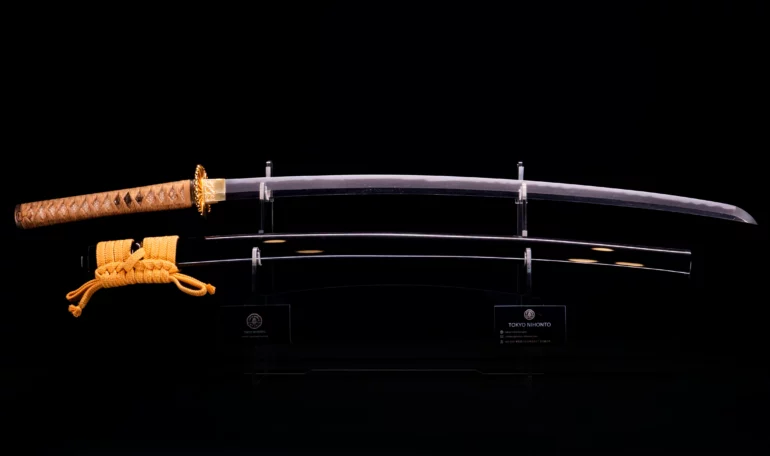
Behind every nihonto lies a masterful fusion of centuries-old tradition, historical heritage, and scientific precision. In this exceptional market, absolute authenticity and craftsmanship shape the object’s value just as much as the buyer’s passion.
The first encounter with an authentic Japanese blade leaves an indelible mark. Beyond the balance of its weight or the perfection of its curve, it is the rare harmony between a martial purpose and timeless aesthetics that captivates. In the world of the Japanese sword, the work of art is never inert: it pulses with the memory of a forge, the spirit of an era, and the lineage of its successive guardians. More than mere prestige, it is this dizzying historical depth that seals the attachment of connoisseurs.
The unique imprint of material and time
No two traditional blades are ever identical. The temper line, the hamon, arises from an unpredictable alchemy between the nature of the steel, the blacksmith’s absolute mastery, and the rapidity of the cooling process. The grain of the metal, revealed by the meticulous art of polishing, acts as an original signature. In contrast to mass production, the Japanese sword is understood as a unique work of art, where the imprint of the human hand transcends every stage of its creation.
This singularity explains the enduring fascination these weapons hold, elevated to the status of masterpieces of design and craftsmanship. Connoisseurs perceive in them the culmination of metallurgical prowess and a tangible fragment of the Japanese soul. Forged in strict adherence to ancestral methods by certified masters, the true nihonto demands total integrity, both in the choice of its materials and in the documentation that accompanies it.
The science of simplicity: an eye for detail
The Japanese blade crystallizes worlds of unprecedented complexity. Technically, selective tempering follows a scientific logic of extreme rigor. Aesthetically, the architecture of the hamon, the tip (kissaki), or the tang (nakago) becomes a precious language for the discerning eye. These visible details form the vocabulary that distinguishes the authentic work from a pale imitation. A counterfeit will always betray its origins through artificial tempering, uncertain geometry, or steel lacking historical authenticity.
This analytical eye is not merely a quest for formal beauty: it forms the foundation of expertise. As their knowledge deepens, collectors learn to decipher the nuances of different schools, periods, and stylistic lineages. While the nihonto market rewards this patient scholarship, it is unforgiving of haste and purely cosmetic judgments.
Genealogy and traceability: the hallmark of the priceless
The valuation of a sword goes far beyond the simple question of its age. Its condition, its pedigree, and the completeness of its documentation are often decisive factors. The market, moreover, reflects the staggering gap between a certified contemporary creation and an antique from the golden age of swordsmithing. While masterpieces from the Kamakura era reach museum-level status, blades from the Edo period offer a subtle balance between narrative heritage and accessibility for the discerning connoisseur.

In this quest for excellence, certification reigns supreme. Documents issued by leading institutions, such as the NBTHK, serve as the definitive authority for authenticating and ranking these works of art. Although they cannot transform a modest blade into a national treasure, they establish a climate of absolute trust. In a field where approximation has no place, this documentary requirement becomes the guarantee of a transparent transaction and fundamental intellectual respect.
Preservation as a Way of Life
Owning a nihonto requires a rigorous, almost choreographed ritual. The meticulous cleaning, the delicate application of oil, and the resting of the steel in a light-wood scabbard (shirasaya) are far more a meditative practice than a mere mechanical task. These age-old gestures forge an intimate bond with the object while ensuring its longevity. Acquiring such a piece makes sense only if it is accompanied by unwavering vigilance and devotion.
Connoisseurs know this: a neglected blade loses not only its value but also its visual soul. Moisture, improper handling, or the use of ordinary cleaning products can irrevocably erase the work of time and the polisher. Thus, caring for a Japanese sword goes beyond mere romanticism; it is an act of heritage preservation in its own right.
A journey of discovery beyond mere ownership
The world of enthusiasts has undergone a transformation. Once the exclusive domain of a few scholars, it now welcomes a new generation of collectors, designers, martial artists, and investors drawn to absolute rarity. Their motivations form a complex mosaic: while some seek to touch history, others are captivated by the pure geometry of a line, and still others see it as the pinnacle of the quest for heritage.
Whatever the origin of this fascination, one thing remains clear: a first acquisition opens the doors to an intellectual thrill. The field of exploration stretches endlessly, from workshop to workshop, from century to century. This is where the true appeal of nihonto lies. More than just a coveted object, it demands to be studied, honored, and, in a sense, earned by its owner.