
Make Texture a preferred source on Google to support us
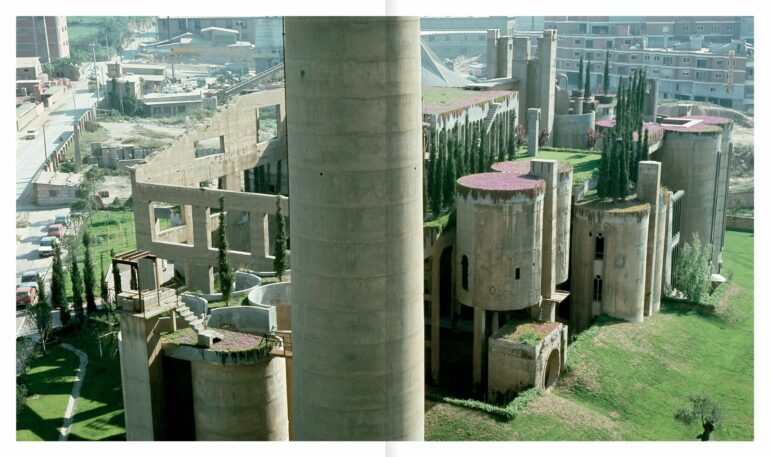
Add Texture to GoogleAlong the N-340 highway, where the silhouette of Barcelona begins to fade into its industrial outskirts, a sudden sight breaks the monotony of the asphalt. In Sant Just Desvern, the sky is no longer defined solely by high-voltage power lines, but by a series of monumental chimneys whose multicolored hues suggest a function quite different from that of emitting soot. This remnant of a former cement plant, which over the decades has become a manifesto of concrete and greenery, houses the beating heart of the Bofill Taller de Arquitectura. A place that, far from being a mere office, asserts itself as an organic structure capable of reinventing itself in the face of changing times and crises.
The Mirage of Sant Just Desvern
Approaching La Fábrica means, first and foremost, bracing for a visual shock. This industrial complex, which Ricardo Bofill acquired in the early 1970s, was never intended to be a mausoleum celebrating Catalonia’s manufacturing past. Originally, the project was an act of architectural rebellion. In a Spain still marked by Francoism, transforming a polluting factory into a space for living and working was a legal heresy, a challenge to the urban planning regulations of the time. Today, the massive silos and raw concrete structures, once filled with cement dust, are enveloped in lush vegetation that seems to be trying to swallow the building whole.
What one discovers upon stepping through the gates of this complex is the embodiment of a philosophy of constant transformation. Under the leadership of Pablo Bofill, the firm’s current CEO, the space resists becoming frozen in time. Here, nothing is sacred in the museum sense of the term. The private galleries of yesteryear have been transformed into office spaces, the long-neglected mezzanines now house creative studios, and the former dining rooms host strategic meetings. La Fábrica is not visited like a monument; it is experienced as a laboratory whose internal layout evolves with the agency’s changing needs.
Ricardo Bofill: Dissent as a Foundation
To understand the soul of this place, one must look back to its founder, Ricardo Bofill. In 1957, the young man was expelled from the Barcelona School of Architecture. His offense? Political activism that clashed with the discipline of the time. This seminal break would shape an architect who looks beyond site plans. From the moment he founded his “Taller” in 1963, he strayed from the beaten path to explore social housing with surrealist touches, far removed from the functionalist dreariness that then dominated Europe.
Ricardo Bofill never viewed architecture as a solitary discipline. For him, building a city or a building requires the input of outside perspectives, sometimes radical ones. This is why he incorporated into his team, from very early on, professionals rarely found in traditional firms: sociologists to conceptualize use, writers to narrate space, filmmakers to capture its rhythm, and even philosophers to question its meaning. This multidisciplinary, almost holistic approach remains the foundation upon which the practice’s meteoric expansion rests today.
Architecture as a Dialogue of Knowledge
At a time when many international firms are locking themselves into an immediately recognizable—and sometimes repetitive—“visual signature,” Taller de Bofill cultivates the absence of a signature style. Dimitri Davoise, a partner at the firm, emphasizes this commitment to never repeating themselves. Each project is conceived as a specific response to a place, a culture, and a history. This intellectual flexibility is made possible by the diversity of backgrounds and disciplines that coexist beneath the high ceilings of the cement plant.
This intellectual effervescence is not merely a romantic pose; it informs every design decision. By inviting poetry and art to the engineers’ table, the firm ensures that it produces buildings that are not merely technical feats, but places imbued with a soul. This approach allows Taller to navigate with equal ease between housing projects in West Africa and complex urban developments in the Gulf states. The influence of philosophy here is not a luxury, but a daily working tool.

Resilience and Influence: The Turning Point of 2008
The firm’s current success—its staff has grown from 50 to 250 employees since 2020—sometimes obscures the turbulent times it has had to weather. The handover from Ricardo to his son Pablo took place against the backdrop of a deep crisis. In the aftermath of the 2008 financial crisis, the firm found itself with only two months of visibility ahead. It was during this moment of vulnerability that Taller’s ability to adapt proved its worth. By expanding its international reach and strengthening its multidisciplinary teams, the firm was able to turn a potential decline into a spectacular revival.
Today, the firm does not merely manage its prestigious legacy; it uses it as a springboard to explore new architectural frontiers. The growth in staff required a reorganization of the space at La Fábrica itself, proving once again that concrete can be a flexible material when handled intelligently. The old cement silos, symbols of the heavy industrial era, have become the hubs of a knowledge- and creativity-based economy, connected to the entire world from the outskirts of Barcelona.
Barcelona, the Stage for Urban Renewal
This renewed vitality is part of a special timeline for the Catalan capital. From September 4 to 6, 2025, Barcelona will host a major conference on the quality of urban life—an event that will place La Fábrica in the spotlight of international observers. This will be an opportunity for experts from around the world to compare their visions with that of the Taller—a vision that is truly unique. For beyond the walls of the cement plant, the entire city is grappling with its future, caught between tourism pressures, housing needs, and the desire for sustainability.
The work of Bofill Taller de Arquitectura offers a possible response to these challenges: an architecture that embraces the unexpected, values the reuse of existing structures, and refuses to be confined to a narrow specialty. By transforming a once-polluting industrial site into a lush, creative ecosystem, Ricardo Bofill had anticipated the challenges of our century. In Sant Just Desvern, the colorful chimneys continue to smoke, but what they release into the atmosphere today is a vision of the world where form finally follows collective intelligence.