
Make Texture a preferred source on Google to support us
Add Texture to GoogleThe Grand Duchy rarely appears on the traditional map of fine watchmaking. Stuck with an image as a financial hub, the country has never been able to claim a historical legacy in micromechanics or watch complications, leaving that monopoly to its Swiss neighbor. Yet, just a few kilometers from European institutions and banking headquarters, the workshops in Dudelange are home to a quiet industrial revolution. It is there that the Grand Ducal Manufacture has chosen to establish itself, building a local watchmaking identity from scratch. This industrial challenge is now accompanied by a direct confrontation with the market. The project has just reached a tipping point by stepping out from behind the curtain of its assembly lines to face the scrutiny of collectors.
Securing a Strategic Location
On September 28, the brand marked its entry onto the public stage by taking up residence at the Royal. The location was not chosen at random. A landmark in Luxembourg’s hospitality industry, the hotel offers an ideal vantage point, attracting an international clientele accustomed to luxury standards. The chosen space also reflects a desire for elevation: in place of the former souvenir shop, the hotel now houses a cozy lounge entirely dedicated to Dudelange’s timepieces. This spatial transformation perfectly illustrates the ambition of Alessio Muller, the architect behind this venture, who saw this location as the necessary springboard to move from the theory of the workshop to the harsh reality of retail.
The on-site approach takes the opposite tack of traditional retail. Visitors do not encounter a sterile row of display cases, but instead enter a welcoming workshop designed for conversation. By appointment, Alessio Muller personally welcomes his clients there to dissect the origins of the models, discuss movements, and sketch the outlines of a future watch. This hub allows the young brand to refine its sales pitch in the face of a steady stream of passersby and connoisseurs. To seal this physical partnership, the manufacturer has taken integration a step further by designing an exclusive timepiece, the “Le Royal Series 1.” Limited to just five pieces, it features a case dubbed “Classy,” designed specifically to resonate with the atmosphere of the space.
A journey far removed from design studios
The very existence of this watchmaking house is not the result of an investment opportunity seized by a financial group, but rather of a slow personal evolution. Alessio Muller honed his keen eye at a very early age, through his father’s involvement in organizing events dedicated to French luxury. This early exposure to artisanal excellence served as fertile ground, but the turning point came later, in Switzerland, during pivotal encounters with leading figures in independent watchmaking. Exchanges with creators such as Vianney Halter infused the project with absolute technical rigor, coupled with a deep respect for the art of handcrafting.
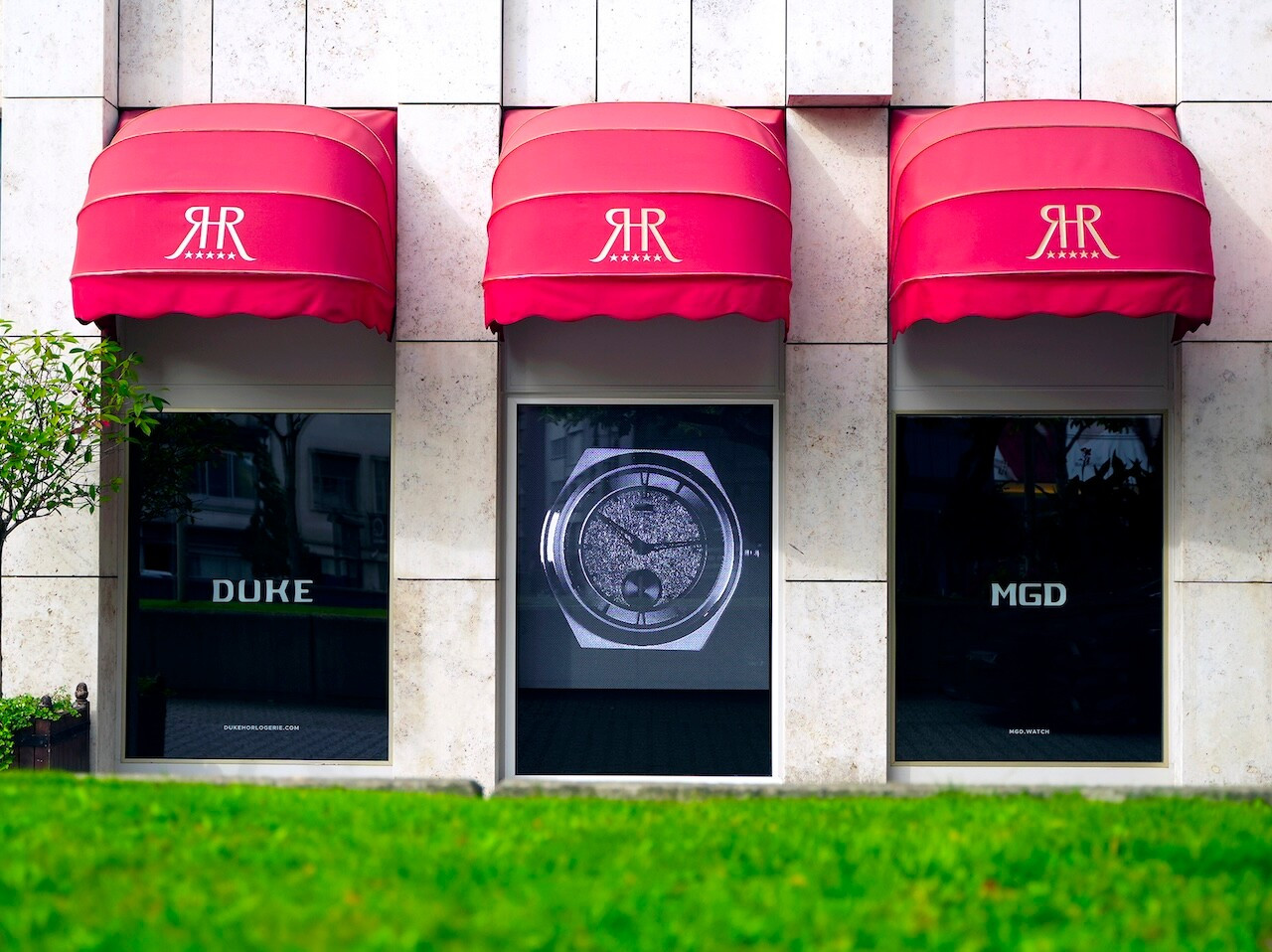
It took six full years of research, setbacks, adjustments, and planning before the name DUKE appeared on a dial. This extended period allowed the Dudelange workshops to be equipped with production tools capable of going beyond the simple stage of case assembly. The initial goal was to master the development of technical solutions in-house, not only to supply the brand’s own collections but also to offer this technical expertise to other companies in the industry. In an industry that values tradition, the manufactory understood that its only weapon against centuries of Swiss history lay in impeccable technical integrity.
Two Perspectives on Mechanical Luxury
From a commercial standpoint, Alessio Muller has structured his offering around two distinct entities, thereby avoiding the pitfall of a wide price gap under a single brand name. At the pinnacle of the pyramid sits DUKE, the laboratory of lofty ambitions. This line embodies technical complexity and rarity. In November 2025, during the highly influential Dubai Watch Week, the brand unveiled its latest evolution: the Clarity Tourbillon. Compared to the First Edition, this new model features more refined dimensions, with a reduced diameter of 41 mm and a controlled thickness of 9.5 mm. These proportions directly address the evolving expectations of collectors, who are moving away from the ostentation of large diameters in favor of a more understated elegance.
This Dubai event served as a catalyst. Located in the immediate vicinity of La Fabrique du Temps, the LVMH Group’s state-of-the-art manufacturing facility, the Luxembourg booth benefited from a dazzling halo effect. The first sales from this collection were finalized immediately afterward. The founder, moreover, maintains DUKE’s exclusive status with an iron fist: production is strictly limited to one piece per month. Given this deliberate scarcity, the order book is fully booked through the end of 2027.
At the same time, the MGD division is tasked with targeting a broader market, without compromising the brand’s positioning. With a price range of 3,850 to 9,000 euros (taxes included), MGD aims to attract enthusiasts of fine watchmaking who may not necessarily have access to tourbillon timepieces. The success of this line is crucial to the company’s health: it must ensure cash flow and brand visibility while maintaining an intact perception of prestige.
Customization Taken to the Extreme
The appeal of the Grand-Ducal Manufacture rests heavily on its value chain and local roots. While the mechanical movement—a prerequisite for reliability—comes from the renowned Swiss manufacturer La Joux-Perret, the rest of the watch’s construction takes place under the Luxembourg flag. The cases, hands, and dials are crafted within the Grand Duchy. The bracelets—a component often outsourced abroad—are entrusted here to the local leather goods maker Van Weis. In Dudelange, the watches undergo meticulous assembly, timekeeping tests, and the production of custom rotors.

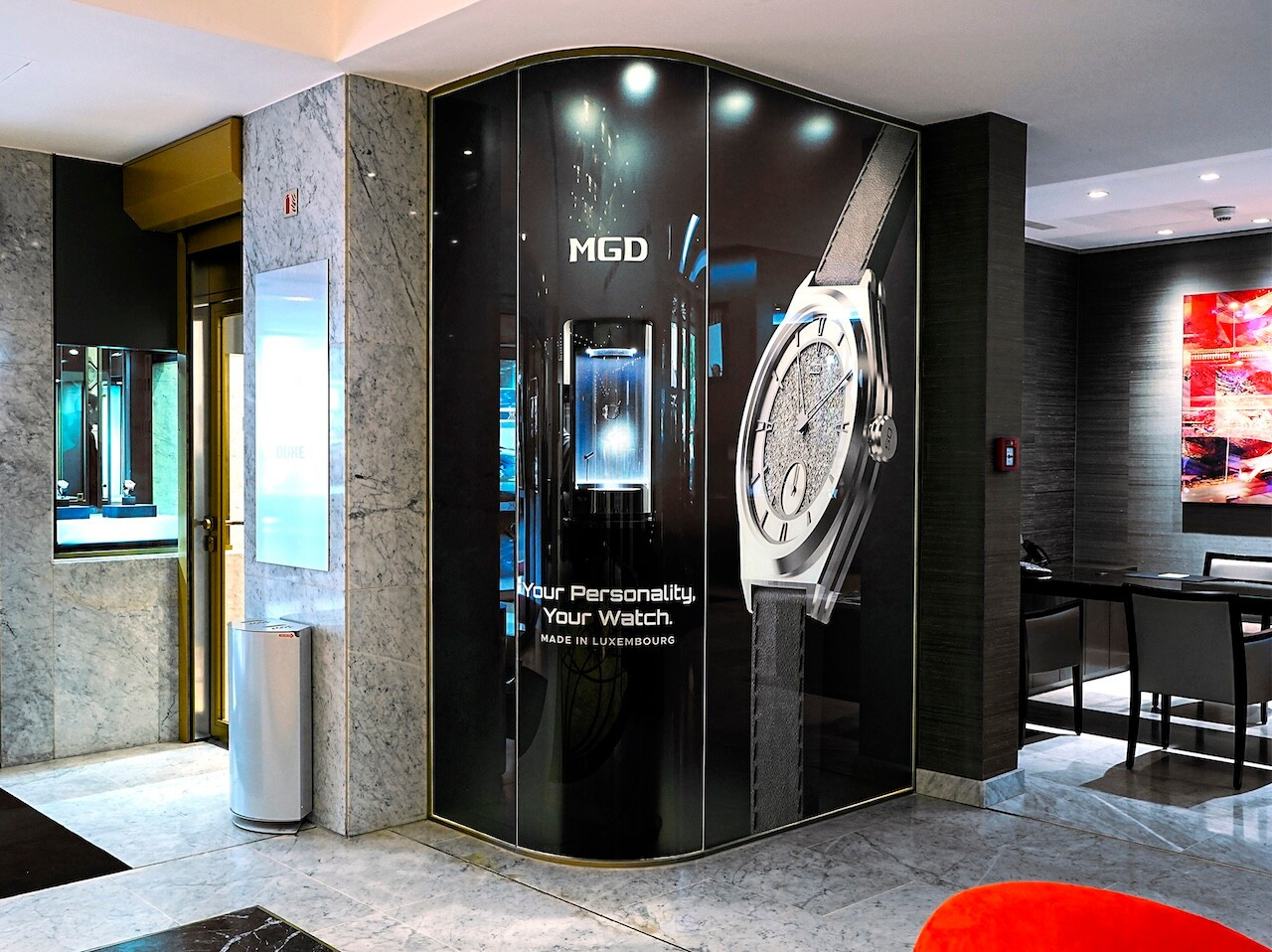
This geographical proximity offers a logistical advantage that the brand has turned into a formidable competitive edge: ultra-fast customization. Where the traditional watch industry imposes months-long wait times for even the slightest variation, the MGD Classic Collection allows customers to dictate their choice of finishes, dial, or strap—with a delivery promise that can sometimes be fulfilled the very next day after the order is placed. The concept reaches its pinnacle with the “Series 1.” Limited to 50 pieces, this edition offers, according to the manufacturer, over a million possible variations. From material treatment to engraving, including beveling and the oscillating weight, the watch transforms to become the exact reflection of its owner.
This extreme flexibility has had an unexpected impact on the demographics of buyers. Alessio Muller observes that women are embracing the MGD concept in droves, currently accounting for 40% of the customer base. This figure stands out in an independent watchmaking landscape traditionally constrained by a nearly exclusively male clientele. By transforming the timepiece into a modular design object, the manufacturer has successfully shattered a demographic glass ceiling.
The Export Gamble
The establishment in the heart of the Royal is merely a prologue. This first physical presence serves as a testing ground before embarking on a bold international expansion. The manufacturer’s roadmap precisely targets three key hubs of global wealth: Miami, Dubai, and Singapore. These future branches will aim to replicate the atmosphere of personalized consultation and immersive experience currently being tested in Luxembourg.
To support this emerging network, the Dudelange headquarters states it is fully prepared. Current production capacity ensures industrial stability for the next two years. The balance of power is thus shifting: the challenge no longer lies in the ability to manufacture, but in the ability to sell in the face of the steamroller of Swiss conglomerates. Convincing a collector from Singapore or Florida to invest in Luxembourg fine watchmaking requires crafting a compelling narrative—proving that, beyond mere geographical curiosity, the product stands up to a watchmaker’s close scrutiny.
By firmly establishing its operations in Dudelange and opening its doors at the Royal, the Grand-Ducal Manufacture has laid the foundation for a complex undertaking. It must now maintain this production pace, keep up with the frenetic pace of DUKE orders, and establish the MGD line as a natural choice on the wrists of a discerning clientele. The road to legitimacy is long, but the stopwatch has well and truly started.