
Make Texture a preferred source on Google to support us
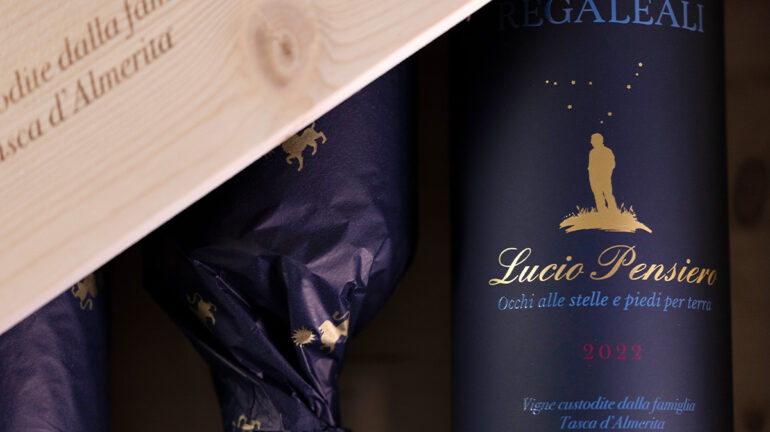
Add Texture to GoogleOn the label, there is neither a castle nor a coat of arms. Instead, there is the silhouette of a man standing on a hill and a phrase in Italian: “Occhi alle stelle e piedi per terra”—eyes toward the stars and feet on the ground. The man is Count Lucio Tasca d’Almerita, who died in July 2022 at the age of 82. The hill is called Cozzo delle Ginestre and is located on the Tenuta Regaleali, the family estate in inland Sicily. The detail that catches the eye is less artistic than agricultural: it is from this very hill that part of the wine in the bottle comes. Named Lucio Pensiero, the wine’s first vintage is 2022, the year of his passing. It captures in a bottle a piece of the landscape that he himself transformed.
The 1984 Gamble
To understand what the family is celebrating, we must go back to the mid-1980s. In 1984–1985, Lucio Tasca introduced Bordeaux and international grape varieties—primarily Cabernet Sauvignon and Chardonnay—to Regaleali, planting them on high-altitude land that seemed ill-suited to them. The goal was clear: to open up Sicilian wine to international competition by pitting Sicily against the varieties by which the rest of the world measured itself.
His vision extended beyond the estate’s boundaries. In 1998, he founded Assovini Sicilia. The estate now presents him as a leading figure in modern viticulture on the island, and it is under the general direction of his successor, Alberto Tasca d’Almerita—the eighth generation of the family—that Tasca d’Almerita pays this tribute. The chosen name, “Pensiero” (thought), speaks volumes about the intention to honor a vision rather than a mere surname.
A blend that defies the cookie-cutter approach
On paper, the formula seems familiar: 50% Cabernet Franc, 30% Merlot, 20% Cabernet Sauvignon. Enough to quickly file Lucio Pensiero away in the convenient category of “Bordeaux-style blends.” The winery rejects this oversimplification. It does not claim to reproduce a classic recipe, but rather to express the unique character of its high-altitude terroir in inland Sicily.
The details of the plots support this claim. Each grape variety comes from a specific location: Cabernet Franc from Vigneto Cavaleri, Merlot from Vigneto Rossi, and Cabernet Sauvignon from Cozzo Ginestre. The grape variety that Lucio Tasca introduced in the 1980s therefore does not dominate the blend. It accounts for only one-fifth of the blend, but it comes from the hill depicted on the label. The connection between the image and the content lies in that one-fifth.
The setting, however, bears no resemblance to Aquitaine. Tenuta Regaleali stretches across the municipality of Sclafani Bagni, on the border between the provinces of Palermo and Caltanissetta, at an elevation between 400 and 750 meters. The temperature differences between day and night are pronounced there, and it is on this contrast that the estate bases its uniqueness. The wine is released under the IGT Terre Siciliane designation, without seeking a more prestigious appellation.
In the cellar, each plot is treated separately
The winemaking process extends this focus on terroir. The grapes are vinified separately, by parcel and by grape variety, before any blending takes place. Maceration is carried out in a non-invasive manner; fermentation occurs at a controlled temperature in stainless steel or concrete tanks, followed by malolactic fermentation.
This is followed by aging for approximately eighteen months in French oak, divided between first- and second-use barriques and tonneaux. The proportion of new oak reflects a deliberate intention: to complement the fruit without overpowering it. The wine then ages for an extended period in bottle at the estate before being released for sale. Four years will have passed between the vintage and the wine’s public release—a timeframe that speaks volumes about the patience required by the estate.
Wagner as a Counterpoint
The tribute spills over from the glass. The project is accompanied by a documentary film, *The Wagner Gift*, centered on the rediscovery of an original manuscript by Richard Wagner that the Tasca family has preserved for over 140 years. The connection is by no means arbitrary. A dynasty that has kept a Wagner autograph for nearly a century and a half and an estate that waits years before releasing its bottles both stem from the same relationship to time. The cuvée thus becomes a chapter in a broader family narrative, where cultural heritage and winemaking heritage echo one another.

What the Balance Sheet Says
Eyes on the stars, then, but feet on the ground—and here, the ground is also measured in euros. In 2025, Tasca d’Almerita generated revenue of 16.8 million euros, a slight decline from the 17.3 million recorded in 2024. Profitability remains strong, with an EBITDA of 3.85 million euros, or 22.9% of revenue.
Exports account for 37.6% of sales, or approximately 6.3 million euros. The new sales management has identified two strategic markets: Germany and the United States. In this context, a limited-edition vintage—rich in history and backed by an auction house—also serves as a calling card for a brand seeking to gain ground outside Italy.
A Deliberately Limited Release
The production run is precise down to the bottle: 5,580 75-cl bottles for the 2022 vintage. In addition, there are magnums, 3-liter double magnums, and 5-liter jeroboams, the exact number of which has not been disclosed.
The launch schedule draws more from the conventions of the art market than from those of a wine fair. The official presentation took place on September 14, 2026, in Rome, at the headquarters of Pandolfini Casa d’Aste, followed by a technical presentation at Tenuta Regaleali between September and October. Choosing an auction house rather than a wine merchant to unveil a wine effectively positions it from the outset as a collector’s item.
The question of price remains, which the auction house has left open. No direct retail price or ex-winery price has been published in the form of a standardized price list. Initial surveys conducted in October 2026 place the price of a 75-cl bottle between 100 and 150 euros. This is only a rough range: the final price will depend on export markets and each distributor’s policy.
For large-format bottles, the market will decide directly. They will be sold at auction in November 2027 in Florence, as part of Pandolfini’s collection of fine wines. The jeroboams bearing the count’s silhouette on his hill will then face the only estimate the market does not dispute: the final hammer price.