
Make Texture a preferred source on Google to support us
Add Texture to GoogleThe Test of Material and Fire
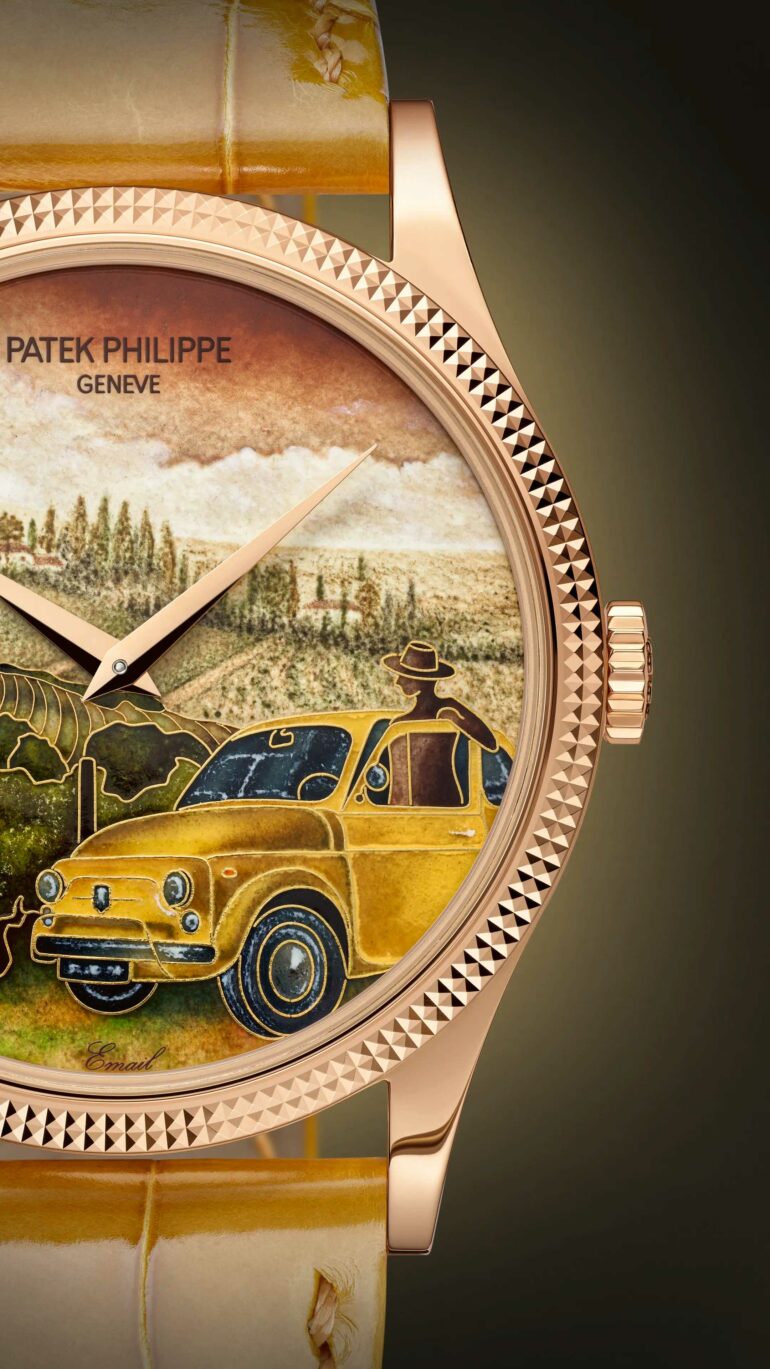
Fine watchmaking often describes itself through vocabulary related to micromechanics, chronometric precision, and innovation in movements. Cloisonné, however, follows an entirely different set of rules. Here, metal is not milled—it is bent. Colors are not printed—they are fired. On a disc whose diameter rarely exceeds a few centimeters, the artisan creates a network of extremely fine partitions. This framework, fashioned using a gold wire that is sometimes barely visible to the naked eye, requires unexpectedly long lengths: about forty centimeters for the simplest recent creations, and more than sixty for the densest patterns.
Next comes the filling, a test of chemistry as much as of dexterity. Up to seventeen, or even twenty, shades of enamel are used to fill the metal cells. The piece is then subjected to repeated passes through a kiln heated to over 800 °C. The balance is delicate. A misjudged temperature or an impurity in the powder, and the dial is ruined, forcing the enameler to start the process over from the beginning. This risk inherent in the firing process makes any form of industrial standardization impossible and ensures that each piece is unique.
Behind the elegance of the final result lies a harsh material reality. Traditional enameling recipes relied heavily on lead or arsenic to achieve specific hues and a distinctive luster. The inability to use these toxic components today forces artisans to take on the role of chemists. Recreating the depth of the color palettes of the past requires a continuous testing process and the adaptation of contemporary powders—a far cry from the idealized images of a craft frozen in time. At Patek Philippe, this standard also applies to champlevé, paillonné, and miniature painting—related disciplines that share this same exposure to risk and irreversibility.
Mapping a Geneva Tradition
The association between this perilous technique and geography took shape in the mid-20th century. Drawing on the universal time system invented by Louis Cottier, Patek Philippe transformed the time zone display into a backdrop for miniature world maps. Between the 1940s and 1960s, the manufacture relied on the firm Stern Frères to supply these dials, which featured maps of North America and Eurasia, as well as mythological figures such as Neptune or a dragon.
These pieces were never intended to flood the market. An examination of production during that era reveals a cautious approach given the cost and complexity of enameling. Of the approximately 95 pocket watches with reference number 605 HU manufactured between 1938 and 1964, only about a dozen featured an enameled dial. This approach was later adapted for wristwatches. As early as 1939, the 1415 HU model pioneered the trend, before the 2523 definitively established the world map as the central motif of this niche aesthetic.
The Spectacular Rise of a Once-Anonymous Art Form
While these pieces were designed in the quiet of the workshops, their contemporary trajectory unfolds under the harsh spotlight of auction houses. The perception of these watches has undergone a radical transformation: from timepieces with luxurious finishes, they have become works of art in their own right.
The timeline of recent auctions traces a staggering curve. In 2012, a Reference 2523, which had previously appeared in Habsburg Feldman’s catalogs, changed hands for approximately $2.96 million. A decade later, the scale of values is unrecognizable. In 2023, a model featuring North America fetched nearly $8.5 million. The following year, in 2024, the market snapped up a 1943 rose gold version for 3.13 million Swiss francs, while a “Eurasia” variant of the 2523 sold for around 8.4 million dollars in Hong Kong. The peak of this rise was reached at a Geneva auction in May 2026: $10.2 million for a 1953 2523 model, featuring a map of South America in gold wire and enamel, supplied by Stern Frères.
When the workshop emerges from obscurity
The paradox of this $10 million dial lies in a troubling detail: the identity of the artist who created it will remain forever unknown. During the postwar decades, the watchmaker’s name systematically overshadowed that of the subcontractor or artisan. Archival records scrupulously documented invoices and delivery dates, but overlooked the artisans themselves.
The gradual revelation of these identities has transformed the very nature of the collection. Names have emerged from old files: Marguerite Koch, Michel Deville, Nelly Richard-Fournier. Patek Philippe has finally broken with this tradition of anonymity, allowing signatures on contemporary dials. Anita Porchet now embodies this recognition. When a piece bears her full name, it guarantees that it was entirely crafted by the artist herself, while the simple initials “AP” indicate the work of her studio. Her presence is part of a specific lineage of craftsmanship: she was trained by Suzanne Rohr, who herself inherited the techniques of Carlo Poluzzi. This direct transmission of knowledge enabled the art of enameling to survive its darkest years.

Resilience in the Face of Quartz and the Figurative Revival
The very existence of this lineage is nothing short of an industrial miracle. The arrival of quartz watches swept away the certainties of mechanical watchmaking, immediately threatening the trades that depended on very long production times. Faced with a sudden drop in orders, enamel work could have disappeared along with its last practitioners.
The survival of this technique owes much to an internal patronage strategy. Patek Philippe deliberately maintained a steady flow of orders by commissioning artisans to create solar-powered table clocks. This medium, more niche than the wristwatch, served as a conservatory for the craft. In the 1980s, Marie-Françoise Martin, Michèle Mauris, Luce Chappaz, and Elisabeth Perusset Lagger were thus able to keep their tools of the trade and continue their stylistic experiments.
This lifeline paved the way for the revival of the 2000s. With the launch of the Rare Handcrafts collection, the range of themes expanded. The 5075, 5077, and 5089 models explored figurative designs: butterflies, horses, as well as the “Transatlantic” series paying homage to ocean liners and locomotives. The world map made a comeback on the wrist with model 5131, followed in 2019 by model 5231, which reintroduced the wing-shaped lugs characteristic of the 2523 case. The archive no longer serves merely as a technical reference; it directly informs contemporary design.
A Living Heritage on Display
This policy of integrating rare crafts is directly reflected in the seventh edition of the Patek Philippe Watch Art Grand Exhibition, taking place October 2–18, 2026, at the CityOval in Milan. Dedicated to 187 years of watchmaking history, the event brings together more than 500 pieces. In addition to enamel work, the exhibition highlights gem-setting, engraving, and marquetry, featuring creations influenced by various Italian regions.
While this public display lends cloisonné an undeniable aura of heritage, it also highlights its fragility. By isolating these dials behind glass cases, we run the risk of reducing the technique to a mere object of museum contemplation, far removed from the fire and chemical processes that shape it. The survival of this craft within an industry focused on cost rationalization proves that a watch’s value is not limited to its chronometric accuracy. It is measured by its ability to fund—and thus preserve—craftsmanship that the market alone would never have ensured would endure.