
Make Texture a preferred source on Google to support us
Add Texture to GoogleThe Architecture of Detail, or the End of the Logo’s Hegemony
It took several seasons of subdued minimalism for the pendulum to swing back in the opposite direction. The Spring/Summer 2027 shows in Milan and Paris mark a clear break with the conventions of luxury. Slowly, almost silently, the flashy monogram is giving way. The market no longer needs obvious branding to assert its status. Style now lies elsewhere: in the twist of a sculptural heel, the eccentricity of an embroidery, the unexpected suppleness of leather. Accessories are no longer conceived as merely the docile finishing touch to an outfit. They have become its starting point, its backbone, its central focus.
In the order books of international buyers, the caution of past years seems to be evaporating. Joseph Tang, head of buying at Holt Renfrew, observes a desire for maximalism that is once again in full swing. Yet this exuberance does not resemble that of the previous decade. It is no longer about accumulating outward signs of wealth, but about finding an intimate connection with the object. This psychological shift, noted by experts interviewed by WWD, reflects a heightened need for individuality. Marissa Galante Frank, of Bloomingdale’s, also points to a decisive shift: customers now expect a pair of shoes or a bag to add depth and character, rejecting purely functional pieces that fade into the background behind their outfits.
The Customer and the Product: The Triumph of Tactility
Impulse buying, driven by the immediate social recognition of a brand, is losing steam. Marco Raccuia, of the Italian department store Rinascente, notes a striking shift in desires toward more sensual materials, more malleable shapes, and a more instinctive connection to the body. Rigid, heavily branded pieces are losing ground to designs that appeal to the sense of touch just as much as to the eye.
This new sophistication, which prioritizes the precision of the cut over brand display, is changing the dynamics of shopping. At Galeries Lafayette, Victoria Dartigues observes a clientele that builds its wardrobe with a collector’s eye. The appeal of a unique clasp, the rarity of a color, or the playful touch of a clutch bag is supplanting the display of status. This is fertile ground for brands like Loewe, The Row, Bottega Veneta, and Celine, which are solidifying their aesthetic vocabulary without relying on an intrusive visual crutch.
When the gaze drops: shoes take center stage
Sometimes all it takes is a few centimeters less fabric to completely transform the perception of an outfit. By radically raising the hems of its skirts, Prada has forced the eye to look down toward the ground. This mechanism is well known to fashion historians: the exposed leg demands a shoe that has something to say. The Spring/Summer 2027 collection thus transforms the shoe into a formidable playground for artistic experimentation.
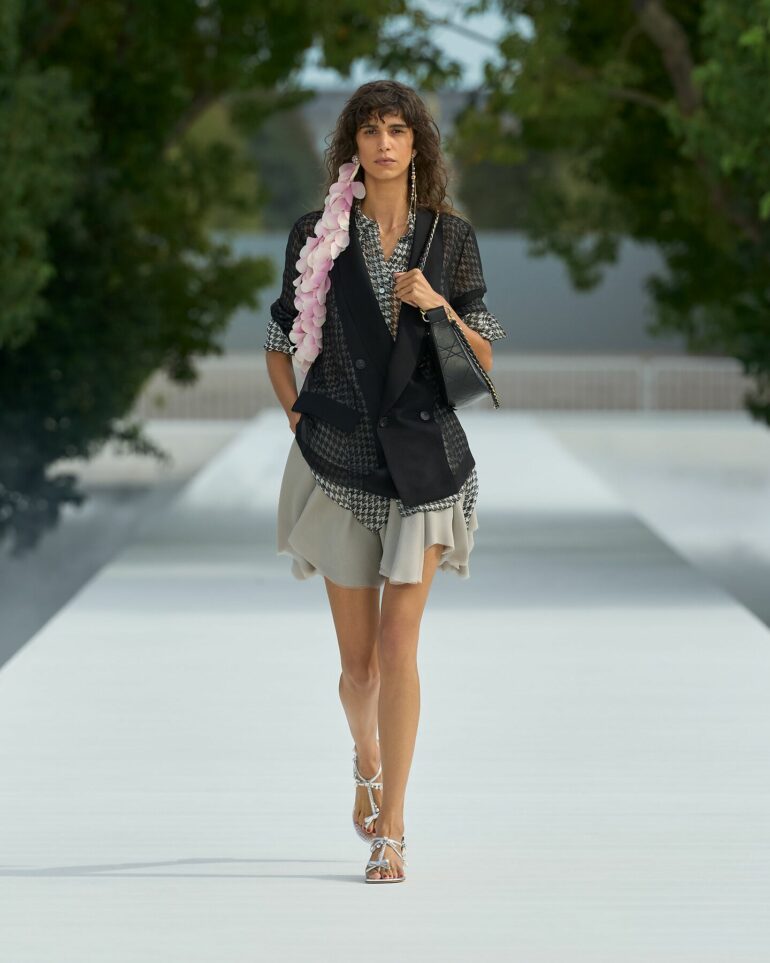
At Saint Laurent, the sandal is elevated to the status of a jeweler’s masterpiece, exploring heels whose reptilian lines border on pure sculpture. Chanel opts for opulence with styles where embroidery reigns supreme, while Loewe plays with contrasts by pairing supple silhouettes with mules encrusted in pearls. Vogue France’s analysis of the runways confirms this rise to prominence of the shoe. The unapologetic eccentricity of Thom Browne’s designs, as well as the playful lightness seen at Valentino and Givenchy, prove that the market demands shoes capable of single-handedly carrying the narrative of an outfit.
Leather Goods: The Balance Between Pragmatism and the Runway
While shoes are breaking free, handbags are splitting into two radically opposing trends, rejecting anything lukewarm. On one hand, the realities of daily life dictate their sizes. Elongated hobo bags, giant tote bags, and flexible designs reassure a clientele that refuses to sacrifice practicality. On the other, an almost theatrical dimension takes hold. Meticulously embroidered clutches and decorative micro-bags belong more to the realm of jewelry than to leather goods.
This balancing act defines the season’s collections. The piercing glacier blue chosen by Celine or the dramatic fringes sweeping across Dior’s designs illustrate this desire to bring together utility and style. At Balenciaga, the reinterpretation of the City Bag follows this same vein. A bag can no longer be merely a container; it must justify its presence through a bold aesthetic statement.
Michael Rider’s arrival as creative director at Celine perfectly illustrates this balance. By introducing XXL sizes, accentuated by wide belts and round sunglasses, the designer creates a silhouette that, without resorting to flashiness, makes a statement through its proportions. The modernity of this equation lies in its clear elegance, devoid of superfluous artifice.

The Return of Ornament
After a period of minimalism, materials are once again taking center stage. Simplicity is no longer the sole definition of chic. Hammered metal, cascades of crystals, clusters of pearls, jingling charms, and floral motifs flood the collections, recreating an opulence that had long been kept at bay. Vogue Arabia, in fact, highlights the visual impact of Chanel’s heavily adorned necklaces and the rigorous architecture of Givenchy’s pieces.
Poppy Lomax, writing for Harrods, interprets this frenzy of details as a direct catalyst for desire. According to the buyer, this profusion of textures, printed surfaces, and braided leather effects helps to feminize silhouettes, softening the androgyny of past seasons. Clothing becomes the backdrop against which accessories reshape the body’s contours. Belts are widening; statement jewelry and cummerbunds cinch the waist and accentuate the bust, reminding us that ornamentation serves a genuine architectural function.
The Incubators of the New Avant-Garde
This creative effervescence isn’t limited to the confines of the luxury giants. International buyers are keeping a close eye on an ecosystem of independent brands that is shaking up the established order. Names like Fane, Nomasei, Neous, Talel, Inès Bressand, Ananyan, Pura Utz, and Kiana Ghavidel keep cropping up in the selections. Their designs, often more striking and distinctive than those produced on an industrial scale, meet the need for exclusivity among a clientele tired of uniformity.
These labels function as open-air laboratories. Historically, accessories have always served as a testing ground for bold design experiments without jeopardizing the commercial viability of an entire ready-to-wear line. A bold color, an off-center heel, or an asymmetrical silhouette can be experimented with at minimal cost, gradually permeating the entire industry.
Spring-Summer 2027, therefore, does not mark the reign of a single trend, but rather celebrates the art of tension. Flat shoes continue to carve out their niche alongside increasingly precarious heels; the softest leathers sit side by side with the perfect rigidity of a clutch bag. The times demand that fashion houses take obvious artistic risks, while maintaining an unwavering functional coherence. Today’s luxury is no longer consumed as a given: it is read, touched, and deciphered.