
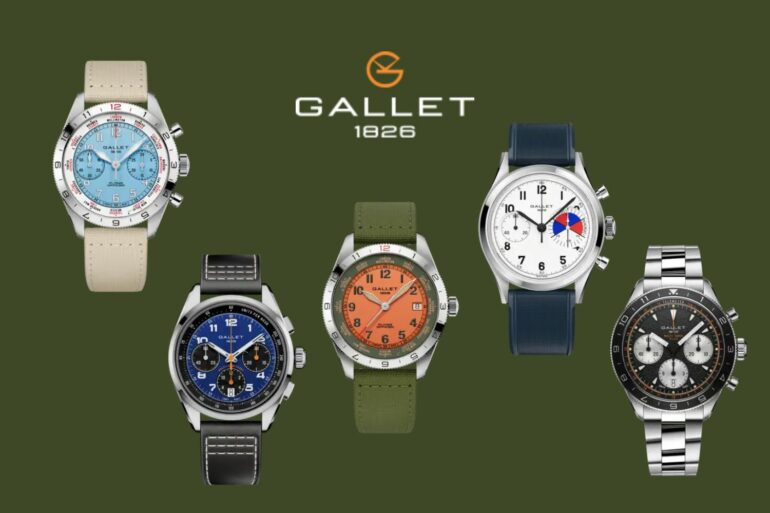
La Chaux-de-Fonds is home to as many active legends as it is to silent factories, frozen in the annals of the past. In the austere valleys of the Swiss Jura, reviving a historic name is often little more than a financial gimmick: one dredges up a prestigious founding date, designs a sepia-toned dial to please the eye, and hopes to capture the attention of a watch market strongly driven by nostalgia. Gallet’s reappearance, however, follows an entirely different logic—one that is infinitely more concrete. Founded in 1826, this house weathered the Industrial Revolution by equipping those for whom telling time was a matter of immediate safety. From the pioneers of commercial aviation to the first racers on the tarmac, the name had established itself as a cutting-edge designer. If the brand is returning to the arena today, it is not solely due to the will of an investment fund detached from the realities of the workshop. The watchmaker benefits from the direct and substantial support of Breitling, an alliance that radically enhances the credibility of this comeback.
An industrial operation on a strategic life support system
In today’s luxury sector, the Achilles’ heel of brands attempting a revival remains invariably logistics: ensuring consistent production, maintaining strict quality control, and above all, providing impeccable after-sales service. By entrusting its manufacturing, technical maintenance, and its entire international distribution network to Breitling, Gallet avoids the teething problems that typically doom such revivals. Georges Kern, at the helm of this structure conceived as a “house of brands,” fully embraces this operational affiliation. The goal is obviously not to cannibalize Breitling’s existing catalog, but to provide an industrial springboard for an entity whose legacy of exploration resonates with Breitling’s own exacting standards.
This synergy is having an immediate impact on the commercial front. Plans to create spaces specifically dedicated to Gallet are already being discussed within certain Breitling boutiques. Such physical coexistence is exceptional in an industry that is typically highly compartmentalized. It proves that the move was carefully considered for the long term. The goal is not to churn out a series of fleeting announcements, but rather to firmly reestablish this heritage brand within the tangible landscape of luxury, while steering it clear of the pitfall of becoming a dusty relic.
Metal Built to Withstand Race Tracks and the Skies
To assert its new identity without spreading itself too thin, the manufacture has structured its relaunch collection around four very clear pillars: Multichron Pilot, Multichron Sport, Flying Officer, and Gallet Classics. Beneath the dials, the mechanical choices—which eschew unnecessary excess—prioritize reliability. The core collections are powered by the Gallet 23 and 17 calibers. Their architectures, derived from Sellita’s robust mechanical movements, guarantee unwavering durability. The Classics line, on the other hand, moves significantly upmarket by featuring the Breitling B09 caliber. With a generous power reserve of approximately 70 hours and COSC chronometer certification, this movement demonstrates a commitment to delivering horological value capable of appealing to a clientele that is highly discerning when it comes to technical precision.
The design of the cases draws directly from the brand’s historical archives. The Multichron Sport, with a modest diameter of 41 mm, is clearly inspired by the racetrack. Its tachymeter scale evokes an era when drivers gauged their average speed with a quick glance at their wrist, in cockpits where mechanics reigned supreme. Right next to it, the Multichron Pilot expands to 42 mm. Designed for the open skies, it features a telemeter scale, the essential second time zone display, and highly distinctive luminescent details. These watches serve as a fitting reminder that readability was once not a stylistic choice, but an absolute necessity.
The 1939 Transoceanic Obsession
If one were to single out just one creation from this vast collection, the Flying Officer would stand out on its own. When it was first launched at the dawn of World War II in 1939, transoceanic commercial aviation demanded navigation instruments of unfailing reliability. The contemporary version revives this original spirit by retaining its characteristic rotating bezel, engraved with 24 destinations. This ingenious feature allowed pre-war travelers to instantly navigate the complexity of the time zones they flew over.

Aware of the diverse expectations of our time, the manufacturer offers this model in two versions. The first stays true to the brand’s tradition of complex chronographs. The second drastically streamlines the dial with a three-hand display, featuring bold colors such as bright orange or dark blue. Above all, the manufacturer had the foresight to incorporate a system of interchangeable straps. With a simple press—and without requiring any watchmaking tools—the wearer can switch from a classic steel strap to a technical rubber strap, or from a raw textile strap to a supple leather strap. This instant modularity demonstrates that Gallet aims to establish itself as part of everyday life, moving beyond the realm of a pure collector’s item.
Bringing the Archives into the Rough Reality of Everyday Life
Today, the legitimacy of a watch designed for extreme conditions is earned far from the hushed confines of trade shows. Rather than limiting itself to traditional press kits or polished studio photographs, the brand has launched a narrative series called Field Notes. This editorial program follows real-life adventures and puts the timepieces to the test in the real world. It features filmmakers, photographers, and environmental activists, all equipped with the brand’s gear during rugged expeditions.
Whether enduring plummeting temperatures during paragliding descents over the peaks of the Himalayas, facing polar conditions while sailing in the Arctic, or supporting wildlife conservation missions, the approach is crystal clear. It aims to free the watch from its status as a piece of jewelry and restore it to its role as a timekeeping instrument.
This overarching strategy perfectly highlights the major challenge facing contemporary watchmaking. Having a solid history dating back two centuries and a name respected by purists is no longer enough to trigger a lasting purchase decision. By leveraging Breitling’s industrial production capabilities while designing a cohesive product line, Gallet is laying a solid foundation. Now comes the most delicate phase of any revival: ensuring longevity and proving that the manufacture has enough energy to set its own pace in the present.