
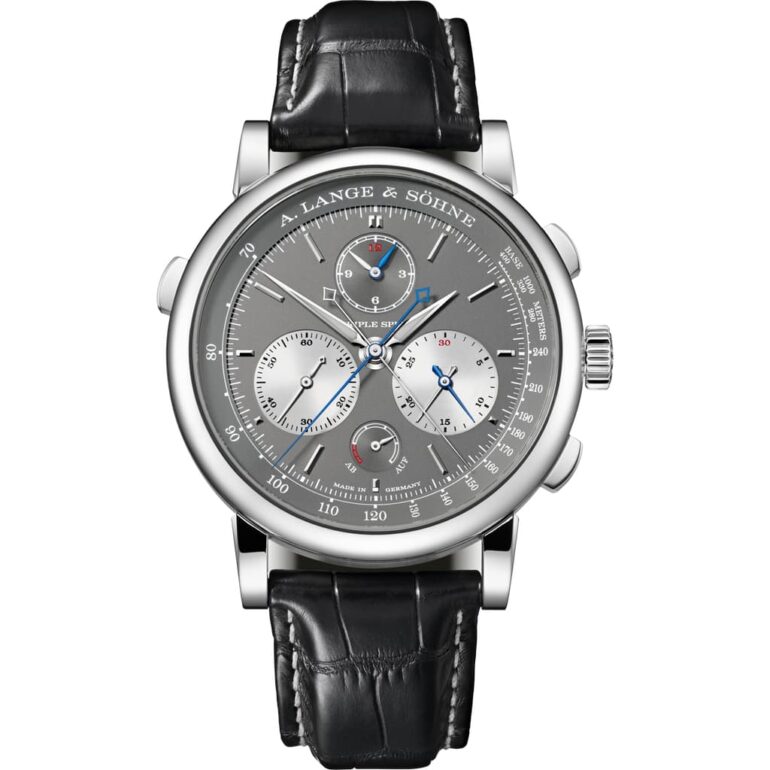
Some watches simply tell time, while others reveal a brand’s approach to mechanics. A. Lange & Söhne’s 2026 new releases belong to both categories, united by a single principle: making every display a matter of readability and construction. On one hand, the 1815 UP/DOWN encapsulates the essence of a dress watch in a 37.5-mm case, now finished in blue. On the other, the Triple Split returns in platinum with a chronograph mechanism capable of timing two separate intervals for twelve hours. Two timepieces with almost opposite proportions and ambitions, yet linked by the same Saxon penchant for visible precision.
The Return of an Extraordinary Movement
The Triple Split is not strictly speaking a new model. It has already existed in two versions: an initial model presented in 2018, followed by a rose gold variant launched in 2021. Each was produced in a limited run of 100 pieces and was discontinued once sold out. Its return, after nearly five years of absence, is therefore a highly anticipated reappearance rather than a mere aesthetic update.
This new edition, reference 424.025F, features a 950 platinum case measuring 43.2 mm in diameter and 15.6 mm in thickness. These substantial dimensions are dictated by what lies within. The platinum lends its bright luster to the rhodium-plated dial, accented by gray sub-dials. The overall appearance remains understated, almost austere, until one pauses to examine the hands and pushers: it is there that the design reveals its true purpose—a split-seconds chronograph pushed to a rare level of complexity.
The classic split-seconds chronograph relies on two seconds hands. They start together, then one can stop while the other continues its run. This mechanism thus allows for comparing two competitors in the same event or recording two successive lap times during a race. Its scope, however, remains limited to measuring seconds.
With the Triple Split, this ability to separate measurements extends to the chronograph’s minute and hour hands as well. It then becomes possible to time two events separately, each lasting up to twelve hours. The result is not only spectacular—it transforms the split-seconds chronograph into a long-range measuring instrument. Split times are no longer limited to a few seconds or minutes; they can span an entire day.
567 components behind the dial
This capability is based on the in-house caliber L132.1, a hand-wound movement comprising 567 components. It has a power reserve of 55 hours and a frequency of 21,600 vibrations per hour, or 3 Hz. It drives the hours, minutes, small seconds, power reserve indicator, a tachymeter, and a triple split-seconds flyback chronograph.
The case back is almost as important as the dial. Through the transparent case back, the movement has been designed to offer a clear view of its components. Bridges, levers, and springs form a dense architecture, where the eye can follow the intricacies of the chronograph mechanism. The visible plates are crafted from untreated nickel silver and decorated with Glashütte stripes, in accordance with the finishing standards associated with the Saxon tradition. Assembly is performed by hand.
The choice of manual winding is by no means incidental in such a technical watch. It maintains a direct connection between the wearer and the mechanism: the 55-hour power reserve is not an abstract figure, but the result of a repeated action. The Triple Split comes on a dark brown alligator leather strap, accented with gray stitching and secured by a platinum folding clasp. Production is limited to 100 pieces, and the price is available upon request.
Restraint as Another Form of Virtuosity
In contrast to this mechanical display, the 1815 UP/DOWN adopts a radically different design language. It does not seek to impress through an accumulation of functions. Its dial is organized around a deliberately corrected imbalance: the small seconds sub-dial moves from the 6 o’clock position to 4 o’clock, while the power reserve indicator is positioned at 8 o’clock. Two sub-dials, two visual focal points—a composition that avoids rigid symmetry without losing its sense of calm.

Its name comes directly from the German inscriptions used for the power reserve indicator. “Auf” indicates that energy is available, “Ab” that it is decreasing. Literally, up and down. This designation gives the watch a very concrete functional focus: it indicates not only the time but also the tension status of its mainspring.
For 2026, A. Lange & Söhne is introducing a blue dial to this line. The sub-dials retain a silvery hue that stands out clearly against the background. The blue adds a new dimension to the traditional aesthetic of the 1815 without disrupting its proportions. It pairs with two metals that each have their own distinct character: 750 white gold and 750 rose gold. The first version features a cool color scheme with a blue strap; the second is worn on a reddish-brown alligator strap, whose warmth echoes that of the case.
A blue dial, a manual-winding caliber
The 1815 UP/DOWN measures 37.5 mm in diameter and is only 8.7 mm thick. These dimensions define its character: it remains a discreet wristwatch, designed to slip under a sleeve rather than to dominate the space. It houses the L051.2 caliber, also hand-wound, regulated to 21,600 vibrations per hour and featuring a 72-hour power reserve.
In this specific case, the power reserve indicator takes on its full meaning. On an automatic movement worn daily, it would often remain close to its maximum, rendered almost decorative by the rotor’s continuous winding. Here, each winding advances the hand; each period when the watch is not worn moves the indicator closer to “Ab.” The complication becomes a piece of information that is truly experienced, integrated into the daily use of the watch.
Both models are limited to 300 pieces each: 244.037 for the rose gold version, 244.028 for the white gold version. Their price is set at 45,000 euros. They display hours, minutes, small seconds, and power reserve on a dial whose new color alters perception without altering the construction. Details of the collection are available from A. Lange & Söhne.
Between the 72 hours of the 1815 UP/DOWN and the twelve hours of dual timing in the Triple Split, the brand offers two very different approaches to time. One requires monitoring the remaining power reserve. The other allows you to separate two durations that progress together. In both cases, time is never treated as a simple reading: it becomes a mechanism to be observed.