
Make Texture a preferred source on Google to support us
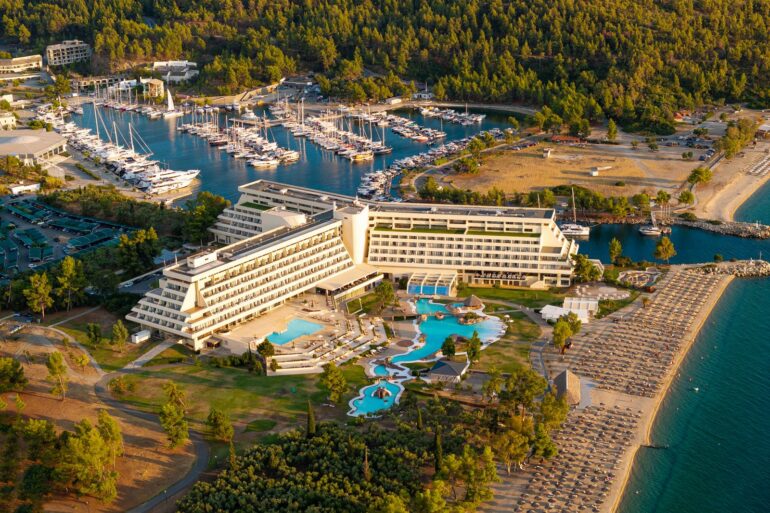
Add Texture to GoogleAll you have to do is step away from the tasting table at Domaine Porto Carras and look up at the hillsides to appreciate the uniqueness of this place. Overlooking the Aegean Sea, the vineyards create a landscape one might readily associate with a secluded wine estate. Yet just a few minutes down the hill, a marina, a long beach, a golf course, and a sprawling hotel form a setting on an entirely different scale. In Neos Marmaras, on the Sithonia Peninsula, Porto Carras embodies an idea that has become rare in the contemporary hospitality industry: that of a comprehensive estate, conceived as a place to live rather than simply a place to spend a few nights.
A Greek shipowner’s extravagant dream
The story begins in 1963. Yiannis Carras, a Greek shipowner, discovered an unspoiled bay off the coast of Sithonia. He then purchased 1,763 hectares from the Monastery of Saint Gregory, one of the monasteries of Mount Athos, located on the neighboring Halkidiki Peninsula. His project was far from that of a modest seaside hotel: Carras envisioned a self-contained complex, complete with a marina, land, plantations, and hotels.
The first vineyards were planted in 1965; these were followed by 45,000 olive trees, and then the hotel buildings, which opened between 1974 and 1980. The architectural project is associated with Walter Gropius, founder of the Bauhaus. This connection—whether interpreted as a modernist ambition or as a real-estate manifesto of its time—sheds light on the estate’s character: Porto Carras has never sought to blend into the postcard-perfect image of the Cyclades. It was conceived on a grand scale, organized, and almost urban in the way it integrates leisure, agriculture, and hospitality.
The guestbook from the early years attests to the aura the resort has acquired: Salvador Dalí, François Mitterrand, Melina Mercouri, and Johnny Hallyday are all listed there. Even today, this legacy lends the site a special depth. People don’t come here for the illusion of a newly built resort, but to immerse themselves in a vision of the 1960s and 1970s that continues to shape the landscape.
A bay that sets the pace
The Meliton, the resort’s main hotel, rises in tiers facing the bay. From its terraces, the view extends toward Neos Marmaras, a fishing village nestled on the other side of the water. At one end lies the marina; in front of the hotel, the beach; behind it, the pine-forested hills of Sithonia. This geography alone explains why Porto Carras defies quick comparisons with the more cookie-cutter seaside resorts of the Aegean.
The crystal-clear water and the immediate proximity of the hills give the shoreline an almost tangible presence. At the end of the day, when the light sweeps across the bay, the architecture recedes into the background. This is undoubtedly the best way to approach the estate: not as a promise of immaculate minimalism, but as an anchor in a landscape whose vastness ultimately imposes its own scale.
Across from the Meliton, the site’s other historic hotel is undergoing renovation, shrouded in scaffolding. The construction site signals a desire for transformation, without, however, erasing the place’s very distinct identity. The Meliton’s interior spaces reflect the age of the complex as a whole: they are well-maintained, functional, and comfortable, but make no attempt to imitate the recent trends in Aegean luxury. This authenticity has its own appeal. Porto Carras doesn’t present itself as a brand-new setting; it bears the marks of its decades, sometimes charmingly, sometimes more visibly.
Finding the Right Balance with the Resort
The property is vast and decidedly family-oriented. A kids’ club and numerous activities shape the vacation experience, particularly during peak season. Those seeking a very secluded stay will therefore need to plan their experience carefully. The suite category offers a significantly different perspective: it provides access to a private stretch of beach as well as the Crystals restaurant, reserved for these guests and overlooking the marina.
This option offers a welcome respite within a property whose sheer scale can be overwhelming. Crystals focuses on a more relaxed atmosphere and the spectacle of boats in the harbor. The contrast with the large common areas is significant: it serves as a reminder that at Porto Carras, luxury isn’t just about a room or a view, but about the way you move through the resort.
After dinner, the marina is perfect for a leisurely stroll. Music plays in the lobby in the evening, while the staff at the marina, the pro shop, and the restaurants lend the stay a reassuring sense of continuity. The quality of a large resort is often measured by this detail: the ability of its staff to make you forget the mechanics of the operation. Here, the hospitality is characterized by warmth without being overbearing, from the beach to the sports facilities.
Cuisine as the Main Attraction
The buffet-style setup of the main restaurant might seem out of place at a property of this caliber. Yet it turns out to be one of the most consistent highlights of the stay. At both breakfast and dinner, the cuisine emphasizes precise generosity and dishes prepared to order. Fried calamari, zucchini fritters, dolmadakia, a well-seasoned Greek salad, and vegetarian moussaka make up a spread that avoids the predictability often associated with this type of service.
On the sand, Cikado takes on a different vibe. The beach restaurant is perfect for leisurely lunches and dinners overlooking the water, with tables set almost at the water’s edge. Seafood, white wine, and the sea breeze are all it takes to create a setting that’s anything but overwhelming. It’s one of the spots that best embodies the connection between the estate and the sea.
The wine list naturally centers on local wines, featuring the vintages of Domaine Porto Carras rather than a selection disconnected from the region. This consistency extends to the restaurants’ musical ambiance, carefully curated to complement the evening without dominating it.
The vineyard that gave its name to an appellation
On the slopes overlooking the resort, Domaine Porto Carras cultivates 450 hectares of organic vineyards. The site describes it as the largest organic vineyard in Greece and one of the largest in Europe. Beyond the numbers, the vineyard has shaped the identity of the entire resort: the “Slopes of Meliton” PDO designation, obtained in 1982, is intimately linked to these lands.
A tasting offers a chance to appreciate the different layers of this history. Indigenous Greek grape varieties grow alongside Cabernet, which helped establish the estate’s early reputation. This coexistence sums up Porto Carras quite well: an international ambition born in the 1960s, yet rooted in soil and a landscape that remain deeply Greek. For those staying on-site, the half-board option takes on a very practical meaning: it leaves room for the estate’s wines without requiring guests to forgo the resort’s cuisine.
Visitors can find practical information and details about their stay directly on the official Porto Carras Grand Resort website. This destination is best appreciated not in a rush but over several days, allowing time to move from the vineyards to the shore, from the restaurant to the marina.
A course in a country with few of them
Golf rounds out this large-scale resort model. Greece has few golf courses, and Porto Carras’s 18-hole course is one of the destination’s most compelling features. The layout remains accessible to intermediate players, with open spaces and mountainous terrain framing the course. Even a poor putt seems less serious here when the hills of Sithonia come into view.
The clubhouse happily extends the day over a cold Mythos, without turning the post-golf experience into a formal affair. This is perhaps where Porto Carras truly shines: in its ability to juxtapose a beach, a harbor, a vineyard, and a green without trying to blend them into a uniform aesthetic. The resort remains imperfect in places, but its blend of grandeur, history, and scenery gives it a personality that even the most polished resorts often struggle to achieve.