
Make Texture a preferred source on Google to support us
Add Texture to GoogleIn watchmaking, anniversaries often serve as an excuse for a new dial color or a subtle engraving. In 2026, however, they tell a broader story: that of timepieces that have transformed the relationship between the watch and its environment. Water-resistant for swimming, light-powered, crafted from ceramic, designed as a sporty piece of jewelry or as an experimental timepiece, the wristwatch celebrates its breakthroughs as much as its milestones. From the first Oyster case to Ulysse Nardin’s radical designs, this retrospective brings together a century of inventions, revivals, and brand strategies.
1926: The Year the Watch Left the Showroom
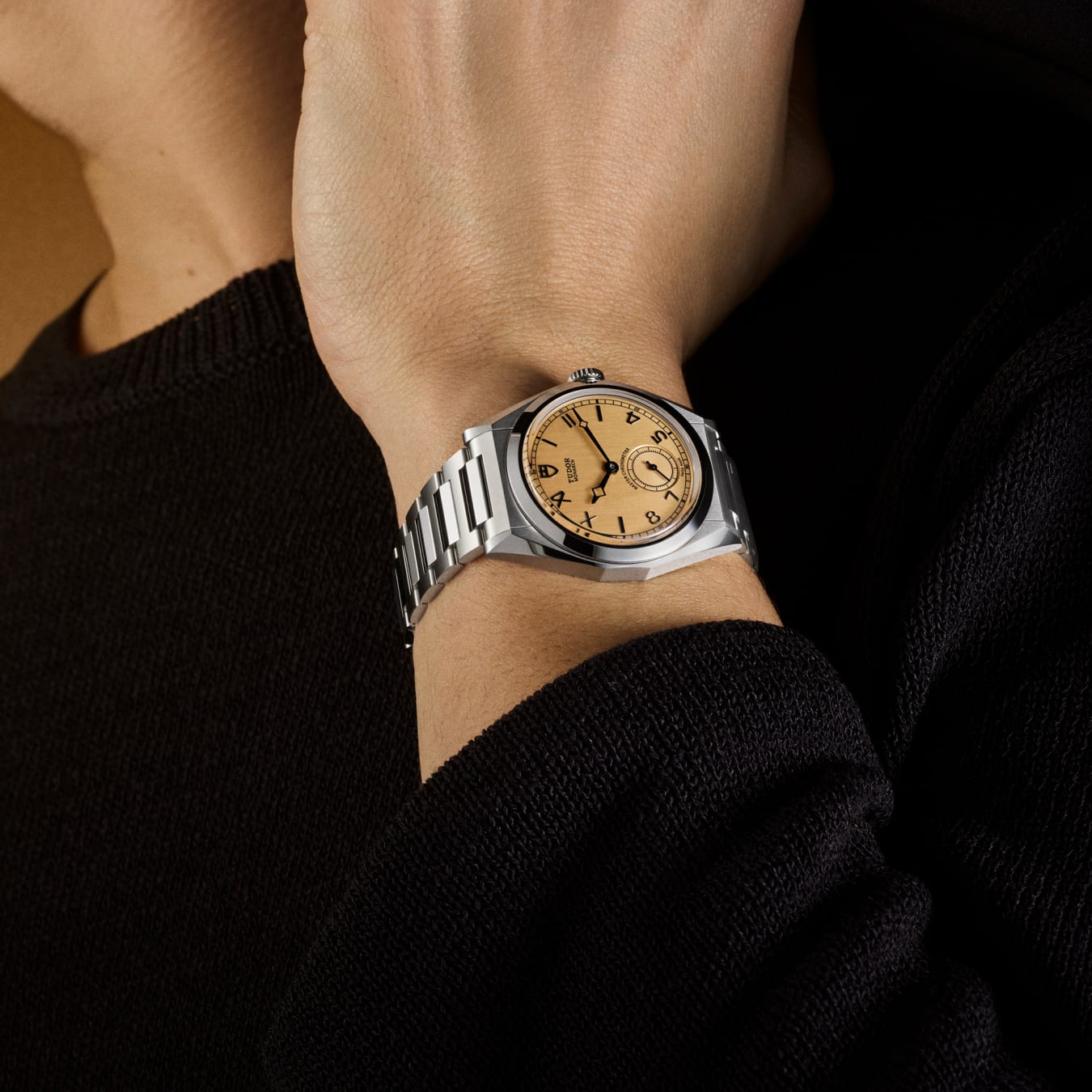
One hundred years after its founding in Geneva by Hans Wilsdorf, Tudor has chosen a brand-new timepiece to mark its centennial: the Monarch. The watch plays with traditional codes without becoming a mere pastiche. Its 39-mm steel case, water-resistant to 100 meters thanks to its screw-down crown, houses the self-winding MT5662-2U caliber, featuring a 65-hour power reserve. The dark champagne-colored dial and steel bracelet lend it a sense of restraint that contrasts with its Master Chronometer specifications. Priced at £4,600, it aptly encapsulates Tudor’s current ambition: to assert its own distinct identity, well removed from the shadow cast by Rolex.
At Rolex, the centennial celebration centers on the model that ushered the watch into the modern era: the Oyster. Launched in 1926, it combined the concepts of precision and durability. Its media profile reached new heights when Mercedes Gleitze wore it during her swim across the English Channel. This moment not only demonstrated the capabilities of a water-resistant case; it also laid the foundation for a communication strategy centered on brand ambassadors and public achievements.
The Rolex Oyster Perpetual 41, model 134303, embodies this legacy in a two-tone design: Oystersteel and yellow gold, with a slate-gray dial and a matching Oyster bracelet. Its 41-mm case, screw-down crown, and water resistance to 100 meters remain true to the watch’s original purpose. The Caliber 3230 beats at 4 Hz and offers a 70-hour power reserve. List price: £8,050. A very contemporary reminder of a century-old insight: durability can become a source of desire.
The 1960s: A Swiss Laboratory and a Japanese Playground
The year 1966 appears several times in this timeline, but not for the same reasons. For Oris, it marked a break from regulatory constraints. In the 1930s, the Swiss Watch Statute had been enacted to protect the Swiss watch industry in the wake of the Great Depression. It also had the effect of hindering certain technical and industrial advancements. Oris helped overturn this regulation through the efforts of a lawyer retained by the company in 1965. The following year, the first Oris Star was able to incorporate the lever escapement.
The contemporary reissue, simply named the Oris Star Edition, prioritizes substance over show. With a 35-mm steel case, a brushed silver dial, and a black leather strap, its design leans toward utilitarian classicism. The 4 Hz Caliber 733 offers a 41-hour power reserve and drives the hours, minutes, seconds, and date. Water-resistant to 50 meters, this Star is priced at £1,750.
That same year saw the debut of the Favre Leuba Harpoon. Its successor, the Harpoon Revival, embraces the very contemporary idea of a watch capable of adapting to different contexts rather than being overly specialized. With a diameter of 36.8 mm, a thickness of 10 mm, a gray dial, and a black alligator-embossed leather strap, it retains an elegant look; its 50-meter water resistance and steel construction ensure it is free from any ostentatious fragility. The FLD04 automatic movement beats at 4 Hz and boasts a 68-hour power reserve. It is priced at £1,800.
Japan is also celebrating its milestones. PADI, the Professional Association of Diving Instructors, is celebrating its 60th anniversary, and Seiko is marking the occasion with a limited edition of 8,000 pieces of its Prospex Mechanical PADI 60th Anniversary “King Turtle.” The partnership between the two organizations has lasted for ten years, but it is the diving organization’s anniversary that inspired this edition. Its 45 mm by 13.2 mm stainless steel case, screw-down crown, blue dial, and 200-meter water resistance make it a watch that makes no secret of its marine purpose. The 4R36 caliber, operating at 3 Hz, provides a 41-hour power reserve as well as day and date displays. The PADI King Turtle is priced at £650.
Light, Color, and Material as Signature Elements
At Citizen, the anniversary marks not so much a collection as an energy concept. In 1976, the Crystron Solar Cell introduced a quartz watch powered by light captured through the dial. The term “Eco-Drive” wasn’t yet in use, but the idea was already there: to replace the chemical battery—which needed to be changed periodically—with the accumulation of light energy. Fifty years later, the Citizen Eco-Drive Photon 50th Anniversary embodies this continuity in a Super Titanium case and bracelet.
Limited to 5,000 pieces and priced at £749, it measures 39.6 mm in diameter and 9.9 mm in thickness. Its black dial accented with blue houses the E036 solar caliber, operating at a frequency of 32,768 Hz, with a power reserve of up to twelve months. Here, there are no complications: hours, minutes, and seconds are all that’s needed. The watch’s appeal lies in the lightness of the material and in a concept of power reserve that doesn’t rely on a mainspring.
Seiko, founded in 1881, is celebrating its 145th anniversary by organizing its creations into three themes: past, present, and future. Gold represents the past; “Seiko Blue” adorns the models dedicated to the present; and Edo purple looks toward the future. The Prospex Speedtimer Solar Chronograph 145th Anniversary belongs to this last category. Its Edo purple dial, 41.4-mm stainless steel case, and V192 solar movement stand in contrast to the brand’s usual penchant for strict nostalgia. This chronograph, featuring a 24-hour display and a date, offers a six-month power reserve, is water-resistant to 100 meters, and is available in a limited edition of 8,000 pieces for £670.

At IWC, the material itself has become a celebration. In 1986, the Schaffhausen-based manufacturer introduced its first ceramic wristwatch as part of the Da Vinci line. Forty years later, this material is an integral part of its design vocabulary. The Ingenieur Automatic 42 in dark olive-green ceramic links this technical milestone to the Ingenieur design reimagined by Gerald Genta fifty years ago. Its 42-mm case, 18-karat gold crown, and ceramic bracelet complement the matching dial. The Caliber 82110 runs at 4 Hz, has a 60-hour power reserve, and features a date display. Water-resistant to 100 meters, this timepiece is priced at £18,500.
From Sporty Chic to the Iconic Watch
The mid-1970s gave rise to two very different narratives. In 1976, Patek Philippe launched the Nautilus, designed by Gerald Genta. Its broad case, integrated bracelet, and textured dial established a language of sporty luxury that continues to dominate watch displays. The Nautilus 50th Anniversary 5810/1G-001 encapsulates this formula in a 41-mm, 6.9-mm-thick white gold case, with a blue dial and a bracelet made of the same metal. Limited to 2,000 pieces, it is powered by the 240 caliber running at 3 Hz, with a 48-hour power reserve, and retails for £75,690. Its water resistance of 30 meters serves as a reminder that it now belongs more to the realm of luxury than to that of a practical tool.
At Raymond Weil, however, the fiftieth anniversary is centered on the tangible legacy of a movement. The Millesime The Fifty, produced in a limited edition of just 50 pieces, draws its design from the Millesime collection but houses a restored Valjoux manual-winding chronograph movement dating from 1976. Its RW1976 caliber beats at 3 Hz and offers a 40-hour power reserve. The 37-mm stainless steel case, topped with an 18-karat white gold bezel, features a silver dial and a blue nubuck strap. Price: £9,250.
The Heuer Monza, also introduced in 1976, has followed a less conventional path. Designed at the time with limited resources, it has become a cult classic. The TAG Heuer Monza Flyback Chronograph 50th Anniversary Edition does not seek to freeze this history in time: it features a black forged carbon 42-mm case, a black dial, perforated calfskin leather, and the TH20-12 caliber with a flyback function. With an 80-hour power reserve, water resistance to 100 meters, and a limited run of 500 pieces, it retails for £11,300.
The mechanical watch that rejects the conventional dial
Two watches bring this journey to a close with very contrasting visions of expressive watchmaking. Orient Star celebrates its 75th anniversary with the M34 F8 Date Meteorite, a limited edition of 255 pieces that dispenses with the open-worked dials and skeletonized effects often associated with the line. Its gray meteorite dial draws the eye. The M34 F8 Date Meteorite features a 40-mm stainless steel case, water-resistant to 100 meters, an F8N64 caliber offering a 60-hour power reserve, and a dedicated power reserve indicator. It is priced at £2,824.99.
Ulysse Nardin takes innovation even further with the Freak, launched in 2001. Here, the rotating movement itself serves to display the hours and minutes: the mechanics become the display. Its influence extends beyond design, particularly because the work conducted on silicon—in collaboration with designers such as Ludwig Oechslin—helped establish this material in contemporary watchmaking. The Freak X 25th Anniversary carries on this tradition in a 41-mm stainless steel case, with a gray dial and a cognac-colored nubuck strap. The UN-232 caliber, operating at 3 Hz, offers a 72-hour power reserve. Priced at £31,100, it serves as a reminder that, even after twenty-five years, some watches still have no intention of conforming to the norm.