Make Texture a preferred source on Google to support us
Add Texture to GoogleIn 1989, David and Karin Chamberlain bought a house built in the 1890s on Broadway in Pacific Heights for nearly $4 million. Thirty-seven years later, their daughters are putting it up for sale at just under $35 million, in a market now driven by fortunes made in artificial intelligence. The sale of 2724 Broadway thus reflects the shift from a home once owned by a civic leader—with ties to the opera and the chamber of commerce—to a clientele whose wealth was amassed in just a few short years.
A Leader of the Old School
David Chamberlain embodied a figure that San Francisco has long cherished: the business leader who devotes part of his time to his city’s institutions. His career took him to the helm of three companies—Shaklee Corporation, Stride Rite, and Genesco—before he became a partner at EaglePoint Advisors. His local commitments were at least as significant a part of his life story. He served as president of the San Francisco Opera and later as president of the city’s Chamber of Commerce. He also served on the boards of UCSF and the CPMC Foundation.
He died on April 28, 2026, at the age of 82, in this house. His wife, Karin (née Molander), passed away the same year. The property passed to their two daughters, Kathryn Hope, who lives in San Francisco, and Pamela Kringel, who lives in South Dakota. They are the ones selling it. This is a common practice in estate settlements. Yet it brings to a close a specific chapter in the neighborhood’s history—one in which an address on Broadway initially signified a place in the city’s civic life.
Thirty-seven years, two lives in the house
The Chamberlains moved in at the end of 1989. That was also the year of the Loma Prieta earthquake, and the house bears the marks of it: its foundations were reinforced following the quake. For a late-19th-century building, this structural work likely matters more to a savvy buyer than any interior decor.
The rest of the house remained largely unchanged at first. The family kept the home almost exactly as it was when they arrived. David Chamberlain’s career then took him to Boston for a time, though the family never sold the house on Broadway. It wasn’t until 2007 that the couple returned to live there full-time. That year marked the start of major renovations.
The renovation is evident in a few specific choices. An elevator, installed after 2007, now connects the four floors. The living room and dining room form a single reception area, open to the kitchen and leading directly onto a terrace. This reflects a less compartmentalized approach to entertaining than the one for which the house was originally designed. However, period features have not been sacrificed: curved wrought-iron balusters have been preserved.
What the listing says—and what it leaves out
The house has seven bedrooms spread across four levels. Its living area is listed at around 9,000 square feet, or approximately 836 m². This figure is a rounded sales estimate, not a measured area. The number of bathrooms has not been disclosed. An enclosed garage accommodates two cars—a tangible luxury in a hilly neighborhood where parking is negotiated on a street-by-street basis.
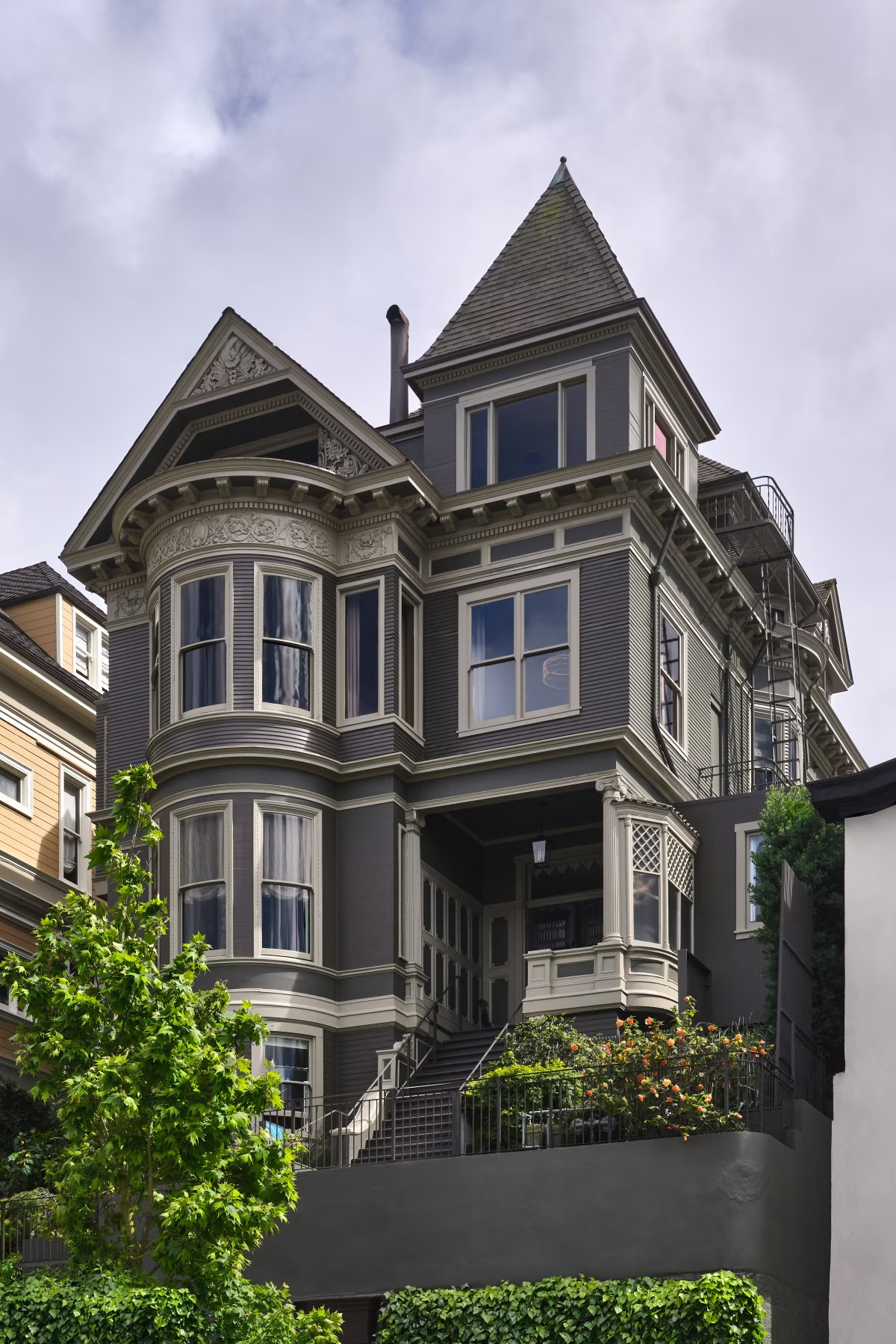
The most distinctive feature is a hidden entrance leading to the kitchen. The listing specifies neither its origin nor its use. In a house of this era, this layout suggests a service circulation separate from that of the guests. In any case, it attests to an interior layout that has not been entirely smoothed over by renovations.
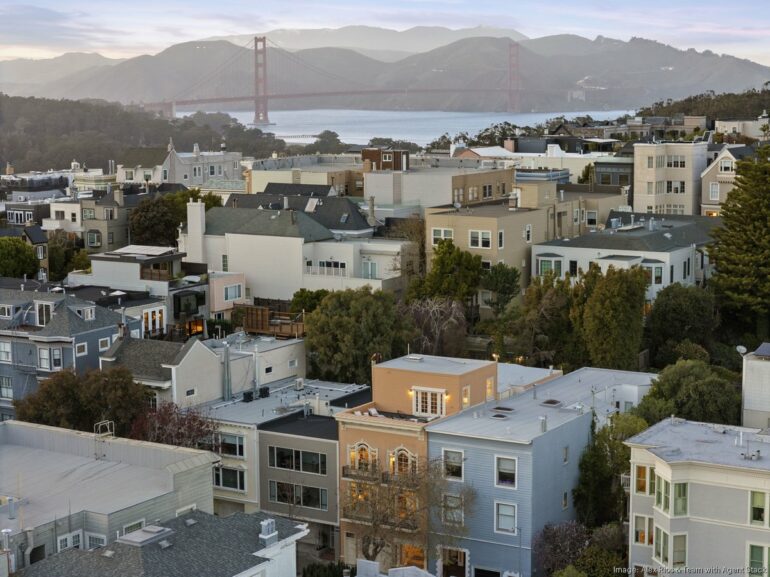
What remains unchanged is the view. From this stretch of Broadway, the gaze sweeps out over the bay and the Golden Gate Bridge. It is this view—far more than the number of bedrooms—that defines the property’s value.

Broadway in the Age of Artificial Intelligence
This stretch of Broadway is often nicknamed “Billionaire’s Row.” The nickname is nothing new, but the neighbors have changed. Jensen Huang, CEO of Nvidia, lives nearby. His presence epitomizes the shift currently underway: the company he leads has become one of the faces of the AI boom, and it is precisely this industry that is driving the demand for Pacific Heights’ luxury homes.
Neal Ward, the real estate agent handling the sale for Compass through his firm Neal Ward Properties, cites figures that illustrate this acceleration. He reports 14 sales of $20 million or more in San Francisco in 2026, through early November, compared to 8 for the entire year of 2025. This tally should be taken for what it is: it comes from the listing agent, who has a vested interest in portraying a booming market, rather than from a public registry or independent statistics. Nevertheless, the trend it reveals aligns with the rise in demand observed in the neighborhood.
The asking price—approximately 33.2 million euros in November 2026—is nearly nine times the amount paid in 1989. The comparison is crude: the roughly 3.8 million euros from that time are not adjusted for inflation, so the actual difference is smaller than it appears. Nor does it account for the renovations undertaken starting in 2007, the cost of which has not been disclosed. Moreover, the listed price has not been published to the nearest dollar: it is presented as just under 35 million.
A Property Changes Hands—and Worlds
What is striking about this listing is not so much the price as the journey. The house was purchased by a leader in the traditional economy—a manufacturer of shoes and consumer goods—who spent part of his life heading local cultural and economic institutions. It is coming on the market at a time when the city’s most active capital comes from an industry that did not exist—in its current form—when the Chamberlains first moved in.
The future buyer will find a home from the 1890s that was reinforced after the Loma Prieta earthquake, equipped with an elevator and opening onto its terrace, complete with its original balusters and a discreet passageway to the kitchen. They’ll also inherit a neighborhood where the name Jensen Huang has replaced, in conversation, those of the opera’s presidents. For Kathryn Hope in San Francisco and Pamela Kringel in South Dakota, the sale brings to a close thirty-seven years of family life on Broadway. For the neighborhood, it will provide a new benchmark: the price at which a home once owned by the city’s former elite will find a buyer among the new elite.