Make Texture a preferred source on Google to support us
Add Texture to GoogleA watch with an open dial, sold without the pedigree of a century-old workshop, without a family lineage, and without the usual trappings of haute horlogerie: that is precisely what makes Valusis so intriguing. Based in Dubai—a city more readily associated with buying timepieces than with making them—this young independent brand puts forward a clear proposition: to make mechanical watchmaking spectacular, wearable, and repairable without charging the high entry price of major brands.
The Volt Skeleton does not seek to rival the virtuosic feats of traditional watchmaking. It plays a different tune—that of practical luxury, where pleasure comes first and foremost from what is visible and from the watch’s role in everyday life. Its appeal lies not in historical rarity, but in a cohesive design: a recognized automatic movement, a robust construction, an interchangeable steel bracelet, and a mechanical layout that remains easy to read. For a French watch enthusiast accustomed to seeing the hallmarks of prestige measured by a manufacturer’s age, this commercial approach deserves a closer look.
The Exposed Movement as an Accessible Language
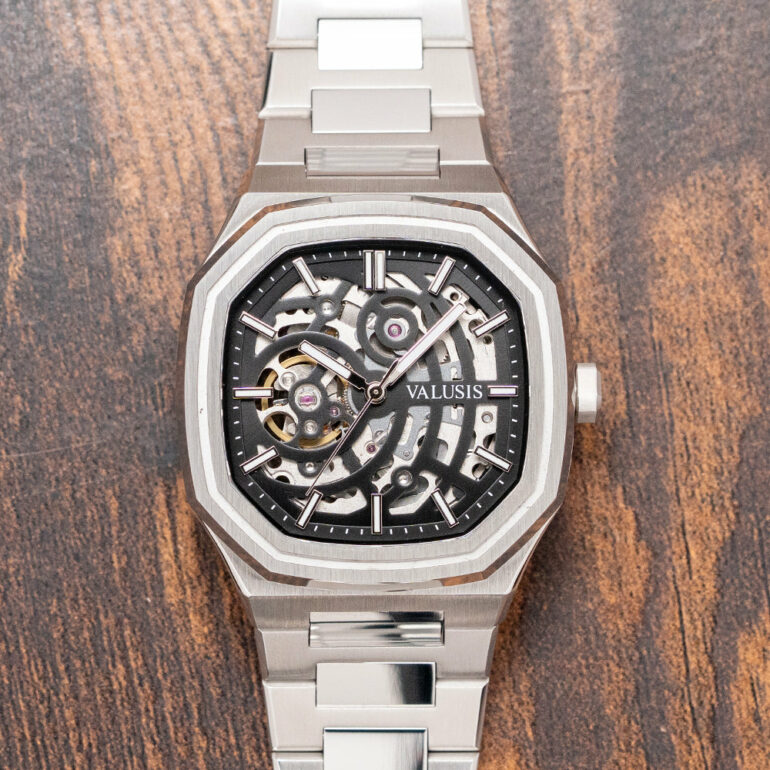
The open dial is one of the most ambiguous territories in contemporary watchmaking. It can reveal the refinement of a movement that has been meticulously openworked, engraved, and hand-beveled. But it can also become a mere graphic effect, exposing components that do little to enhance the watch’s appeal and complicating the reading of the time. The Volt partly avoids this pitfall thanks to a dense architecture—which prevents the wrist from showing through the mechanism—and a prominently placed balance wheel.
The terminological nuance matters. Historically, a skeleton watch is created from an existing movement from which superfluous parts are removed, before the remaining elements are decorated and finished. It is a discipline requiring patience—almost sculptural in nature—whose cost reflects the manual labor involved. The Volt is more accurately classified as an openworked watch: its plates and bridges were designed from the outset with their openings in mind. Valusis nevertheless uses the term “Skeleton,” which is more immediately recognizable to the public. At this price point, what matters most is not so much the lexical debate as the clarity of the result: the watch truly reveals its mechanics without attempting to replicate the codes of a traditional skeleton watch.
This stance is not insignificant. It speaks to a market where the desire for visible mechanics has become widespread, while the most demanding artisanal finishes remain reserved for a select clientele. Valusis does not sell the dream of a movement entirely hand-finished; it offers the visual experience of the balance wheel and gear train on a more accessible scale. The watch embraces its role as an entry-level piece, rather than an imitation.
The Pragmatic Choice of the Seiko Caliber
At the heart of the Volt Skeleton lies the Seiko NH70, a skeletonized version of the NH35—a caliber widely used by independent watch brands. Its appeal does not lie in surprising collectors with an exclusive technical signature. Rather, it relies on a quality far more valuable for a watch meant to be worn: its reputation for durability and ease of maintenance.
This automatic movement beats at 21,600 vibrations per hour and offers approximately 41 hours of power reserve. It can be wound manually, stops when the time is set, and allows its balance wheel to take center stage on the dial. The bridges supplied by Seiko remain understated; Valusis therefore focuses its design on the presentation, featuring openworked bridges, an exposed balance wheel, and an oscillating weight personalized with the brand’s name. The transparent case back extends this mechanical display to the rear of the case.
The choice of the NH70 also has practical implications. Unlike some watches whose sophistication makes repairs difficult or costly, the Volt is based on a widely recognized movement. For a first mechanical watch purchase, or for anyone who wants to wear an open-face watch without reserving it solely for special occasions, this serviceability is far from a secondary consideration. Affordability isn’t measured solely at the time of purchase: it also depends on an object’s ability to last without becoming tied to an exclusive network.
A case designed to leave the display case
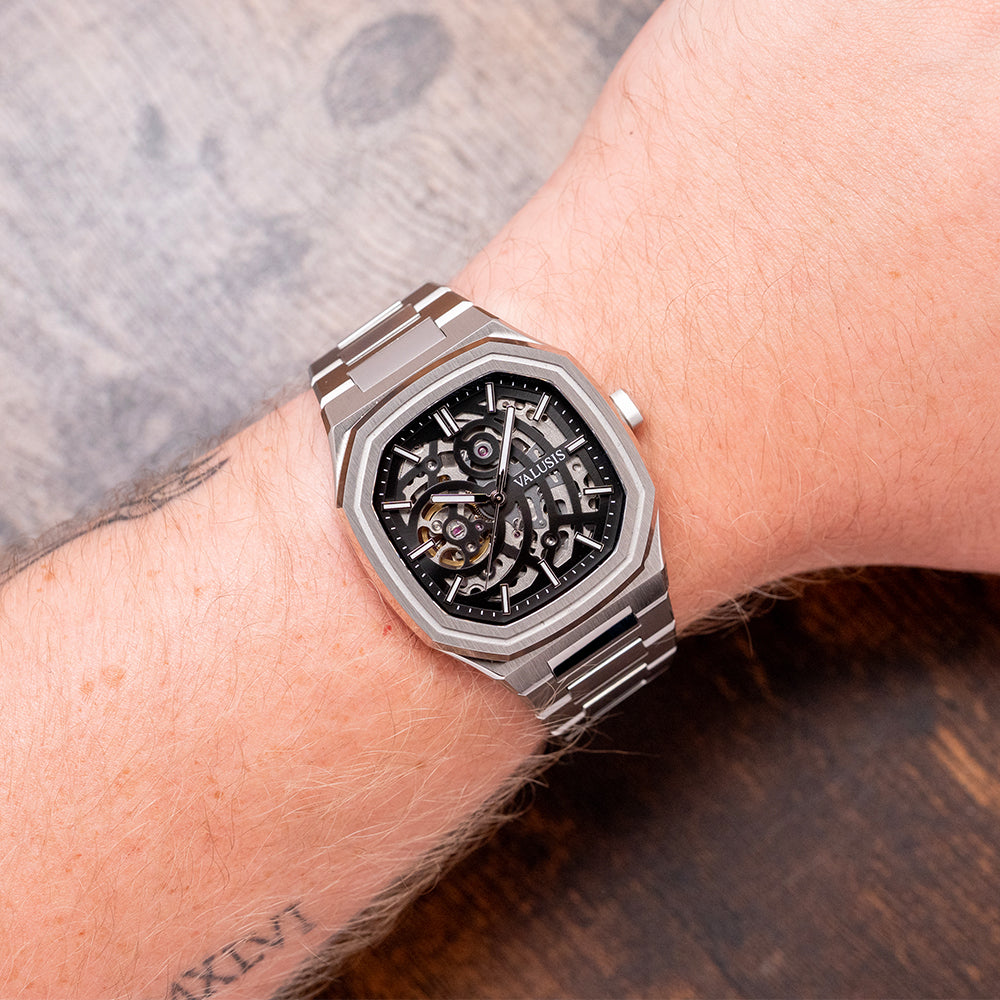
Valusis has given the Volt a case measuring 40 mm in diameter and 11 mm in thickness, crafted from 316L stainless steel. These proportions align with the model’s overall concept: to offer a visual presence sufficient to showcase the movement, without veering into the realm of a showpiece. The edges are described as diamond-cut and then hand-polished. The dial is protected by an anti-reflective sapphire crystal, while a display caseback allows the movement to be viewed from every angle.
Its water resistance of 100 meters also sets the Volt apart from many open-face watches in this category. It is suitable for occasional immersion, without making the watch a dedicated diving watch. Above all, this demonstrates that an open-face dial does not preclude a certain freedom of use. All too often, skeleton watches are perceived as “showpiece” timepieces—fascinating but fragile in the collective imagination. Here, the approach is less ceremonial: the mechanical movement becomes part of everyday life.
The steel bracelet reinforces this intention. Also crafted from 316L stainless steel, it combines polished center links with brushed outer links, featuring a butterfly clasp. When worn on a steel bracelet, the watch weighs 150 grams. This weight may appeal to those who associate heft with a sense of solidity; it may also prompt others to opt for the silicone strap, which brings the total weight down to 90 grams. The silicone strap comes with the tools needed to change it. This detail matters: switching between metal and silicone changes the Volt’s look without requiring a trip to a watchmaker.

From Color to Material
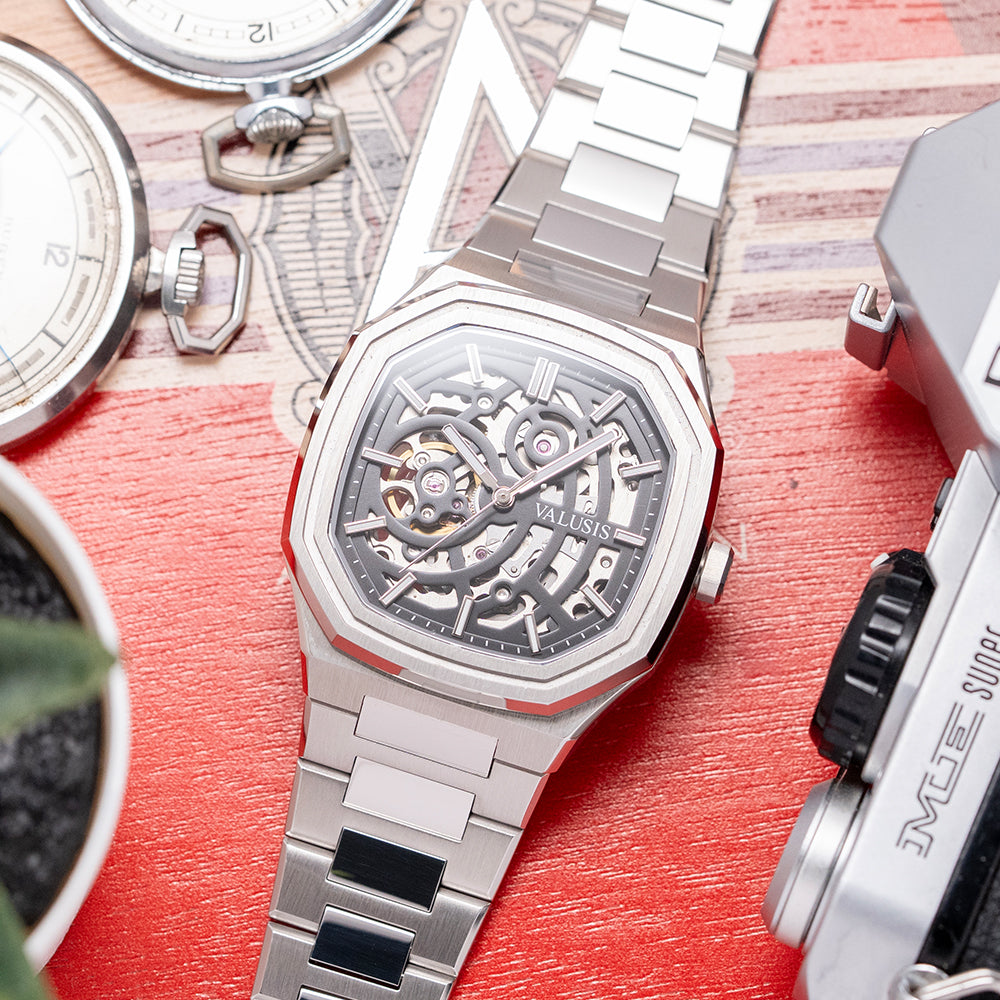
The first Volt Skeleton is available in six variations, ranging from natural steel to black, blue, white, green, or red dials, with matching straps. Within this visual universe, readability remains a decisive factor. Affordable skeleton watches often fall short in this regard, as the proliferation of cutouts can make reading the time confusing. The Volt retains hour markers that are prominent enough to ensure the movement remains a spectacle, not an obstacle.
The Volt Skeleton II takes this concept a step further toward a more dressy aesthetic. It introduces black and blue variants, as well as gold and rose gold versions, featuring 24-karat plating over steel. The latter two are being launched in an initial limited edition of 200 pieces. They shift the watch from an industrial aesthetic toward a more decorative presence, without altering the principle that defines its identity: the visible architecture remains the design’s focal point.
The Volt collection, however, does not stop at the language of the skeleton. It is perhaps in the material dials that the brand best asserts its aesthetic ambition. The Volt Pearl Purple Fumé features natural mother-of-pearl reduced to 0.3 mm, with smoked edges. Malachite, turquoise, and tiger’s eye round out this collection. Here again, Valusis relies on elements that immediately command attention on the wrist, without requiring a complex narrative to justify their appeal.
Value is also a factor after the purchase
Perhaps the most revealing aspect of Valusis’s strategy lies not so much in the dial as in the suite of guarantees that surround it. Each watch comes with a five-year international warranty against manufacturing defects, a 60-day return window, and free shipping. A wristband, an alternative strap, and tools are included. In an industry where accessories and extended warranties can quickly drive up the price, this approach creates a sense of overall value.
The brand also details six stages of testing: calibrated impact tests followed by timekeeping checks, pressure tests exceeding the advertised water resistance with temperature variations, verification of the sapphire’s hardness and transparency, measurement of luminescence in a darkroom, adjustment of the movement in multiple positions over several days, and evaluation of the anti-reflective coating under intense light. However, the origin of the cases and the assembly location are not specified. This caveat is worth noting, particularly for a public that values the traceability of the items they purchase.
The Volt, therefore, does not require adherence to a heritage narrative. It offers visible Seiko mechanics, a stainless steel construction, water resistance to 100 meters, and an ownership model designed to minimize additional costs. For those who enjoy watching a balance wheel in motion without turning that pleasure into a staggering expense, Valusis’s approach offers a unique alternative: less mythologized, yet surprisingly comprehensive.