
Make Texture a preferred source on Google to support us
Add Texture to GoogleA chair placed in the center of an empty room, isolated beneath a skylight, is no longer enough to convey contemporary design. If we examine the latest snapshot of the transalpine creative landscape—unveiled on October 1, 2026, beneath the vaults of the ADI Design Museum in Milan—one thing becomes clear: the discipline has definitively broken free from the strict production of self-contained objects. The 2026 edition of the ADI Design Index paints a portrait of an industry that is now infiltrating the interstices of society. Recycled materials, service interfaces, territorial scenography, or interior architecture: Italian design is expanding, sometimes becoming dematerialized, and above all, striving to redefine uses even before outlining their contours.
An in-depth look at a rapidly expanding discipline
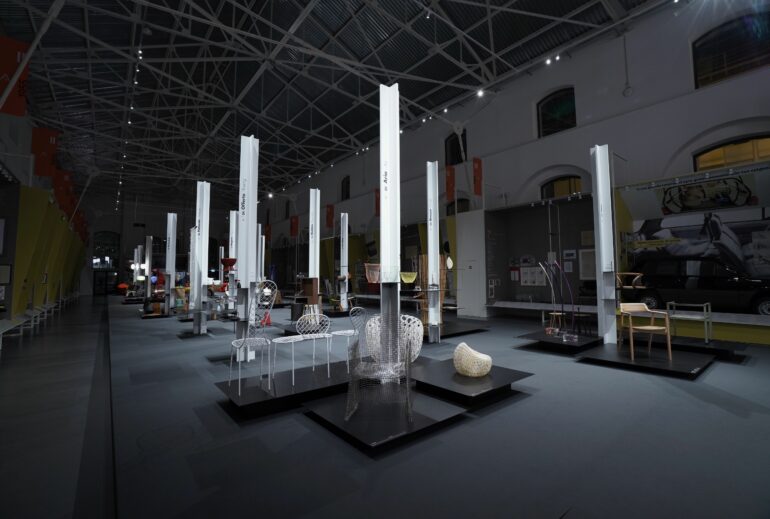
The 2026 edition features exactly 340 projects. This annual selection, closely watched by the entire sector, serves as a gateway: it kicks off the long biennial evaluation cycle that will culminate, in the spring of 2028, with the presentation of the highly coveted XXX Premio Compasso d’Oro. The scientific committees did not seek to single out beautiful forms, but rather focused on relevance. Alessandro Colombo, Maite García Sanchis, Valentina Fisichella, Fabrizio Pierandrei, and Francesco Zurlo, who led this selection process, all point to the same trend. The historical boundaries that once separated furniture, architecture, and technological systems have collapsed.
The distribution of projects across the fourteen categories selected by the Permanent Observatory confirms this transformation. Unsurprisingly, housing retains its historical roots with 84 entries. The intimate, domestic sphere remains the primary testing ground for Italian designers. Yet an examination of the other sectors reveals a societal shift. Personal care (31 projects), communication (28), and the purely social dimension of design (27) are now hot on the heels of the traditional categories. Exhibition design (26), materials engineering (22), the design of intangible services (19)—not to mention mobility (11) and food (11)—paint a picture in which aesthetics serve the overall function.
This systemic approach resonates particularly strongly in the second edition of the report published by the Centro Studi ADI. Under the leadership of Carlo Branzaglia, and supported by institutions such as Federculture, Federlegno, and the Fondazione Symbola, this document refuses to confine design to a mere cultural value. By cross-referencing the 340 projects in the Index with economic statistics from ISTAT, the report demonstrates that Italian design is a driving force behind regional development, a catalyst for the energy transition, and a direct lever for transformation within production sectors.
When Material Redefines Space
In this effort to blur the boundaries between scales of intervention, several projects selected this year illustrate how a material or a piece of furniture becomes a true architectural component. Piero Lissoni’s work for Atlas Concorde is a perfect example of this. With the TRATTO collection, porcelain stoneware breaks free from its role as wall or floor covering to transform into furniture in its own right. Combined with wood, metal, and glass, the ceramic is arranged in extremely precise proportions to create objects that visually structure a room’s space rather than merely conforming to it.
This same logic—of the functional element transformed into a sculptural presence—is evident at Scrigno. The brand demonstrates that the door has ceased to be a mere technical partition and has become the focal point of interior design. Two designs illustrate this shift: Montebello, designed by Elisa Ossino for the Mappa Mundi line, which harnesses the raw, mineral quality of Cimento, and the AXIAL model designed by Egidio Panzera. This reinforced pivot door from the Archè collection successfully conceals high-security requirements behind a highly sophisticated exploration of materials.
Smoothness and visual fluidity represent another key area of focus, particularly when it comes to rethinking the ergonomics of our living and working spaces. For his very first collaboration with Turri, Marco Acerbis developed Kenobi, a table available in both circular and rectangular formats. The design is based on the complete elimination of sharp edges: the continuity of the curve softens the perception of what is, in fact, a massive structure.
Design Ethics and New Narratives
The issue of recycling and environmental impact is no longer just a nice-to-have; it now dictates the very genesis of projects. With OPALIA, designer Patricia Urquiola is pushing Glas Italia to rethink the material’s life cycle. The collection, which includes vases, side tables, and tables, is made entirely of recycled glass. The innovation lies in a specific thermal treatment applied to industrial waste, which transforms a cold, brittle material into fluid surfaces with an unexpected tactile quality.
At Pedrali, the Griante chair—the result of a collaboration with the Cazzaniga Mandelli Pagliarulo studio—approaches sustainability from the perspective of assembly. Designed to transition seamlessly from indoor living rooms to outdoor patios, it combines an aluminum frame with turned wood elements. Above all, its exclusively mechanical assembly anticipates the end of its life cycle by allowing the materials to be instantly separated to facilitate recycling, without any adhesive hindering the process.
Energy efficiency also inspires solutions of great technical elegance, such as the Carlo radiator offered by Antrax IT. Designed by Dante O. Benini and Andrea Crosetta, this heating accessory—made of stainless steel and recyclable aluminum—consumes a mere 35 watts. Its silhouette, conceived as a functional coat hook, pays direct homage to the famous “droplet” motif once theorized by architect Carlo Scarpa.
Finally, design is embracing regional narratives and education. The “Le Alpi dei Ragazzi” museum exhibition, installed at Forte di Bard by WAU Architetti in partnership with Opera Laboratori and auroraMeccanica, demonstrates that the discipline is capable of creating immersive environments. This interactive exhibition completely rethinks the transmission of knowledge related to the mountains to engage a young audience, transforming the traditional visit into a spatialized learning experience.
Geographical and Cultural Resonance
Before hoping to win the Compasso d’Oro in 2028, these projects are currently on public display through a two-part exhibition that highlights the event’s national roots. The galleries of the ADI Design Museum in Milan are hosting this selection through October 15, 2026. The event will then move further south, taking over the Palazzo ex OMNI from October 30 to November 17.
The choice of this second venue is no coincidence: the city of L’Aquila, designated Italy’s Capital of Culture for 2026, offers a highly symbolic setting. In this city shaped by the challenges of reconstruction and resilience, exhibiting design focused on functional integration, resource efficiency, and sustainable materials takes on a clear political dimension. Further proof, if any were needed, that Italian aesthetics are no longer content merely to decorate the world, but actively aim to repair it.