Make Texture a preferred source on Google to support us
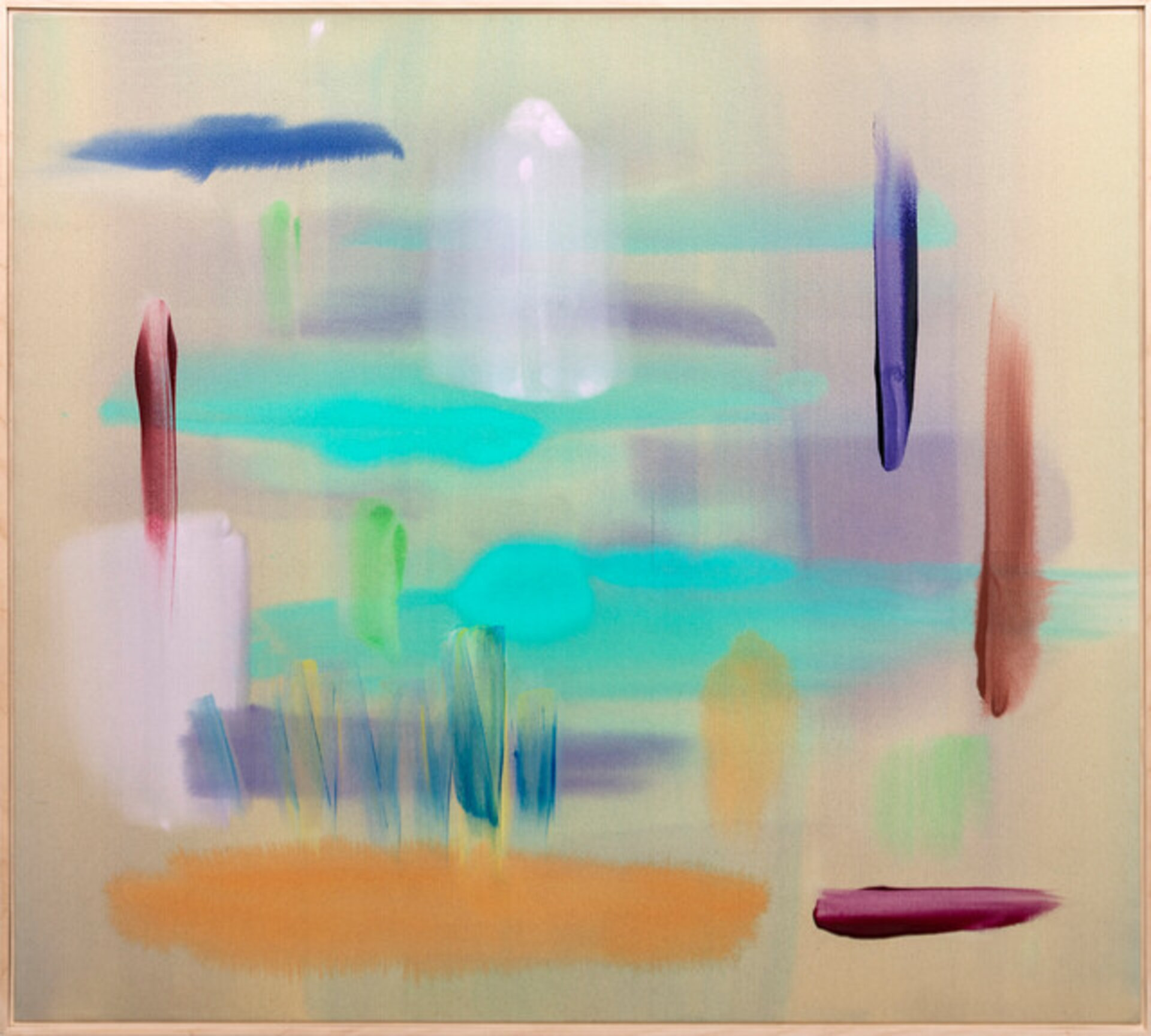
Add Texture to GoogleIn the heart of Prince Edward County, Ontario, the architecture of painting breaks free from the conventions of perspective to explore a fundamental question: how do we construct emptiness? Through November 8, 2026, the group exhibition “Constructing Space,” on view at the Oeno Gallery, brings together works by five leading figures in Canadian abstract art. The issue goes beyond mere aesthetic composition. Here, the canvas is no longer a flat surface intended to receive pigments, but a construction site where color serves as the structural material. David Cantine, Milly Ristvedt, Charles Robb, Otto Rogers, and David Sorensen share the insight that pictorial space is not a preexisting given, but a structure to be built through rhythm, texture, and chromatic vibration.
Color as a Structural Element
For visitors stepping through the doors of the gallery in Bloomfield, the experience begins with a reexamination of depth. Traditionally, art employs perceptual systems—shadows, vanishing points, gradients—to simulate distance on a two-dimensional surface. The thesis advanced by this curatorial project proposes a reversal of this paradigm. For these five painters, abstraction is not an escape from structure, but a direct way of building it. Color is never merely decorative or illustrative; it acts as a pillar, a force capable of generating its own tension and optical relief.
This architectural approach to painting transforms the work into an object of tension. By manipulating planes of color, the artists manage to circumvent the canvas’s natural flatness to create a depth that owes nothing to classical illusionism, but everything to the interplay of hues.
From the Rigor of the System to the Flexibility of the Grid
Among the visual languages presented, that of David Cantine (born in 1939) stands out for its almost obsessive radicalism. For several decades, the artist has followed a rigorous minimalist protocol whose starting point is the observation of two apples and their cast shadows. This original composition has become for him an infinite framework for analysis. By practicing reverse painting on Plexiglas, Cantine uses a calibrated palette of seven colors. This system allows him to study how minute variations in hue radically transform the perception of spatial depth, turning an organic subject into a purely geometric study.
Milly Ristvedt (born in 1942) approaches spatial construction through the grid. However, far from being a straitjacket, this device becomes, in her work, a dynamic and breathing structure. Her works unfold through rhythmic sequences and repeated intervals in which saturated color ultimately erases the rigidity of the initial outline. Space thus becomes an immersive experience where light seems to emanate from the colored planes themselves, creating a sense of volume that extends beyond the physical frame of the work.
Jazz Rhythm and the Prairie Horizon
The work of Charles Robb (1938–2023), son of the renowned modernist painter Jack Bush, brings a temporal dimension to the exhibition. A former professional jazz drummer, Robb transposed the principles of improvisation and musical syncopation onto the canvas. After exploring the hard-edge style in the 1960s, he turned toward gestural and lyrical abstraction. His brushwork carves out space through rhythm, creating compositions where movement seems suspended. The announcement that the gallery will be managing his estate and planning a solo exhibition for 2027 marks a key milestone in the recognition of his contribution to the Canadian art scene.
In contrast to this pulsating energy, the compositions of Otto Rogers (1935–2019) invite silent contemplation. Inspired by the horizontal expanses and unique light of the Canadian Prairies, Rogers creates a space of tension between emptiness and presence. His geometric forms, floating against contrasting chromatic planes, evoke an architecture of the mind, where depth is not a physical measure but a meditative dimension.
Architectural Heritage and Material
David Sorensen’s (1937–2011) approach brings this dialogue between art and architecture full circle. Originally trained in architecture, Sorensen retained from his studies a keen interest in the built environment. His paintings are built up in layers, using large fields of color superimposed in thick, textured layers. Here, the question of space shifts from the visual to the tactile. Depth no longer results solely from a play of colors, but from the very materiality of the surfaces. The canvas becomes a wall of color where the actual relief of the layers of paint interacts with the illusory depth created by the superimposed tones.
Perspectives and the Canadian Abstract Art Market
Beyond aesthetic analysis, this exhibition is part of a broader context of rediscovery of these masters of abstraction in the art market. Although prices for the works currently on view at Oeno Gallery are provided only upon request, past auction results attest to their strong market value. Otto Rogers holds a public record of $19,903, set in 2021 for his painting *Blessed is the Spot*. For their part, Milly Ristvedt and David Sorensen have set respective records of $11,303 and $9,930 at recent auctions.
The event, which is free to the public, is being held at Bloomfield through early November 2026. It offers a rare opportunity to observe how five distinct trajectories converge toward a single certainty: in painting, space is not a receptacle, but an active construction—a language that continues to evolve long after the last stroke of paint has been applied.