Make Texture a preferred source on Google to support us
Add Texture to GoogleJuly 7, 2026 marked a symbolic milestone for the British cultural landscape with the publication of *Made in England: Art and Culture in Changing Times*. Co-published by Comma Press and Arts Council England (ACE), this 222-page volume celebrates the 80th anniversary of the institution responsible for distributing public funding to the arts. Featuring a cover illustrated by Chris Riddell, this hybrid collection blends personal essays, poetry, fiction, and forward-looking analyses. Yet behind the elegance of this paperback edition, priced at £12.99, a historiographical controversy is emerging. Several observers, including cultural historian Robert Hewison, point to a sanitized narrative, describing this publication as an institutional commission that reads more like an annual report than a rigorous historical account. In seeking to celebrate its legacy, the Arts Council appears to have omitted the darkest chapters of its recent history.
A pantheon of contributors for a sanitized account
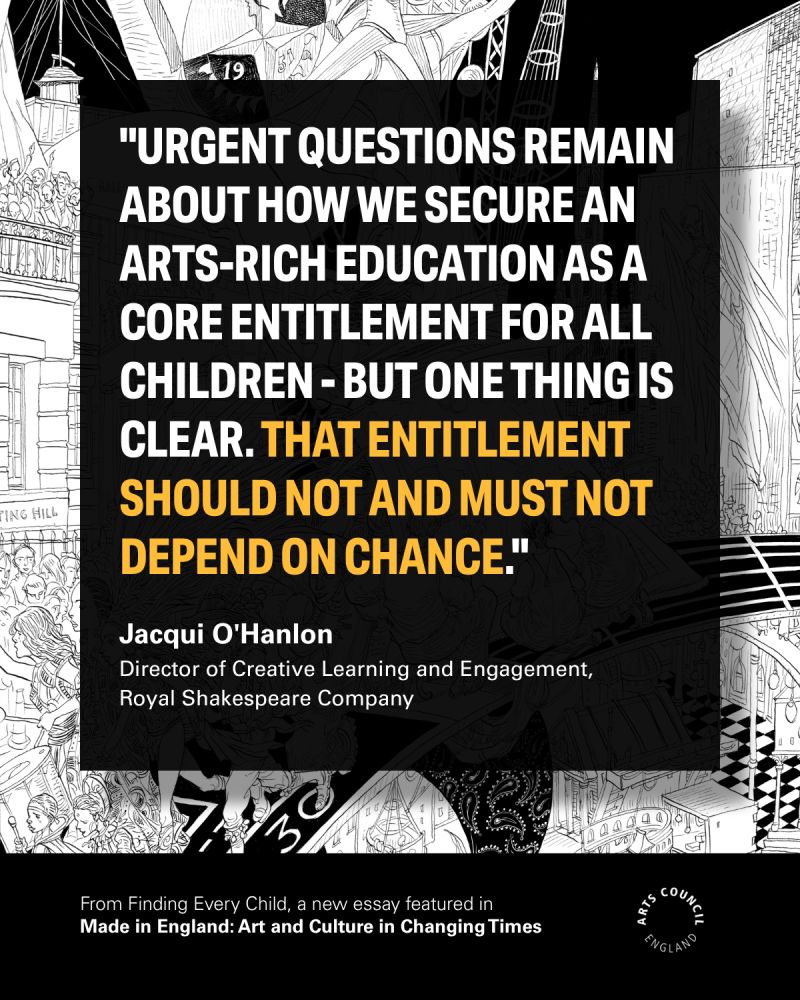
The book’s editors—Sarah Crown, Martin Prendergast, and Sir Nicholas Serota—have assembled a high-profile lineup of contributors. From the introduction written by Serota himself to the contribution by Darren Henley, CEO of the ACE, on the theme of “excellence,” the book draws on major figures from the cultural scene. Among them are choreographer Carlos Acosta, actor David Harewood, artist Lubaina Himid, poet Simon Armitage, and novelist Naomi Alderman. Jacqui O’Hanlon, director of creative learning at the Royal Shakespeare Company, also contributes her expertise to this collection, which comprises sixteen diverse essays.
While the diversity of formats—ranging from fiction to future-oriented essays—allows for a certain creative vitality, the content is considered too consensus-driven. For the project’s critics, this publication caters more to the expectations of cultural administration officials than to the need for understanding among a discerning public or the artistic community. The book is criticized for its tendency to present creativity as a mere civilizing amenity intended to harmonize public life, thereby dismissing the inherently destabilizing or subversive nature of the artistic act.
The Blind Spots of Decentralization and Funding
The history of the ACE dates back to August 9, 1946, when it succeeded the Council for the Encouragement of Music and the Arts (CEMA), which was established during the war at the instigation of John Maynard Keynes. Since the 1994 split, which saw the organization divide into separate entities for England, Scotland, and Wales, the council has managed a colossal amount of funding. Each year, approximately one billion pounds sterling (about 1.19 billion euros) from government grants and National Lottery proceeds is redistributed.
It is precisely the management of this windfall and the evolution of its structures where the book falls short in its official account of history. The book makes no mention of the major crisis of 2002 that led to the dissolution of the Regional Arts Boards (RABs). These regional bodies were absorbed into a central structure, marking a shift toward greater centralization. Another notable omission is the erosion of the principle of “additionality.” Introduced in 1994, this safeguard was intended to ensure that National Lottery funds would supplement the public budget without ever replacing direct allocations from the Treasury. The gradual phasing out of this commitment is not addressed in the pages of *Made in England*.

The Trauma of Austerity and Political Interference
The analysis of the post-2010 period is one of the most glaring omissions pointed out by critics. Under successive Conservative governments, the institution faced unprecedented budgetary austerity. Estimates from industry observers indicate a real reduction in funding of nearly one-third. Added to this is the collapse of local government budgets for culture—a pillar that is nonetheless essential to the artistic ecosystem across the Channel. These financial and social realities are absent from the institution’s retrospective.

Alongside this financial crisis, the ACE has had to navigate turbulent political waters. The book glosses over recent ministerial interference, particularly during the tenure of former Secretary of State for Culture Nadine Dorries. This period was marked by directives mandating forced geographic redistribution, requiring funds to be shifted out of London—sometimes at the expense of the artistic coherence of the projects. This political pressure undermined the council’s historic independence, a crucial factor in understanding the current state of culture in England.
The “Let’s Create” Strategy in the Eye of the Storm
At the heart of the current turmoil lies the ACE’s ten-year strategy, titled “Let’s Create.” This ambitious plan was severely called into question by the independent review led by Baroness Margaret Hodge between late 2025 and early 2026. The Hodge report calls for a complete overhaul of the funding model for National Portfolio Organizations (NPOs), even suggesting the outright replacement of the current strategy. Although the operational abandonment of “Let’s Create” remains a matter of political negotiation and has not yet been formalized by decree, the fact that the 80th-anniversary publication ignores this major strategic crisis raises questions about its relevance as an analytical tool.
Finally, the semantic ambiguity surrounding the term “excellence”—which the institution’s leadership repeatedly emphasizes without providing a precise programmatic definition—seems to mask a difficulty in defining the role of art in contemporary society. The publication coincides with a major transition at the top of the organization: the departure of Sir Nicholas Serota after nine years as president (2017–2026) and the arrival of Dawn Airey in the summer of 2026. This change in leadership comes at a time when the institution appears to be searching for a new lease on life, caught between celebrating past glory and facing the reality of an uncertain financial and strategic future.