
Make Texture a preferred source on Google to support us
Add Texture to GoogleThe whistle of the train marks a sharp break from the frenetic hustle and bustle of the Parisian boulevards. Escaping the capital sometimes requires nothing more than a journey so brief it borders on the anecdotal: barely enough time to watch the landscapes of the outer suburbs flash by before the horizon already opens up to new vistas. It is within this narrow window of time—a brief interlude lasting less than the symbolic threshold of 120 minutes—that an unexpected geographical and sensory shift lies in wait. Troyes then emerges, far from being merely a stopover, as a poetic anomaly. The appeal of immediacy here fulfills a need for escape without the constraints of complex planning. You leave a concrete metropolis to immerse yourself almost instantly in a setting where strict urban geometry seems to have yielded to the fluidity of nature. The appeal of this destination lies in this striking contrast: absolute geographical proximity coupled with a total change of scenery, where the hustle and bustle of the Paris region dissolves into the reflections of ancient architecture.
The illusion of a lagoon in the heart of the countryside
The flattering nickname “Venice” is often used too freely, hastily bestowed upon any small town crossed by a stream. Yet the Champagne version of this lakeside myth follows a visceral logic. In Troyes, water refuses to play the role of a mere peripheral extra or a centralized backdrop: it irrigates the urban fabric from within, fragments it, and imposes its own rhythm upon it. The canals that wind through the city trace an intimate geography, a network of liquid veins around which all urban life has come to be structured.
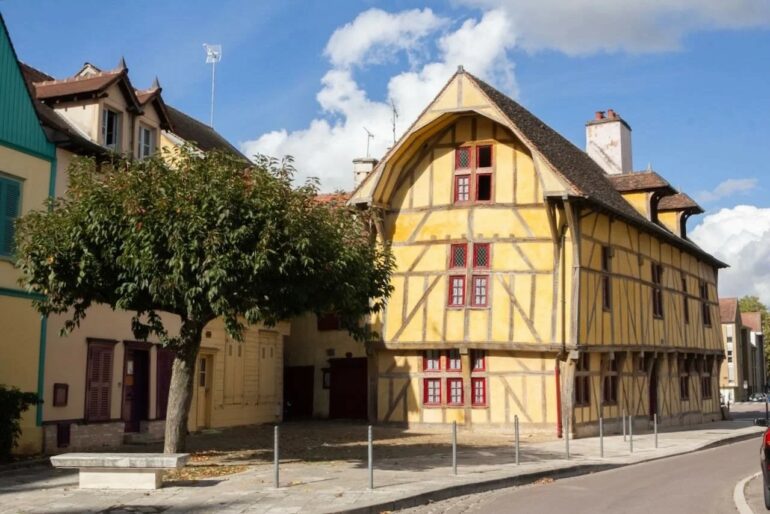
These waterways should be understood not as ornamental mirrors, but as the historical matrix of laborious activity, once harnessed to power the machinery of artisans and dyers. Today, this strictly utilitarian dimension has given way to an aesthetic melancholy. The half-timbered facades, slightly curved by the weight of the decades, lean over the waterways with gentle gravity. The absence of gondolas or marble palaces in no way diminishes the kinship with La Serenissima: the Venetian essence lies elsewhere. It lies in the unique way the light ricochets off the rippling surface to illuminate the corbelled eaves and pointed roofs from a low angle. On misty days, the illusion captivates the imagination. The ambient humidity saturates the colors of the half-timbered buildings, reviving faded hues and creating a scene that shifts with the changing weather.
Wood and Water: A Regional Identity
For the city, asserting its Champagne identity is not limited to being situated in the heart of a prestigious wine-growing region. It is a matter of materials, soil, and light. The region possesses a unique geology—chalky and forested—which is directly reflected in the city’s architecture. The vast surrounding forests provided the massive oak for the roof trusses, erected with a technical virtuosity that still defies gravity. This architecture of joinery and mortise-and-tenon joints creates an aesthetic of resilience. Unlike the blocks of hewn stone on Parisian boulevards, which project a cold, monolithic authority, the intertwining wooden structures of Troyes suggest flexibility—an ability to move with the passage of time, to sag slightly without ever breaking.
The city’s roots are embodied in the very morphology of its streets and in the spirit of preservation that prevails there. Getting lost in this labyrinth is like walking through an open-air textbook on vernacular architecture. The narrow alleys—sometimes so narrow that the opposing roofs seem on the verge of touching in a frozen embrace—force the walker to slow their pace. The eye is constantly drawn to the rough texture of an old beam or the fascinating irregularity of a row of facades.
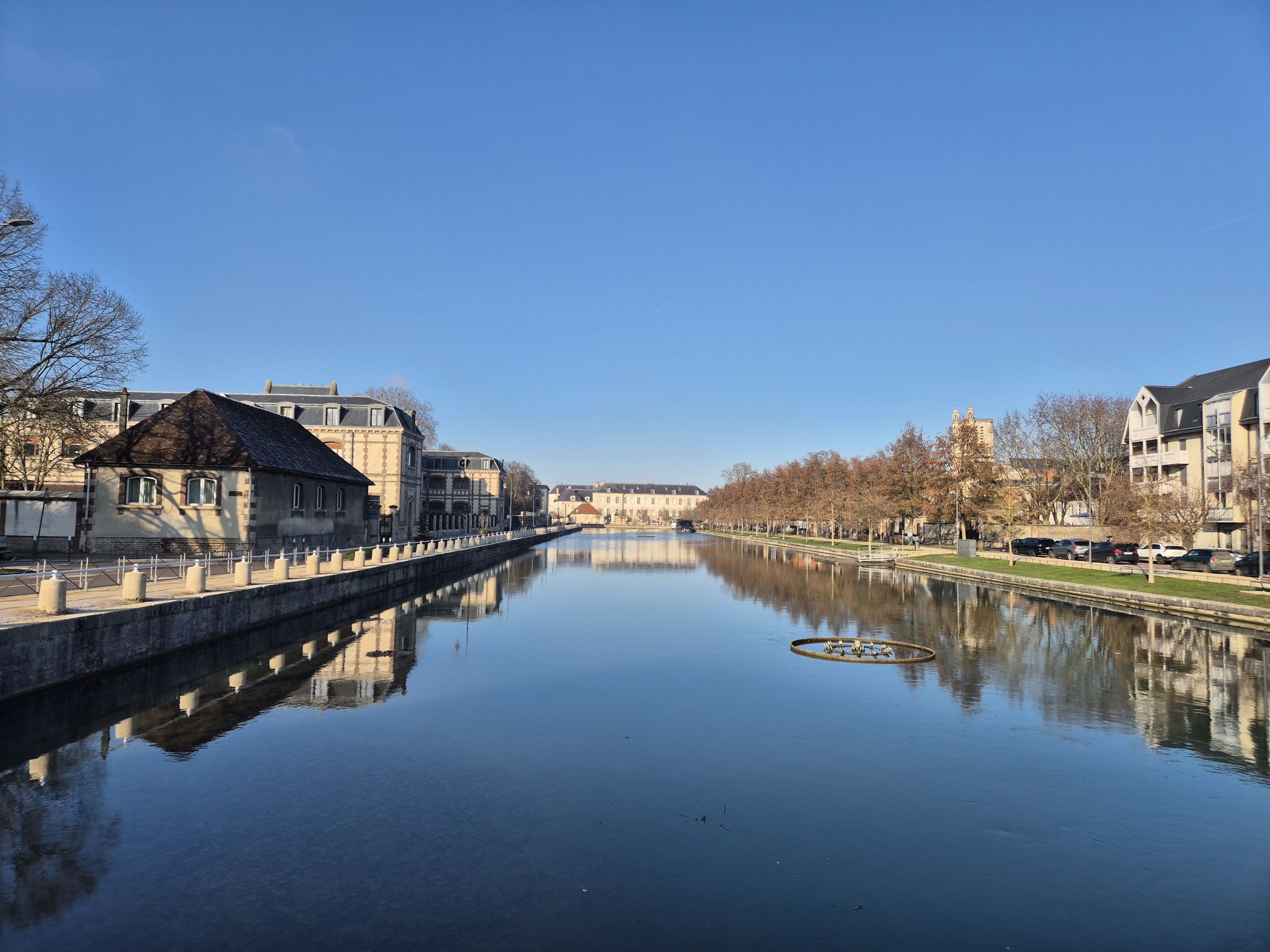
The omnipresence of water dictates the daily rhythm of this stroll. Unlike the Italian lagoon, which opens onto the sea, the waters of Troyes are introspective. It slips discreetly under the stone bridges and laps at the foundations of the patrician mansions. It is water that has become a source of charm, creating a coexistence where stone and wood seem to perpetually breathe. In winter, it gives off a light mist that blurs the outlines of the streets; in summer, it brings a refreshing microclimate that draws visitors to its shaded banks. The city’s fabric responds to this humidity with a play of textures and patinas that the centuries have long shaped.
A suspended sense of time outside the capital
The ultimate privilege of the contemporary traveler no longer lies in the dizzying accumulation of distances, but in the surgical mastery of one’s time. Having a visual and architectural retreat at such a short distance from one’s point of departure radically transforms the approach to travel. The journey becomes a prelude, a gentle transition that spares the visitor the fatigue of long trips, delivering them intact and fully receptive to the vibrancy of the place.
The journey itself contributes to this preparation. Leaving the station means watching the urban fabric of Île-de-France gradually dissolve through the train car windows. Rows of apartment buildings give way to the vast agricultural expanses of the Briard Plateau, then to the first undulations of the Aube plain. This period of visual decompression lasts barely long enough to skim through the morning paper, yet it brings about a decisive mental shift. Upon arrival, the absence of monumental grandeur strikes you immediately. The gaze, accustomed to stumbling upon six-story buildings lined up in perfect rows, suddenly plunges into a network of intimate perspectives, fragmented by the curve of a canal or the projection of a gable.
This spatio-temporal window gives the city a unique character: it is distant enough to ensure that metropolitan concerns are immediately left behind, yet close enough to serve as a spontaneous refuge. Those accustomed to the hustle and bustle of Paris, in search of silence, find an ideal playground here. The experience is rooted in this subtle shift. Observing the play of shadows on a row of crooked houses or listening to the miniature lapping of a canal against its banks takes on a special resonance when one realizes that, just a few hours earlier, one was still walking beneath the muffled rumble of the ring road.
The city imposes its physical scale. You don’t traverse it with the nervous urgency of a surveyor pressed for time; you come to terms with it by accepting its winding topography. This rejection of the straight line, this resistance to distant and receding perspectives, acts as a silent antidote to the standardization of contemporary spaces. Come evening, as one walks back to the station plaza, the echo of footsteps on the damp cobblestones definitively replaces the original bustle. A final glance from the railing of a bridge at the dark reflections on the water is enough to grasp the true extent of this escape: the capital is only a few minutes away by train, but the inner distance gained in these narrow streets is measured in centuries.