Make Texture a preferred source on Google to support us
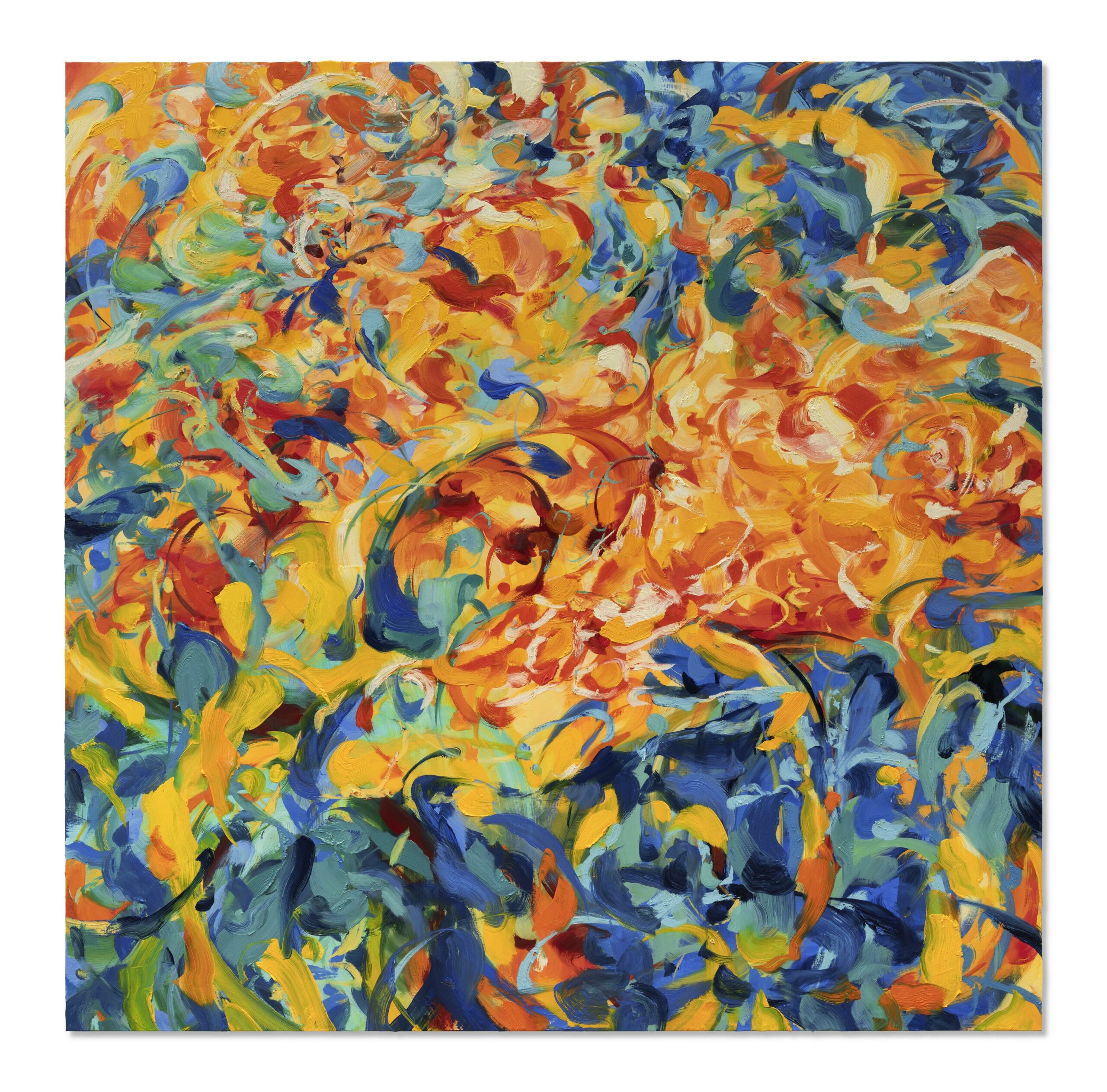
Add Texture to GoogleThe adrenaline took a while to kick in. It wasn’t until the very last lot of the auction was sold—on November 19, 2026, under Christie’s hammer in New York—that a real electric tension filled the room. *One Fell Swoop*, an abstract painting by South Korean artist Julia Jo, born in 1991, suddenly sparked a flurry of bidding and sold for $409,000. This final surge, which set an all-time record for the young artist, served as a revelation. It highlighted the strange atmosphere of an evening dedicated to 21st-century art, where buyers traded speculative frenzy for cold, calculated investment.
On paper, the financial results are remarkably strong. The auction house closed the session with a total of $145.86 million, an 18% jump from the previous year. You have to go back to 2021 to find such a high level of performance in this category. The sell-through rate stood at a reassuring 91%, once the five withdrawn lots and two last-minute withdrawals were factored out. Yet behind these robust statistics—which include buyer’s premiums, contrary to initial estimates—the market sent a very different message. The days of blind bidding driven solely by the prestige of a signature are over.
The Renaissance According to Basquiat: A Triumph Without Euphoria
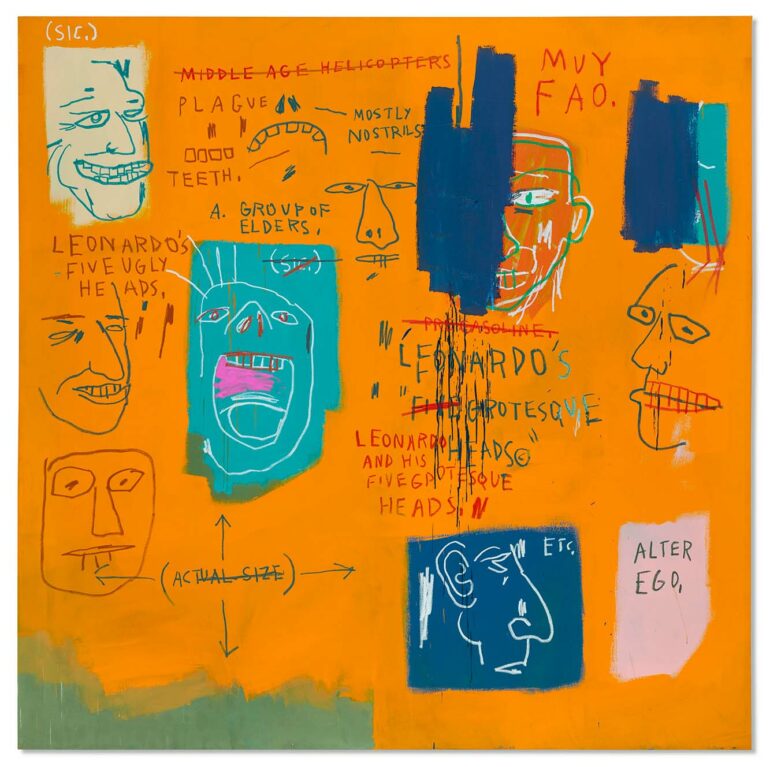
The case of the evening’s star lot perfectly illustrates this paradigm shift. Christie’s had placed immense hopes in a monumental canvas by Jean-Michel Basquiat, *Untitled (Leonardo and His Five Grotesque Heads)*. Painted in 1983, this square piece—measuring over two meters on each side—stages a head-on collision between the Italian Renaissance and the raw energy of 1980s New York. In it, Brooklyn’s enfant terrible reimagines five grotesque faces sketched five centuries earlier by Leonardo da Vinci, drowning them in bold swaths of color and his signature textual vocabulary.
The painting lived up to its reputation as a financial powerhouse, selling for $32.88 million. A colossal sum, which validates the work’s trajectory since its last public appearance in London in 2005, where it was acquired for the equivalent of $1.3 million. However, the final hammer price fell just short of its low estimate of $30 million, excluding fees. The painting served as the tipping point for the auction’s overall sales figures, yet it never sparked the bidding war that its pedigree might have led one to expect. Basquiat’s name guarantees that values will hold steady, but it is no longer enough to generate the same frenzy.
The Relentless Judgment of Historical Provenance
This new rationality was particularly evident during the auction of historic collections. The auction opened with a group of twenty works from the collection of Antonio Homem Sonnabend. Through him, the watchful shadow of his adoptive mother, the legendary gallerist Ileana Sonnabend, and her partner Leo Castelli loomed over the room. These two figures shaped the postwar American art market, dictating the taste of an entire era. The twenty-odd lots generated $41.9 million, settling just above the low end of the estimates.
A detailed analysis of these sales reveals a discerning public, separating the wheat from the chaff even among the legends of Pop Art. An Andy Warhol can, *Campbell’s Soup Can (Turkey Noodle)*, far exceeded expectations by crossing the $9.03 million mark, shattering its high estimate of $8 million. The market rewarded the visual immediacy of this piece. The verdict was significantly harsher for Roy Lichtenstein. His painting *Large Spool* sold for $8.6 million, falling short of its low estimate of $10 million. As for Jasper Johns, his work *Numbers* barely met the minimum threshold, selling for $3.2 million.
Philanthropy Put to the Test
The contrast continued in the section dedicated to Agnes Gund. Former president of the Museum of Modern Art in New York and a steadfast patron of contemporary art, she was selling ten works, the proceeds of which will go directly to the Gund Art Foundation. This block raised $25.7 million. While the nobility of the cause was appealing, buyers focused on rarity and technical excellence rather than the collector’s reputation.

The surprise came from Chicago, courtesy of Jim Nutt. The painter, a central figure in the Imagist movement, saw his 1999 painting *Loom* fetch $1.1 million—an all-time high for him at auction. Vija Celmins’s obsessive body of work also captured the spotlight. Her 1990 frontal seascape, *Untitled (Ocean)*, fetched $7.1 million, coming close to the artist’s record set in 2021. A little later, another of her paintings, *Night Sky #21*, marked the first time a piece from this series had appeared on the secondary market and sold for a solid $4.51 million.
A Selection Without a Safety Net
In this climate of extreme selectivity, the slightest weakness perceived by dealers resulted in immediate punishment. The market made no concessions, not even to the giants of contemporary art. An abstract painting by Gerhard Richter—despite its prestigious provenance directly from the collection of Marian Goodman, a friend and longtime dealer of the German painter—faced an icy silence in the auction room and went unsold. The same fate befell Yayoi Kusama: her 2014 sculpture *Starry Pumpkin* was simply passed over. The sheer volume of the Japanese artist’s output is clearly beginning to prompt buyers to exercise caution.
When the works offered something fresh, buyers’ checkbooks opened once again. George Condo’s *Double Heads on Blue and Silver*—a face with dislocated features, appearing at auction for the first time—found a buyer at $3 million. The Lalanne couple saw their *Poisson Paysage V* sell for $3.3 million, confirming the unshakable status of French sculptural design, while painter Antonio Santín set a new personal record.
As they left the auction room, art professionals seemed to agree on the takeaway from this New York evening. Suzanne Modica, head of Modica Carr Art Advisory, observed clients who were extremely selective in their choices, refusing to get swept up in the frenzy of the bidding wars. Alex Glauber, a representative of the Association of Professional Art Advisors, summed up the auction as a lackluster session but one skillfully managed by Christie’s specialists. The money is there, and the sales volume is reassuring, but 21st-century collectors now demand a perfect balance. The mere combination of a big name and prestigious provenance no longer guarantees success; the work must now possess the formal merit capable of justifying millions of dollars in a market that has regained its full clarity.