
Make Texture a preferred source on Google to support us
Add Texture to GoogleDigitizing the Precious: When the Cellar Becomes Precise Data
The ritual remains unchanged. There’s the descent down the stairs, the chill that grips your shoulders, and that distinctive scent of damp stone and cork. For decades, managing a wine collection was akin to divination—or, at best, tedious bookkeeping in large leather-bound ledgers whose ink eventually faded. But in the most prestigious cellars, yellowed paper is now giving way to the glow of screens. The bottle—the quintessential physical and sensory object—is now accompanied by an ultra-precise digital avatar.
The challenge is no longer simply knowing what one owns, but understanding how each bottle evolves in the solitude of its rack. Tools like CellarTracker and InVintory have transformed what was once a simple inventory list into a platform for analyzing and managing a collection. This technological shift is radically altering the balance of power between the collector and their stock, transforming the discerning enthusiast into a precision manager.
Wisdom of the Crowd at the Service of Grand Crus
The first major upheaval brought about by digitization lies in access to a shared knowledge base that extends far beyond the realm of professional critics. Within this data architecture, a service like CellarTracker has established itself not through its aesthetics, but through the size and engagement of its community. It is no longer just a handful of experts who call the shots on a vintage, but millions of tasting notes written by collectors from around the world.
This accumulation of feedback helps answer the most crucial question for any owner of wines meant for aging: when to open them? The app compiles these reviews to plot a dynamic maturity curve. If dozens of tasters report that a 2005 Lynch-Bages is beginning to close up or, conversely, is entering its peak phase, the information appears in real time on the owner’s dashboard. This moves us from the realm of conjecture to that of statistics applied to taste.
The system is based on rigorous indexing. Each bottle is assigned a unique barcode, enabling full traceability within the cellar. A simple scan when a case arrives integrates the bottle into the digital ecosystem. This precision helps avoid the classic collector’s pitfall: forgetfulness. The bottle lost at the back of a shelf, rediscovered ten years too late when its flavor has faded, becomes a relic of the past.
Precise mapping or the aesthetics of organization
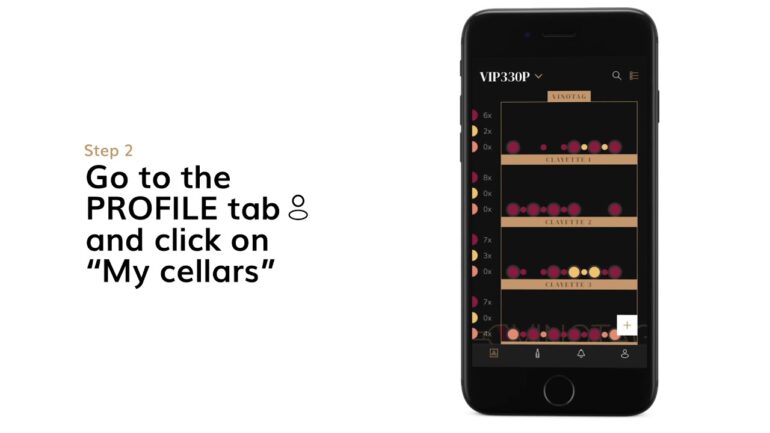
While raw data is the strong suit of the industry’s pioneers, new players like InVintory have chosen to approach the wine cellar from the perspective of spatial visualization. For someone who owns several thousand bottles spread across different locations, the problem is no longer just knowing what they have, but knowing where it is. The VinLocate feature offers a three-dimensional model of the storage space.
The collector navigates through a virtual replica of their own wine racks. A bottle of Romanée-Conti or a vintage Krug lights up on the screen, indicating precisely the shelf and row. This approach reduces unnecessary handling, which can often compromise the wine’s stability. You no longer rummage in the dark; you pinpoint your target. This pursuit of efficiency is complemented by an interface designed for visual comfort, where labels are carefully digitized, restoring the aesthetic appeal to the inventory.
This space management extends to multi-site collections. A collector can thus monitor—from their phone—the bottles stored at their second home, at a professional wine storage facility, or in their main cellar. The technology bridges geographic distances to provide a consolidated view of an overall investment.
Wine as a Financial Asset Under Surveillance
Beyond the pleasure of tasting, the modern wine cellar is increasingly viewed as a distinct asset class in its own right. Digital tools now integrate data feeds from major marketplaces. By linking inventory to prices from the Wine Market Journal or other auction aggregators, these platforms enable real-time assessment of a collection’s market value.

Owners can thus see the value of their liquid assets fluctuate according to market trends. This financial transparency is changing buying and reselling behaviors. Knowing that a lot of Bordeaux cases has appreciated by 20% over two years enables owners to make informed decisions: whether to hold onto the wine for future tasting or to sell it to finance new acquisitions. The emotional aspect of the wine cellar is complemented by rigorous portfolio management, where every addition and disposal is documented, valued, and analyzed.
Some services go a step further by offering integrated concierge services. For the largest collections, experts can visit in person to conduct the initial inventory, label the bottles, and set up the system. The end user need only enjoy the seamless interface, delegating tedious data entry to professionals. We are entering an era of luxury management where technology takes a back seat to service.
A New Paradigm for the Collector
This digital transition is transforming the very psychology of the collector. Collecting used to involve hoarding physical objects in relative secrecy. Today, collections are shared, compared, and displayed digitally. Wish lists are becoming strategic tools for wine merchants and brokers, who—with the customer’s consent—can anticipate their needs.
The app has become a mobile notebook. While dining at a restaurant, snapping a photo of a label triggers its immediate addition to a search list or personal inventory. There is complete fluidity between the moment of discovery and cellar management. This responsiveness is changing the way cellars are built—in a more organic and less planned manner than before.
Yet, despite this abundance of technology, the essence remains the same. The software does not replace the nose or the palate. It simply serves as a safeguard against the chaos that an overflowing passion can create. By streamlining storage and providing visibility into the wines’ maturation, these apps paradoxically ensure that each bottle will be enjoyed at the moment when it has the most to offer. Digital technology serves the ephemeral: the moment the cork pops and the wine finally leaves the screen to find its way into the glass.
The evolution of these platforms toward ever-greater integration—including real-time temperature and humidity readings via connected sensors—seems to be the next natural step. The wine cellar is no longer a windowless room; it is a living organism, scrutinized and optimized, where every cubic millimeter of silence and darkness is now under algorithmic control.