
Make Texture a preferred source on Google to support us
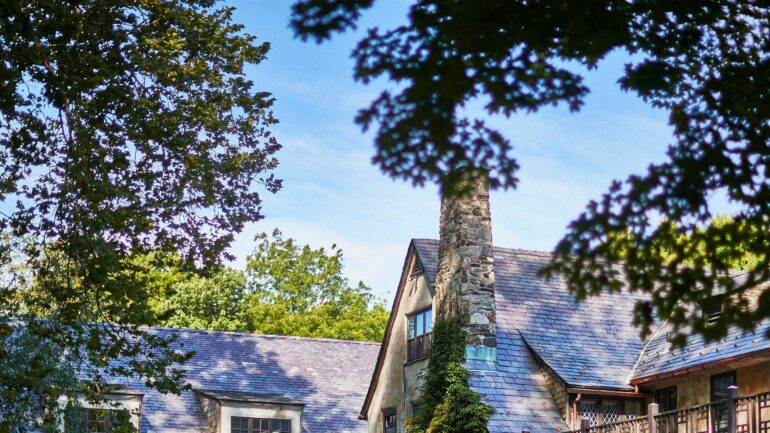
Add Texture to GoogleTwo hours away from the pulse of Manhattan, where the meandering Webutuck River traces the contours of a slower-paced landscape, the Troutbeck estate commands a unique presence. This is not one of those rural retreats born of a passing trend, but a property whose roots stretch back to the 18th century. This 250-acre estate, located in Dutchess County, echoes with the conversations that shaped American history, having once hosted figures of the stature of Theodore Roosevelt and Thurgood Marshall. While the current stone mansion, built in 1919, has remained the centerpiece of the property since its reopening in 2018, a new milestone was reached this summer. Four riverside cottages, tucked away on a wooded hillside, redefine the experience of staying in the heart of nature, far from the hustle and bustle of shared spaces, without severing the invisible thread that connects them to the soul of the place.
An immersion shaped by the topography
The placement of these new structures is not a matter of chance, but the result of a careful analysis of the terrain. The architectural firm Stonehill Taylor, whose expertise has already been showcased at the Crosby Street Hotel in New York and Ned’s Club in Washington, D.C., approached this project with almost surgical precision. Before laying a single stone, an in-depth study of the tree canopy was conducted to preserve the integrity of the existing trees. The cottages are thus nestled along the hillside, overlooking the winding waters of the river, as if they had always been part of the woodland.
Landscape architect Reed Hilderbrand orchestrated this transition between the built environment and the wilderness by recreating an ecosystem of native plants, shrubs, and wildflowers. To access the site, guests pass through a new entrance pavilion that opens onto a network of restored walking trails. This approach, which Neill Parker, director of Stonehill Taylor, describes as an effort to expand the relationship between the built environment and nature, focuses on total geographical immersion. The architecture recedes to make way for the landscape, ensuring a sense of privacy that only a dense forest can offer.
The Art of the Inhabited Home
Inside, the contrast is striking. One leaves the apparent ruggedness of the forest behind to find the hushed atmosphere of a grand English country house, subtly transposed to New York State. Champalimaud Design prioritized a curated aesthetic, carefully avoiding standardized furniture in favor of pieces that seem to have stood the test of time. Antique blanket chests serve as coffee tables, while fireplaces clad in tiled glass bring a homey warmth to the living rooms.

The attention to detail in the textiles underscores this pursuit of absolute comfort. The canopy beds are draped in Frette linens, while tall windows, framed by curtains made from Holland & Sherry fabrics, offer views to the west over the vast expanse of the estate. The color palette, composed of warm, neutral tones, serves as a backdrop for original works of art by Kiva Motnyk, the founder of Thompson Street Studio. This blend of textures and origins reinforces the idea of a place that is not just a hotel, but a home to be passed down through generations.
Toward a reimagined approach to group hospitality
These cottages aren’t just about aesthetics; they’re designed to adapt to new ways of traveling. Capable of accommodating up to twelve adults when booked together, they offer an ideal solution for multigenerational getaways or group bookings—a rapidly growing trend in the luxury sector. This setup allows guests to enjoy the privacy of a private villa while having immediate access to the amenities of a world-class hotel.
For beyond the walls of the cottages, Troutbeck offers a range of activities that celebrate the Hudson Valley’s art of living. From its acclaimed gourmet dining to the wellness facilities known as The Barns, the estate strikes a balance between activity and relaxation. Tennis courts, the swimming pool, and fly-fishing sessions round out the sports offerings, while a robust cultural calendar serves as a reminder that the intellect has always had a place here. In this estate where time seems to have stood still, allowing for deeper reflection, these new structures prove that Troutbeck continues to write its history, one page at a time, balancing respect for the past with architectural boldness.