Make Texture a preferred source on Google to support us
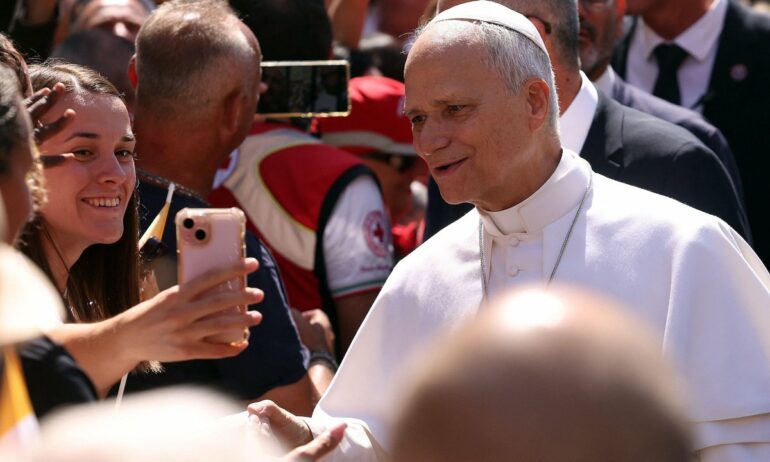
Add Texture to GoogleOn October 2, 2026, amid the gilded splendor of the Consistory Hall in the Apostolic Palace, Pope Leo XIV drew a symbolic red line in the digital sand of our time. Before an assembly of artists and curators gathered for the event “The Art of Possibility: Weaving Together,” the pontiff contrasted the “spark of humanity” with the coldness of statistical calculation. For the first American pope in history, elected in May 2025, this is not merely an aesthetic dispute, but an “ontological difference.” This stance, rooted in a desire to safeguard humanity in the face of algorithms, found an unexpected echo in an open letter addressed directly to the successor of Peter in late October 2026.
The Doctrine of Leo XIV: The Instrument Versus the Person
Since his election, Robert Francis Prevost—now Léon XIV—has made the moral regulation of artificial intelligence one of the pillars of his magisterium. His first encyclical, *Magnifica Humanitas* (“On the Protection of the Human Person in the Age of Artificial Intelligence”), published in May 2026, had already laid the groundwork for a doctrinal wariness. For the Holy See, AI systems are merely instruments and cannot under any circumstances claim legal personality or autonomous creative capacity.
This view crystallized during his recent addresses to the Pontifical Academy for Life. There, the pope insisted that machines are not persons. By calling for a renewal of the alliance between the Church and cultural institutions to protect the uniqueness of human creation, Leo XIV sparked a profound debate on the very nature of art in the age of algorithmic generation. It is against this backdrop of intellectual tension that Sarp Kerem Yavuz, a renowned visual artist and researcher, chose to respond to the pontiff.
An Outstretched Hand Between Chicago and the Vatican
Sarp Kerem Yavuz, who heads the Contemporary Istanbul Foundation, is no stranger to technology think tanks. His advocacy for AI-generated art is rooted, first and foremost, in a biographical connection. A native of Chicago, just like Leo XIV, Yavuz uses this connection to the American Midwest—where he studied in Ohio and the Windy City—to establish a dialogue of mutual understanding with the pontiff. His central argument is simple: the dichotomy established by the Vatican between the human artist and the machine is a figment of the imagination.
For Yavuz, artificial intelligence is not a competing entity, but the logical continuation of the tools humanity has always invented to transcend its condition. He rejects the idea that the use of AI would strip the work of its intentionality or the effort required for its creation. The artist draws an analogy with the history of photography: while a camera may produce mediocre shots in automatic mode, it becomes a tool of genius in the hands of a creator who masters its nuances. AI, he argues, demands the same rigor, the same determination, and, ultimately, the same measure of humanity as any other medium.
From Sol LeWitt to Algorithms: The Legacy of the Concept
The artist’s argument draws on a reinterpretation of modern and contemporary art to demonstrate that the notion of an “instruction” or “prompt” is nothing new. Yavuz points out that major figures such as Sol LeWitt and Yoko Ono based part of their work on conceptual instructions or protocols delegated to others, without anyone ever questioning the presence of a soul in their work. Similarly, the incorporation of chance—so dear to John Cage—finds a natural extension today in the stochastic iterations of language models.
More radically, Yavuz highlights how artists have always known how to repurpose potentially oppressive technologies into objects of beauty or reflection. He cites, in particular, Richard Mosse’s use of military infrared film and Jon Rafman’s exploration of global surveillance via Google Street View. From this perspective, AI is simply a new territory for the human mind to explore—a tool of resistance rather than an instrument of erasure.

The Challenge of the Artist-in-Residence Program
Rather than remaining stuck in a theoretical debate, Sarp Kerem Yavuz submits a concrete proposal to the Vatican to break the deadlock. He suggests creating an artist residency within the Vatican City itself, specifically dedicated to artists working with artificial intelligence. This initiative, he argues, would allow doctrine to be tested against the actual practice of digital creation and would put the validity of the “human spark” to the test in works co-generated by computation and intuition.
However, the path toward such a reconciliation remains fraught with technical and legal obstacles. While the Vatican emphasizes the protection of the individual, the art market, for its part, questions the longevity of AI-generated works. Recent debates surrounding “attribution decay”—a concept explored by MIT researchers in August 2026—show that the question of authorship remains contentious. Whether or not a model retains traces of its initial training after several iterations radically alters the perception of the final work.
For now, the impact of the Pope’s intervention on the AI-related art market remains an uncertain factor. While Leo XIV continues to reject any form of legal personhood for machines, Yavuz’s invitation to a dialogue effectively marks a crucial step in the recognition of these new practices. The debate is no longer merely about whether a machine can create, but whether the Church—guardian of centuries of artistic heritage—will one day agree to include statistical calculation in its definition of the sacred.