Make Texture a preferred source on Google to support us
Add Texture to GoogleIn the exclusive world of fine collectibles, the appearance of a previously unseen Fabergé object on the public market is akin to an earthquake. On December 16, 2026, Sotheby’s will auction in New York a treasure that, despite its Lilliputian dimensions, is already capturing the attention of international collectors: a miniature sedan chair made of gold and translucent enamel. This masterpiece of whimsy, preserved for decades in the storerooms of the prestigious A La Vieille Russie gallery, is set to enter an auction house for the first time with an estimate exceeding one million dollars.
The Art of the Superfluous and the Absolute
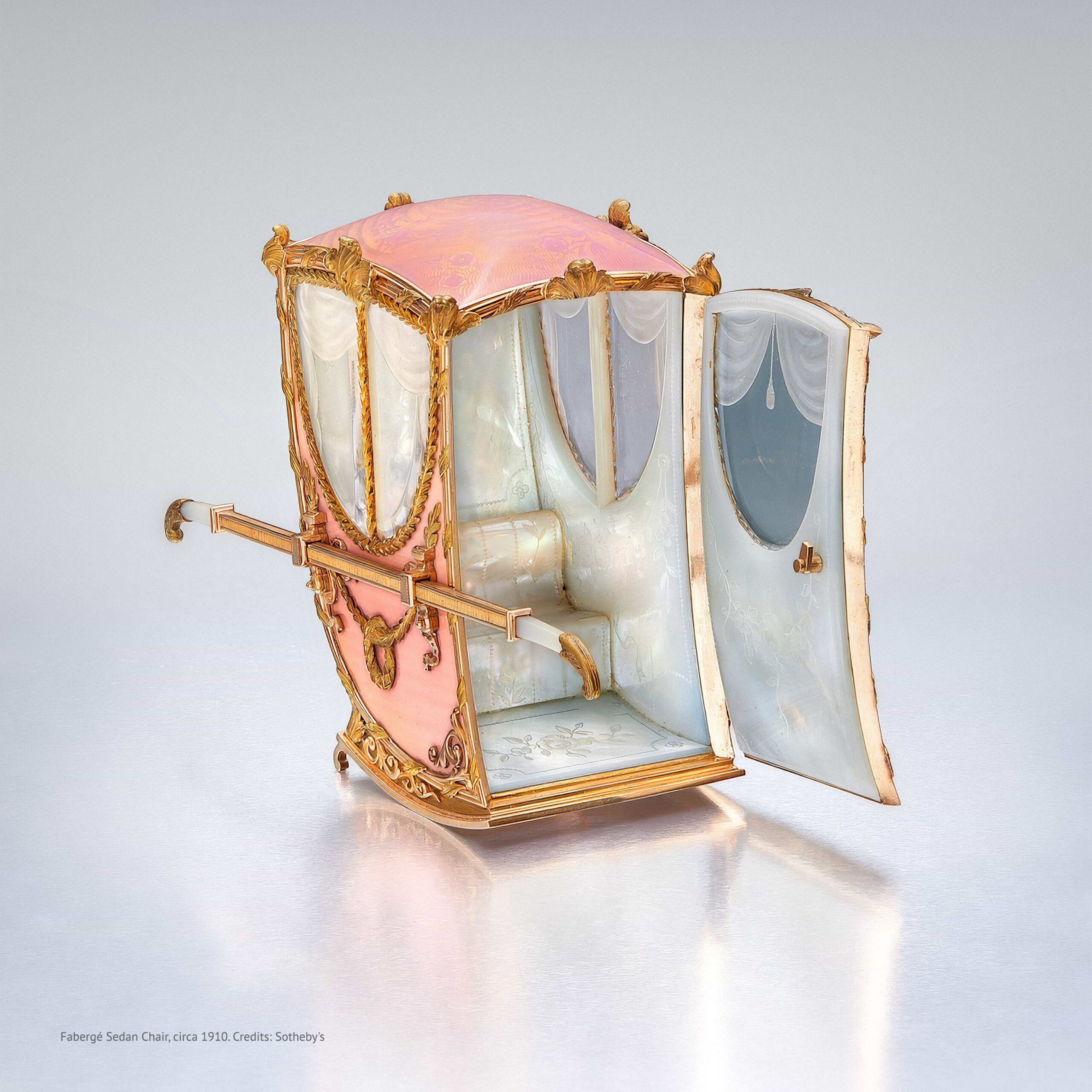
Standing just 7.62 centimeters tall, this piece embodies the pinnacle of craftsmanship from the St. Petersburg workshop around 1910. Crafted under the direction of Henrik Wigström, the last of the great master craftsmen at the House of Fabergé, it reinterprets the Louis XV aesthetic with the neoclassical rigor characteristic of the Russian imperial court’s taste. The structure is a technical tour de force: it uses chiseled gold in three colors—yellow, red, and green—to create subtle chromatic contrasts that highlight the object’s curves.
The body of the chair is adorned with translucent pink enamel, applied over a guilloché gold background featuring an exquisitely delicate moiré and floral pattern. The attention to detail borders on obsession: the windows are carved from engraved rock crystal, while the interior reveals a lining of engraved mother-of-pearl, imitating with uncanny precision the silks and upholstery of period palanquins. This type of model, classified as a “fantasy object,” serves no practical purpose; it exists solely for the pleasure of contemplation and as a demonstration of unparalleled technical virtuosity.
Rothschild provenance and certified rarity
The history of this miniature is inextricably linked to the European financial elite of the early 20th century. In 1910, the British banker Leopold de Rothschild acquired it for 146 pounds sterling—a luxurious indulgence at the time—to give as a birthday gift to his brother Alfred. This aristocratic pedigree underscores the piece’s exceptional nature, especially since the model itself is extremely rare. Sotheby’s lists only six known examples of miniature sedan chairs signed by Fabergé worldwide, although some broader estimates suggest the existence of fewer than ten such pieces.
The sale of this lot comes at a significant time for the A La Vieille Russie gallery. Founded in Kyiv in 1851 and based in New York, this institution is celebrating its 175th anniversary with a strategic reorientation. By shifting its focus to antique and collectible jewelry, the gallery has chosen to part with a substantial portion of its decorative art treasures. The auction, titled “From the Vaults of A La Vieille Russie,” thus presents a historic opportunity to see pieces resurface that have remained hidden from public view since their creation or initial acquisition.
The Russian Art Market Aims for Records
While the official auction catalog lists an estimate available upon request, preliminary estimates provided by experts place the value of the sedan chair at over one million dollars (approximately 920,000 euros). This projection is based on solid precedents: in November 2017, a comparable piece by master craftsman Michael Perchin sold for over one million dollars at Christie’s in London. Another piece, combining jadeite and pearls, also reached record heights in the United Kingdom with a hammer price nearing $600,000.
Interest in Imperial Russian silverware shows no signs of waning, driven by recent spectacular results such as that of the 1913 Imperial Winter Egg, which sold on December 2, 2025, for over $30 million. The sale of the “A La Vieille Russie” collection, estimated at a total of over $15 million, includes more than 300 lots, ranging from porcelain to icons, paintings, and gold boxes. Before the final auction in New York, the most iconic pieces will be featured in a traveling exhibition that will stop in Paris, Geneva, and London, offering this little treasure of the Belle Époque one last tour of Europe before it returns—perhaps for another century—to the privacy of a private collection.