
Make Texture a preferred source on Google to support us
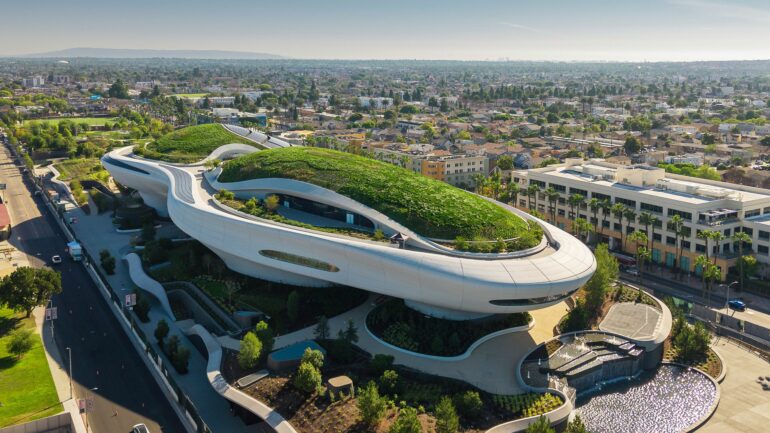
Add Texture to GoogleThe skyline of South Los Angeles has just been enriched by a unique landmark. In Exposition Park, the Lucas Museum of Narrative Art (LMNA) will open its doors on September 22, 2026, following a long administrative journey that began more than a decade ago. This colossal project, spearheaded by filmmaker George Lucas and his wife Mellody Hobson, is envisioned as a sanctuary dedicated to narrative art in all its forms—from traditional illustration to cinema—nestled within an architectural setting that looks as though it came straight out of a science-fiction film.
An architectural masterpiece blending fluidity and grandeur
Designed by architect Ma Yansong of MAD Architects, the building unfolds its organic curves across an area of approximately 28,000 square meters. Clad in white polymer panels (FRP), this architectural structure evokes a spaceship delicately set down on a new urban landscape. The fluid and slender design is striking for its ability to naturally guide visitors through its various levels, centered around a monumental atrium topped by an oculus.
The building is more than just its futuristic shell. It is integrated into a campus spanning over 4 hectares, designed by landscape architect Mia Lehrer of Studio-MLA, creating a breath of greenery in a densely populated neighborhood. Inside, the approximately 9,300 square meters of galleries are complemented by two movie theaters, a freely accessible research library, a café, and a gift shop. The cost of this structure, funded entirely by private donations, is estimated at approximately $1 billion (about 900 million euros based on September 2026 exchange rates), a massive investment that reflects the founders’ ambition following successive failures to establish a presence in San Francisco in 2014 and Chicago in 2016.
Narrative as the Central Theme
The concept of a “museum of narrative art” may seem vague. At its opening, the LMNA aims to shed light on the concept by exhibiting approximately 1,300 pieces from the vast collection of 40,000 works amassed by George Lucas over the decades. The reception is spectacular, to say the least: a life-size Naboo N-1 Starfighter hangs in the main hall. This display, while impressive, proves almost misleading. It suggests a temple dedicated to the Star Wars saga, whereas the franchise’s universe actually occupies only 7% of the total exhibition space.
The collection is a vast inventory of ways to tell a story through images. It features masters of American illustration such as Norman Rockwell, N.C. Wyeth, and Maxfield Parrish, whose figurative paintings form the historical heart of the collection. The exhibition then broadens to include comic strips, manga, and comic books, featuring original artwork by Jack Kirby and Frank Frazetta, as well as excerpts from *Peanuts* and *Garfield*.
An artistic syncretism that can sometimes be disorienting
The museum’s strength lies in its commitment to breaking down the hierarchies between high art and popular art. Visitors thus move from a self-portrait by Frida Kahlo to works by Diego Rivera, Judy Baca, and Robert Colescott. Unprecedented installations by Banksy sit alongside major pieces from the history of cinema, such as the original costumes of Darth Vader and Princess Leia, as well as elements from Batman, The Wizard of Oz, and Close Encounters of the Third Kind.
However, this diversity sometimes borders on excessive eclecticism. While the building’s open layout makes for a pleasant stroll, the grouping of such disparate works leaves an impression of incoherence at times. The exhibition design, described as bizarre by some observers, attempts to create thematic bridges between objects that, at first glance, have little in common. The contrast between the high-tech design of the building, designed by Ma Yansong, and the sometimes uneven quality of the collection on display raises questions about the institution’s long-term artistic direction.
A New Cultural Hub for South Los Angeles
Beyond criticism of the galleries’ content, the Lucas Museum of Narrative Art stands out as a premier cultural institution for the city. By choosing Exposition Park, across from the University of Southern California, George Lucas and Mellody Hobson are anchoring their project in a rapidly changing neighborhood. Free access to the research library and the programming of the two movie theaters suggest a commitment to engaging with the local community, going beyond the mere display of collectible objects.
The museum now begins its public life with a major challenge: transforming a personal collection, born of a passion for popular imagery and cinema, into an institution capable of engaging with the history of global art. The structure is there, impressive and technically flawless; it remains to be seen how future programming will shape this visual narrative to avoid coming across as merely an inventory and to refine its unique identity.