
Make Texture a preferred source on Google to support us
Add Texture to GoogleThe most significant change to the Breguet Marine Chronograph 5527 is not found on the case, in the movement, or even in the choice of metals. It lies in a space that has been left empty. By removing the 12-hour counter, Breguet has streamlined the face of its marine chronograph and given it a sense of breathing room that the previous tricompax versions did not always have. The watch remains imposing, technically sophisticated, and deliberately showy in its execution; its dial, however, suddenly gains a welcome clarity.
The Bicompax as an Exercise in Clarity
The Marine Chronograph 5527 already existed in numerous variations of cases and dials. The arrival of six bicompax variants now brings the entire family to over twenty references. This proliferation could have diluted the model’s identity. On the contrary, it highlights a very precise aesthetic revision: the movement remains the same, but the organization of the information takes on a new character.
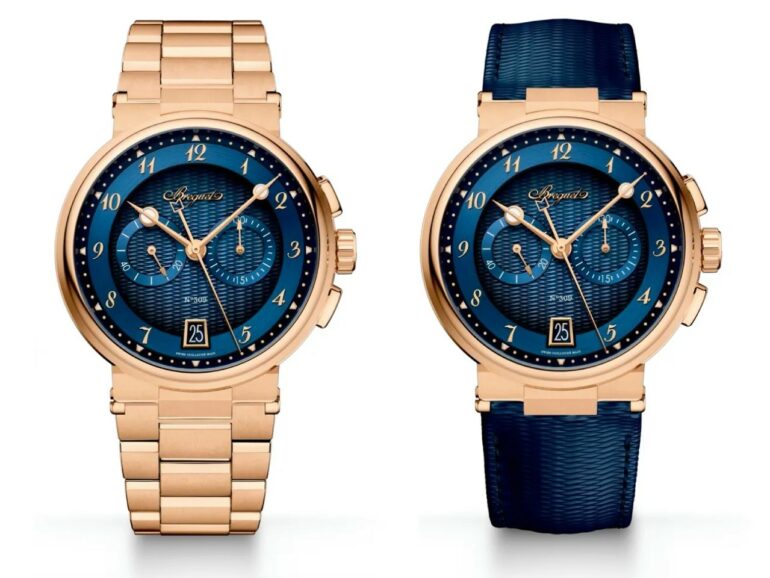
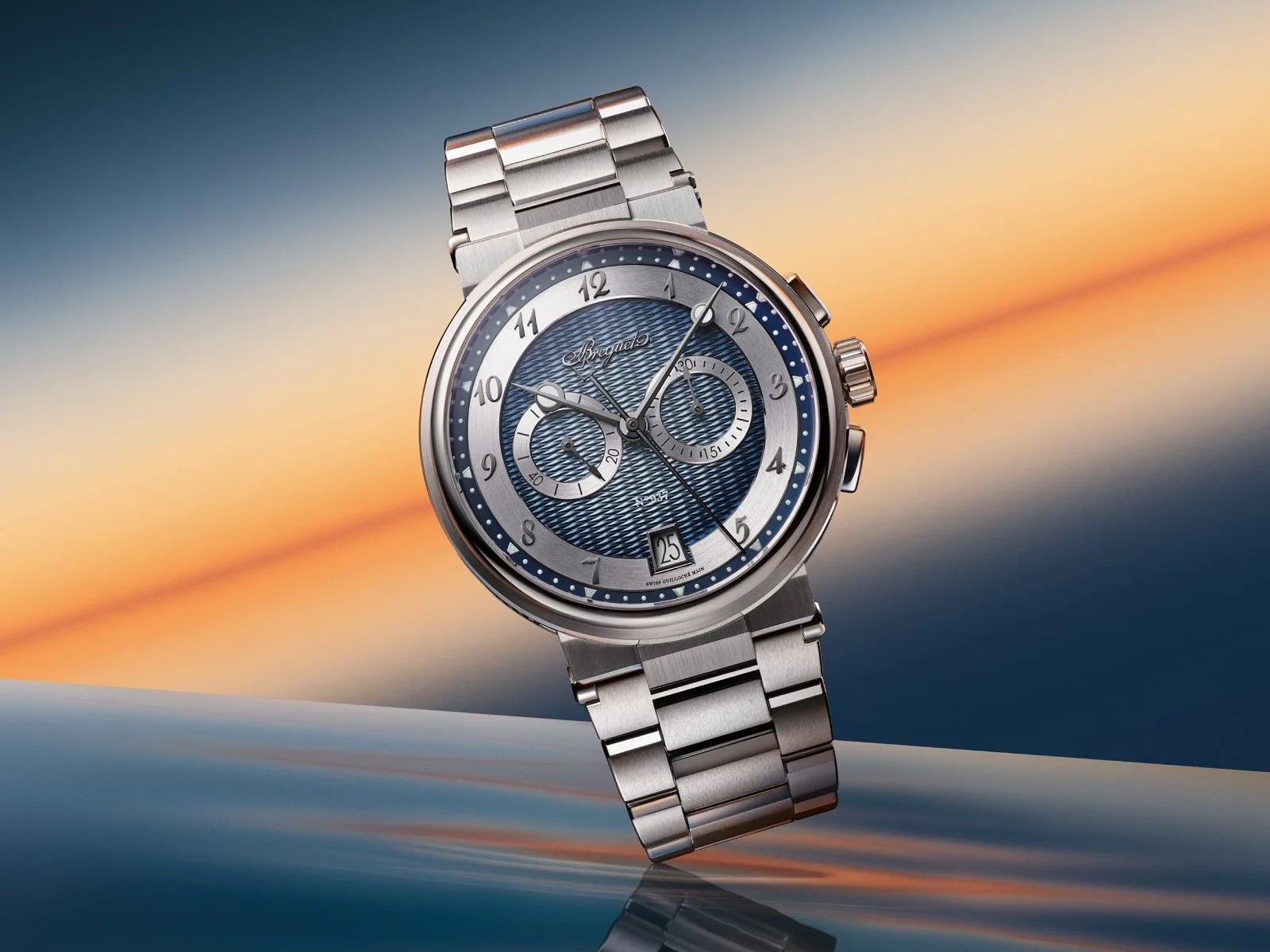
On reference 5527BR/Y9/5WV, the dial now features only two sub-dials. The small seconds sub-dial is positioned at 9 o’clock; the 30-minute totalizer is placed opposite it at 3 o’clock. The date window, previously located between 4 and 5 o’clock, has been moved down to 6 o’clock. This rearrangement seems simple on paper, but it completely redefines the balance of the dial. The displays no longer compete with one another, and the date, now aligned along the vertical axis, contributes to a much more orderly readability.
This design choice is all the more noticeable given that Breguet has abandoned the prominent Roman numerals of earlier versions. They have been replaced by Breguet Arabic numerals, which are slimmer and all arranged horizontally. This detail matters: a dial whose numerals follow radial orientations can force the eye into constant movement. Here, the information is presented head-on. Around the guilloché center, a brushed minute track serves as a frame and structures the composition.
At the center, the hand-engraved motif is known as the “Quai de l’Horloge.” Its network of interlaced lozenges adds a graphic element without weighing down the overall design. On this rose gold version, the deep blue of the dial creates a direct contrast with the metal of the case, the numerals, and the hands. It is in this interplay between the relief of the guilloché, the deep blue, and the polished gold that the watch makes its mark.
A Marine Model That Prioritizes Design
The collection bears the name Marine, but this 5527 does not seek to come across as an austere instrument. Its nautical heritage is revealed in subtle touches. The most distinctive is undoubtedly the counterweight of the central chronograph hand: it takes the shape of the letter “B” used in the maritime signal flag alphabet. A discreet nod, almost hidden in the hand’s movement, rather than an overpowering maritime motif.
The hour and minute hands feature the traditional Breguet silhouette, recognizable by the ring near their tips. Here, they are treated with luminescent material. The watch does not, therefore, entirely abandon functionality, but it expresses it with a newfound restraint. The chronograph remains front and center, without every element on the dial striving to proclaim its utility.
This evolution illustrates a fairly clear choice: rather than altering an established design with a radical case redesign or an additional complication, Breguet reworks the relationship between the eye and the watch. The proportions, however, remain unchanged. The Marine Chronograph retains its 42.3-mm diameter and 13.9-mm thickness. It is not a small chronograph, and the dial’s new architecture does not attempt to make one forget that. It simply makes this size more consistent with what the watch actually displays.
A substantial case, better integrated on the wrist
The round case remains framed by bold lugs, designed to naturally extend the bracelet. The polished rectangular pushers are positioned on either side of the crown, at the 3 o’clock position. The screw-down crown contributes to the advertised water resistance of 100 meters, or 10 bars.
The most revealing measurement, however, is not the diameter but the lug-to-lug length, set at 50.7 mm. The lugs curve inward fairly quickly around the wrist, allowing the case to stay close to the skin. This design mitigates the perceived bulkiness one might expect from a 42.3-mm watch. While it does not eliminate the watch’s weight—which is particularly noticeable in 18-karat rose gold—it prevents the 5527 from feeling like a rigid piece.
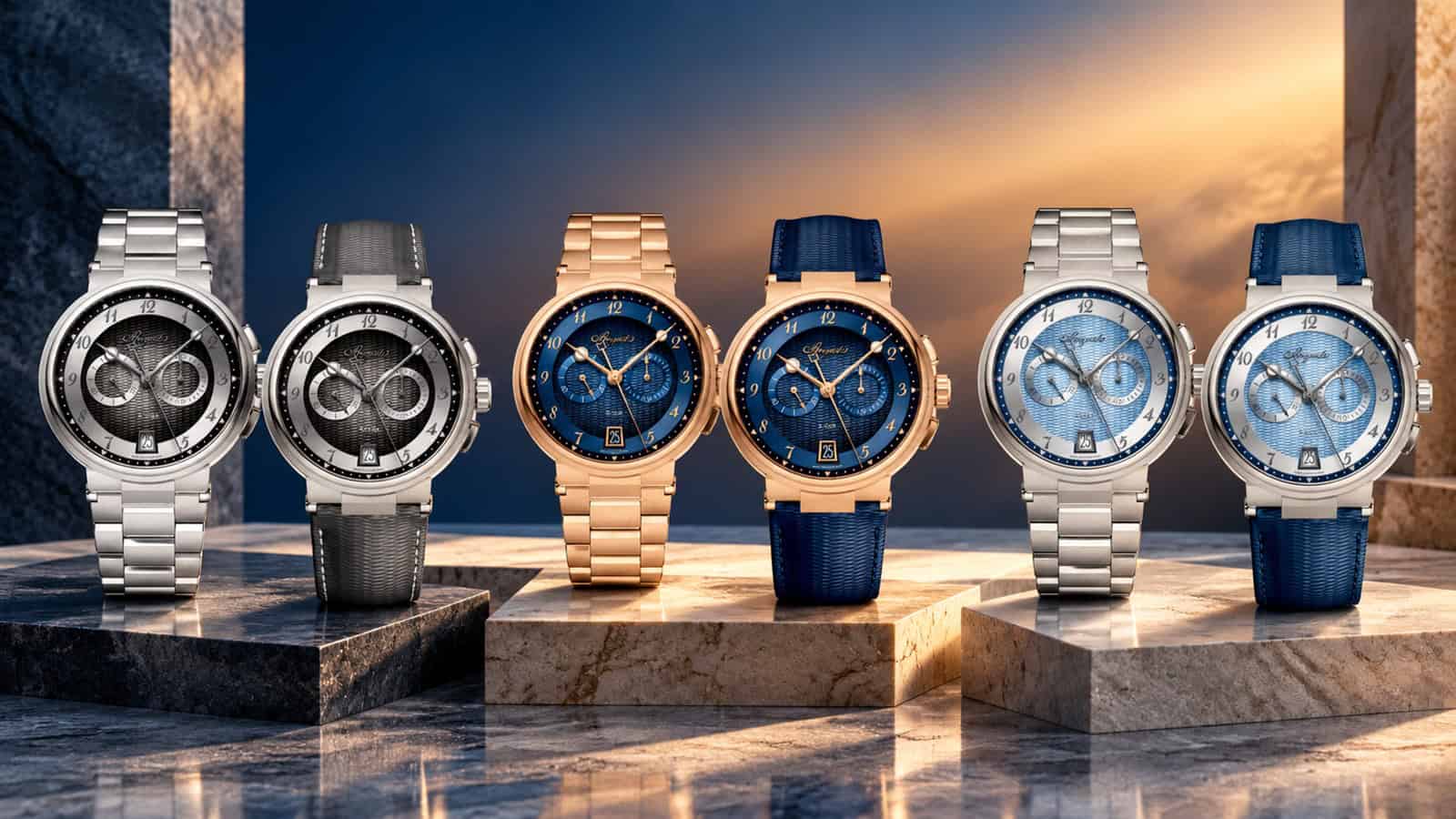
The 5527BR/Y9/5WV is fitted with a blue rubber strap, secured by an 18-karat rose gold folding clasp. This combination has the advantage of not adding to the case’s already substantial weight. For those who prefer a lighter feel, the Bicompax line is also available in titanium. Breguet therefore does not seek to impose a single interpretation of the Marine: the same overall design, but with noticeably different material characteristics.

The same movement, a different take on time
The transparent case back reveals the Breguet Caliber 582QA, already used in the Tricompax editions. The change in display does not, therefore, correspond to a change in the movement. This continuity serves as a reminder that the innovation lies on the most visible face of the watch: the one that organizes the functions and sets the rhythm of the dial.
The automatic movement beats at 28,800 vibrations per hour, or 4 Hz, and offers a 48-hour power reserve. It powers the hours, minutes, date, and flyback chronograph. This latter function allows the user, with a single press of the pusher, to stop the current measurement, reset the hand to zero, and then immediately start a new count. When timing consecutive sequences, successive laps, or different stages of a voyage, the practical benefit is clear: there’s no need to stop, reset, and restart the chronograph separately.
That is the paradox of this version. It removes a sub-dial from the face without compromising the chronograph’s mechanical sophistication. The caliber remains the same, as does the flyback function, but the interface becomes more understated. The 5527 Bicompax does not seek to pile on technical details; it reserves that complexity for the movement, visible only when the watch is removed from the wrist.
The price of a meticulously crafted simplification
In rose gold with a blue rubber strap, the Breguet Marine Chronograph 5527, reference 5527BR/Y9/5WV, is priced at 45,700 pounds sterling. With a strap made entirely of rose gold, the price rises to 72,100 pounds sterling. The entry-level model in this new bicompax series is the titanium version on a rubber strap, priced at 25,400 pounds.
These price differences do not merely reflect a hierarchy of materials; they alter the physical relationship with the watch. Rose gold accentuates its status symbol appeal and weight, while titanium meets a different expectation—one of lightness. Between the two, the bicompax dial is the true common thread: a Marine 5527 that remains true to its dimensions and flyback caliber, but whose readability has finally taken precedence over the accumulation of features.
Complete information on this model is available on the Breguet website.