Make Texture a preferred source on Google to support us
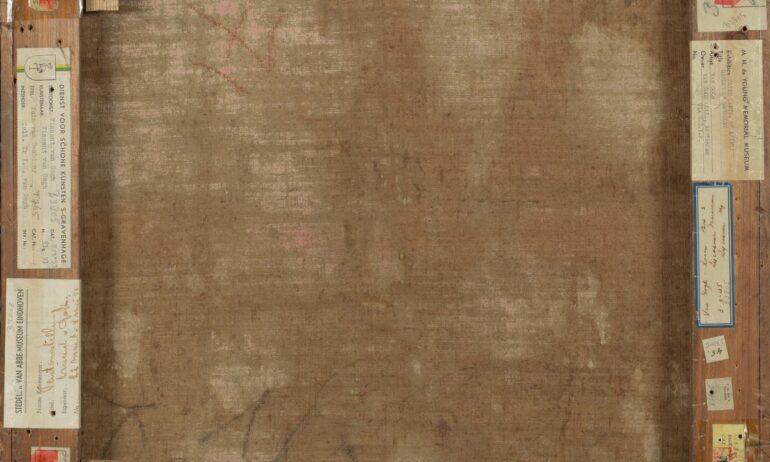
Add Texture to GoogleIt is a square with sides measuring fifty centimeters that, at first glance, appears to be nothing more than an explosion of greens and the energetic brushstrokes characteristic of Vincent van Gogh’s final years. But to fully grasp the uniqueness of Daubigny’s Garden, one must dare to do something that museum curators usually reserve for the privacy of their studios: turn the painting over. On the reverse side of the painting, the wooden stretcher and the weave of the canvas do not merely reveal the material hardship of an artist at the end of his rope in June 1890; they bear the physical scars of a global odyssey through the upheavals of the 20th century.
A Kitchen Towel as a Studio Canvas
On June 17, 1890, Vincent van Gogh wrote to his brother Theo from Auvers-sur-Oise. In the letter, he mentioned his work on the garden of the home of Charles-François Daubigny, a painter of the Barbizon School whom he deeply admired. At that very moment, the artist had run out of canvases. Rather than wait for a new supply, he grabbed a piece of household linen—a simple kitchen towel made of linen and cotton. The origin of the canvas is revealed by a striking domestic detail: two horizontal red stripes, woven directly into the weft, still run across the back of the work, visible along the top and bottom edges.
While museum research suggests that this fabric came from the kitchens of the Auberge Ravoux, where Van Gogh was staying at the time, no contemporary documents formally confirm this source. Nevertheless, this preliminary study, executed in haste on a makeshift support, attests to the painter’s creative fervor. It was not until July 1890, once he had received his canvases, that Van Gogh returned to this subject to create two larger panoramic versions, known as “double square,” now housed at the Hiroshima Museum of Art and the Kunstmuseum Basel (Rudolf Staechelin Foundation collection).
The chromatic transformation from pink to gray
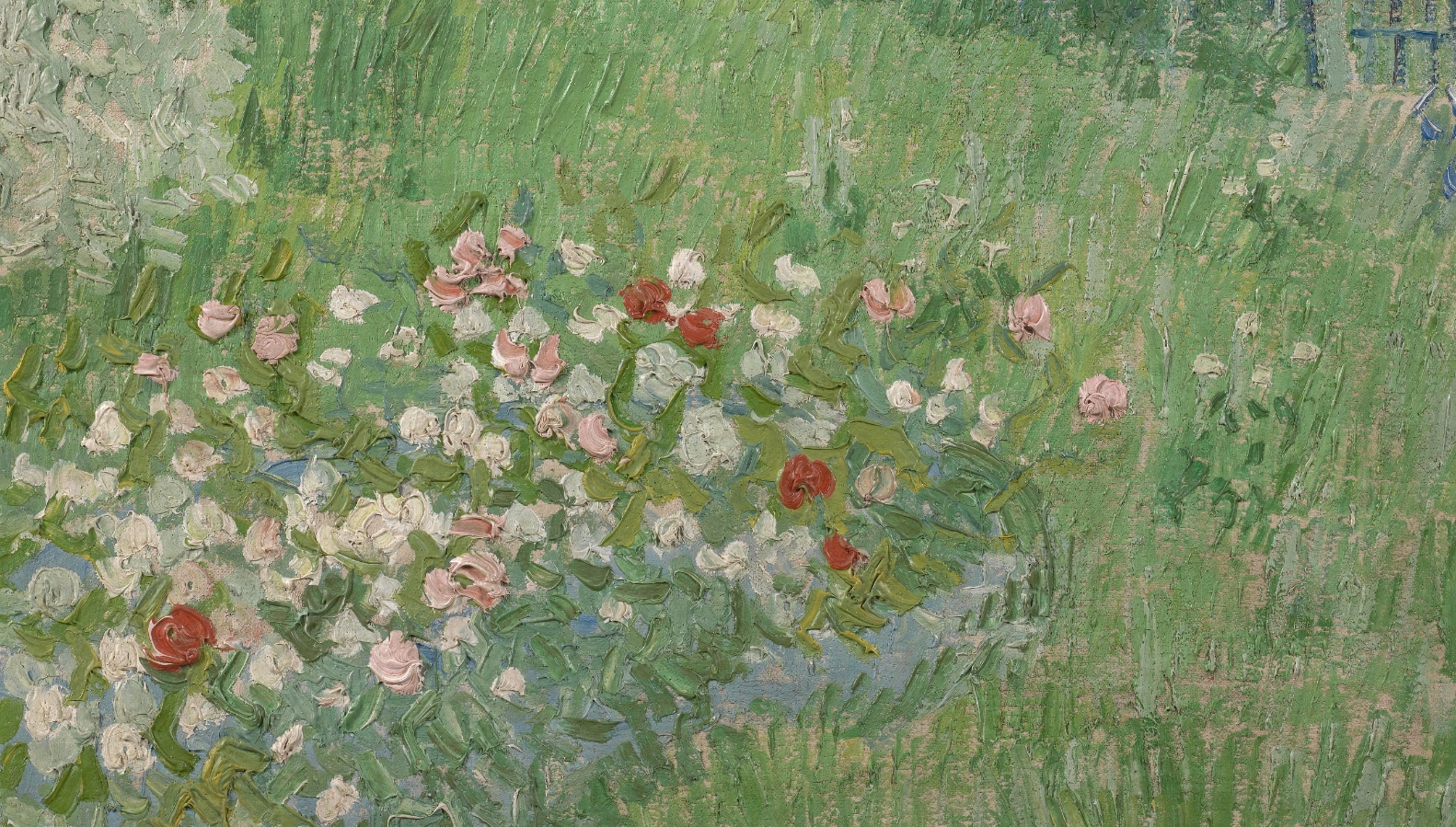
A technical analysis of Daubigny’s Garden reveals a chromatic intention that time has partially erased. To make the greens of the garden pop, Van Gogh applied a preparatory layer—a bright pink undercoat composed of a mixture of lead white and a red pigment, an organic lacquer. This choice was intended to create a powerful optical contrast between the background and the layers of paint applied on top.
However, the red pigment’s sensitivity to light has led to gradual discoloration. Today, this undercoat—still visible between the brushstrokes—has lost its original brilliance and taken on a grayish hue. This shift in color alters the overall perception of the work compared to the moment of its creation, reminding us that the materiality of a Van Gogh painting is a living entity, subject to complex chemical processes that continue to evolve more than a century after the paint was applied to the canvas.
The Odyssey of a High-Stakes Stretcher
While the front of the painting belongs to art history, its wooden stretcher belongs to political history. Since 1896, the work has been featured in 105 exhibitions around the world. The wood of the stretcher retains the memory of these journeys in the form of 17 vintage labels and tags, affixed over the decades. These fragments of paper trace the genealogy of a tireless traveler, marked by a period of forced exile during World War II.

In 1938, Vincent Willem van Gogh, the painter’s nephew, agreed to loan fourteen works, including *Daubigny’s Garden*, for a tour of Indonesia. The painting was exhibited in Batavia (Jakarta), Surabaya, and Bandung until January 1939. After these stops, the collection crossed the Pacific to reach the United States for the Golden Gate International Exposition in San Francisco. It was then that the conflict broke out in Europe. Returning by sea to the Netherlands was deemed too dangerous due to the hostilities. The paintings were stranded in North America for an indefinite period.
The North American Exile and the Wooden Stretcher Archives
For six years, between 1939 and 1945, the fourteen masterpieces traveled to 39 North American cities. The labels still affixed to the frames at the Van Gogh Museum in Amsterdam bear witness to this safe journey. They list the names of prestigious institutions that hosted the work to protect it from the conflict in Europe: the Toledo Museum of Art, the Art Association of Montreal (now the Montreal Museum of Fine Arts), the Syracuse Museum of Fine Arts, and the MoMA in New York.
Although archival records confirm that the painting passed through nearly forty locations, the stretcher physically bears only seventeen marks from these stops. This discrepancy underscores the value of the painting as a physical archive: each label is a scar of history, a testament to the era when Van Gogh’s works had to wander from one museum to another to escape the threat of destruction.
Today, *Daubigny’s Garden* is part of the permanent collection of the Vincent van Gogh Foundation. Unlike the versions in Hiroshima or Basel, this painting on canvas will never appear on the art market. An inalienable part of the foundation’s heritage, it remains at the Van Gogh Museum, preserving on the back of its household canvas the red traces of its humble origins and the yellowed labels of its global exile.