
Film possesses this unique ability to freeze movement while revealing duration. In his latest documentary project, director Hélio Goldsztejn sets out to capture a journey that defies hasty categorization: that of the artist Amelia Toledo. Through Goldsztejn’s lens, what unfolds is not merely a biography, but a demonstration of an artistic practice that has spanned six decades with an unwavering curiosity about material and form.
The film highlights a body of work that seems to have been sculpted by the elements as much as by the human hand. Toledo’s career did not follow a straight path, but was built through a series of bridges spanning worlds that are often believed to be opposites. On one hand, the raw roughness and geological slowness of stones and shells; on the other, the mathematical precision of an abstraction with sharp contours and the fleeting nature of photography. This duality lies at the very heart of the artist’s work—a constant dialogue between the natural and the artificial, between the randomness of a crystal and the precision of a line.
The Poetics of Earthly Structures
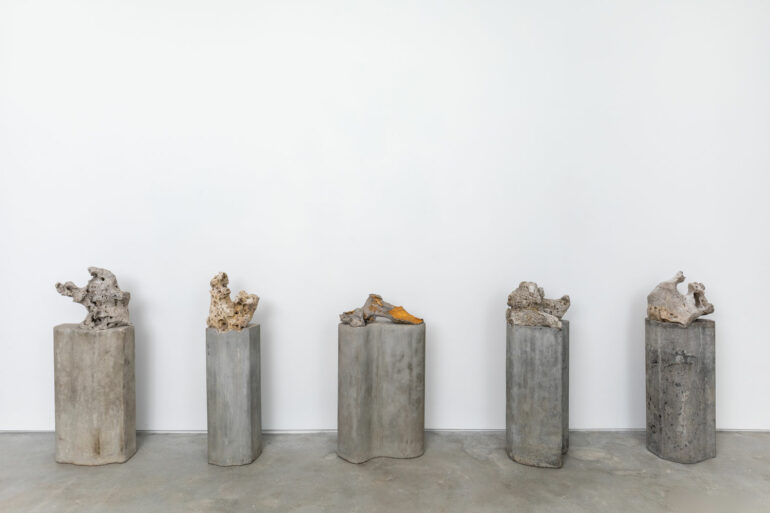
In Toledo’s world, crystals, shells, and stones are never mere found objects or decorative elements. Hélio Goldsztejn’s documentary explores this tactile relationship with the earth. The artist treats mineral matter as a language in its own right. By integrating these elements into her creative process, she challenges our perception of nature: a stone is no longer an inert fragment, but a complex architecture, a witness to the passage of time.
This fascination with the mineral and the organic is part of a quasi-scientific research approach. Shells, with their spiral curves, and crystals, with their natural geometric facets, serve as starting points for a reflection on the very structure of the world. Toledo does not merely exhibit these objects; she stages them, juxtaposing them with other materials, creating a tension between organic growth and human craftsmanship. Goldsztejn’s film pays tribute to the artist’s ability to see, in the structure of a pebble, the beginnings of a monumental work.
From Hard-Edged Lines to Capturing Light
One of the most striking aspects of Toledo’s career, as highlighted by the film, is her foray into so-called “hard-edged” abstraction. Here, the fluidity of the organic gives way to strict formal discipline. The documentary’s wide shots reveal how the artist was able to shift from working with stone to creating flat surfaces with sharp boundaries and saturated colors. This transition from one medium to another does not mark a break, but rather an expansion of her field of exploration.
For Toledo, abstraction is a matter of vibration and space. By working with sharp contours, she explores how color and form interact with the environment. This is where photography comes in as an essential mediating tool. For Toledo, the camera is a tool for sampling. She uses it to isolate details, to capture the play of reflections or chromatic arrangements that, once isolated, become part of the language of abstraction. Goldsztejn’s film clearly shows that, for this artist, photographing a reflection on a metallic surface or the edge of a crystal is part of the same quest for visual precision.

Sixty Years in the Spotlight
Six decades of creative work demand a form of intellectual resilience and constant self-reflection. The documentary explores this longevity by showing how Toledo has navigated artistic movements without ever allowing herself to be confined by them. She embodied her era by using the tools of her time, from traditional sculpture to more contemporary experiments with light and industrial materials. This versatility is the hallmark of an artist who rejects specialization in favor of a holistic vision of art.
Hélio Goldsztejn’s editing highlights this fluidity. By creating a dialogue between works from the 1960s and more recent installations, the director reveals a deep coherence behind the apparent diversity of media. Whether Toledo works with polished steel, transparent resins, or raw stones, the subject remains the same: the encounter between the human gaze and the physical structure of reality. His career is a testament to the persistence of an idea across changing forms.
Hélio Goldsztejn’s Perspective: A Film as a Living Archive
Hélio Goldsztejn’s new film is not limited to a simple inventory of works. It offers an immersion into the Toledo method. By following the common thread of materials—from crystal to photographic film—the director succeeds in capturing the energy that drives the artist. The documentary thus becomes an extension of Toledo’s work, an additional tool for understanding how an artistic vision unfolds in space and time.
The film also positions Toledo as a leading figure in art history, capable of bridging the most earthly materiality with the most conceptual abstraction. By documenting these sixty years of work, Goldsztejn offers an indispensable framework for grasping the significance of this artist within the cultural landscape. Toledo’s work, as presented on screen, appears as an organic whole, a structure in perpetual motion where each new medium enriches the previous ones. It is this synthesis—between the time of nature and the time of creation—that gives her work its quiet power and enduring relevance.