
Make Texture a preferred source on Google to support us
Add Texture to GoogleRediscovering the Past of a Centennial Home
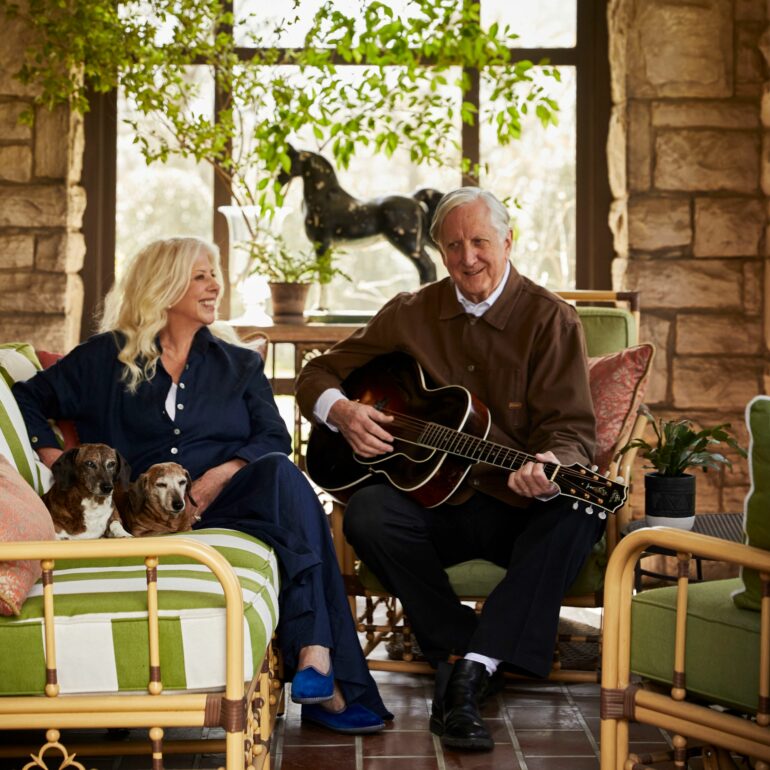
Amid the turmoil of a cultural industry often obsessed with immediacy and the veneer of novelty, certain projects set a radically different pace. Such is the case with this century-old residence, whose transformation spanned two years of careful consideration and deliberate action. Here, luxury lies not in ostentation, but in a form of creative restraint. This project, led by a duo whose names resonate with the precision of a guitar chord and the power of a cinematic dialogue, reflects a fierce determination not to erase the past, but to invite it to the table of modernity. Within the walls of this century-old building, history does more than merely haunt the space; it forms its very structure.
Taking two years to breathe new life into a residential structure may seem anachronistic. Yet for the legendary producer and the screenwriter whose pen etched the journeys of *Thelma & Louise* into the collective memory, this timeframe was the sine qua non of a successful restoration. Restoration, in this sense, means listening to what the walls have to say before imposing a new design upon them. This patience reflects a standard found in their respective careers: that of the detail that changes everything, the perfect note, or the word that packs a punch. By choosing to follow in the footsteps of those who came before them, they transformed a simple renovation into an act of cultural preservation.
The Archaeology of the Sensible and Respect for the Setting
One of the most striking aspects of this long-term project lies in the preservation of elements that others would undoubtedly have sacrificed on the altar of modernity. The original wallpaper, a fragile testament to decades past, has been preserved with almost museum-like devotion. This bold aesthetic choice anchors the house in a long-term historical context. It is no longer merely a decorative surface, but an archaeological layer that gives the space its depth of field. This respect for the existing material creates a constant dialogue between the era of the home’s construction and its current uses, avoiding the pitfall of a soulless model home.
This preservation approach extends beyond the aesthetics of the walls. It permeates every corner of the century-old home, where the old and the new coexist without clashing. The Oscar-winning screenwriter brings a director’s eye to the project: each room is conceived as a scene, where light and textures play a pivotal role. One senses, in the decision to preserve these fragments of the past, a sensitivity to storytelling. A house that has spanned a century has its own intrigues, its shadows, and its moments of brilliance; the goal was not to rewrite the script, but to restore it to its most authentic form.
Top-Notch Acoustics in the Service of Creativity
While the house’s structure looks to the past, its heart beats to the rhythm of cutting-edge technology. The integration of a professional recording studio—designed to meet the standards of a multi-Grammy Award-winning producer—serves as the property’s technical backbone. The challenge was significant: how to incorporate an ultra-modern sound production space into such a historic architectural framework? The answer lies in an organic fusion of domestic comfort and technical excellence. This studio is not a superficial addition, but a natural extension of the occupants’ lives—a place where music can be born in the hushed silence of a historic home.
The fact that this studio is described as a space capable of producing “Grammy-winning” works underscores the sophistication of the installation. This is not simply a home studio, but a precision work tool. The acoustics had to be designed to respect the building’s structure while perfectly isolating creative sessions. It is this duality that makes the project unique: on one hand, the old-world charm of century-old wallpaper; on the other, the mathematical precision of pure sound. This coexistence of the art of cinematic storytelling and the art of music production defines a new way of inhabiting one’s work.

The house as a work of memory and the future
After these two years of patience, the result transcends the simple notion of a luxury residence. It is a manifesto on how we treat our architectural heritage. By rejecting the easy path of starting from scratch, the couple has proven that a century-old building can offer a richer living and working environment than a new construction. The experience gained on film sets and in studios in Nashville and elsewhere is reflected in this use of space, where every vantage point is a composition and every moment of silence an opportunity.
This home thus becomes a refuge where creativity is protected by the thickness of the walls and the patina of time. For a musician and a screenwriter whose work consists of capturing the essence of humanity, living within such historical continuity is a constant source of inspiration. The house does more than simply house their trophies, whether Oscars or Grammys; through the power of their work, it has become a centerpiece of their own body of work. A place where, ultimately, the greatest luxury is having known how to wait until the house was ready to reveal its new secrets.
The project concludes with a simple truth: the value of a place is not measured by how quickly it is completed, but by the richness of the memories it preserves and those it is poised to create. Between the period wallpaper and the state-of-the-art mixing consoles, this century-old house begins its second century with renewed vigor, proving that patience is undoubtedly the finest design tool an artist possesses.