
Make Texture a preferred source on Google to support us
Add Texture to GoogleThe New Brutalism of the Intimate
For decades, the bathroom was treated as a purely functional space—a laboratory of hygiene dominated by sterile white and smooth ceramic. This clinical vision is crumbling. The bathroom is undergoing a profound transformation, moving away from its original function to become an extension of the living room—a sanctuary where raw materials reclaim their place. People no longer seek merely cleanliness there, but a form of sensory reconnection. This metamorphosis involves a radical return to the elements—stone, earth, textiles—crafted with a sophistication more akin to fine artistry than to household fixtures.
This evolution marks the end of the era of “disposable everything” and plastic. Today, interior architects and designers are embracing materials capable of aging, developing a patina, and telling a geological story. Water no longer simply runs off an anonymous surface; it strikes volcanic lava, veined marble, or textured sandstone, creating a dialogue between the liquid element and mineral density.
Stone in Its Prime
At the heart of this revolution, natural stone is no longer merely a flooring material but has emerged as a sculptural centerpiece. The collaboration between Agape and designer Patricia Urquiola perfectly illustrates this trend with the Cenote series. Here, the bathtub breaks away from industrial standards to take the form of natural cavities. Carved from dark lava or earth-toned stones, it retains a raw, almost wild exterior texture, while the interior is polished with extreme precision. This tactile contrast transforms bathing into an earthy experience.
For its part, Salvatori continues to explore the limits of mineral modularity under the artistic direction of Piero Lissoni. The Hito collection, for example, reimagines bathroom furniture as an assembly of monolithic blocks. Stone is no longer a weight constraint, but a vehicle for formal purity. Each sink and each countertop is designed to highlight the material’s natural imperfections, transforming everyday objects into collector’s items. The engineering remains discreet, giving way to the inherent beauty of marble and travertine, reminding us that luxury often lies in the rarity of a vein or the depth of a shade of gray.
Ceramics Beyond Enamel
While stone dominates through its mass, ceramics reinvent themselves through their texture. Michael Anastassiades’ work for Mutina with the Fringe collection is a testament to this. The Cypriot designer, more accustomed to the lightness of lighting fixtures, has transferred his obsession with line and rhythm to porcelain stoneware tiles. By cutting the surface with horizontal and vertical grooves, he creates a play of shadows that shifts depending on the lighting and humidity in the room. We move beyond flat tiles to enter an architectural skin that vibrates to the touch.
This approach is also evident at Laufen, which continues to push the boundaries of SaphirKeramik. This material, with its exceptional thinness and hardness, makes it possible to create walls of a thinness that was previously impossible. The Medusa collection, developed by the Alaska Alaska studio (founded by Virgil Abloh), embodies this fusion of contemporary art and industrial technology. The forms are bold, almost graphic, proving that porcelain can break free from its traditional constraints to embrace aesthetic codes drawn from urban design and conceptual art.
Textiles as Objects of Contemplation
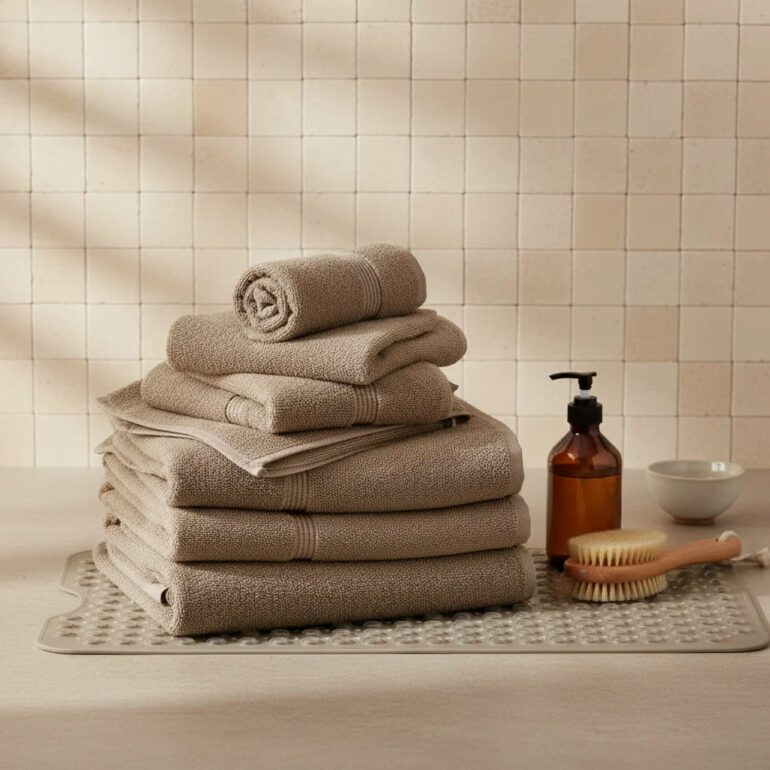
One of the most surprising changes in the design of these new spaces is the widespread emergence of textiles with high artistic value. The bath mat, once a simple absorbent accessory, has become a work of art in its own right. The Italian company cc-tapis has launched a collection called Plaster, designed by photographer Casper Sejersen. These pieces are more than just functional; they mimic the textures of cracked plaster or ancient frescoes with uncanny precision.
The idea is to break the usual coldness of hard surfaces. By incorporating natural fibers and intricate patterns, stepping out of the bath becomes a moment of visual and physical comfort. These rugs are no longer hidden behind a door; they are displayed like tapestries, creating an organic connection between the bedroom and the bathroom. The choice of colors—often ochres, sandy tones, and deep grays—contributes to this desire to create a subdued atmosphere, far removed from the harsh glare of chrome.

The Artistry of Detail
The refinement of these spaces is also evident in the faucets, treated like genuine jewelry. At Gessi, the Perle collection even incorporates spheres of natural stone or Murano glass into the handles of the mixers. Interaction with water begins with contact with a precious material, transforming a mechanical gesture into a conscious ritual. You no longer simply turn a knob; you handle a work of art.
This attention to detail extends even to the most technical accessories. Kohler, in collaboration with designer Samuel Ross on the Formation 02, offers an almost brutalist take on the sink. With its sharp angles and bright orange color, this limited-edition piece represents a radical departure from the soft curves typically favored. It’s a statement of intent: the bathroom has become the space for all kinds of formal experimentation, where one can dare to make aesthetic departures that might not be permitted in a reception room.
Lighting follows the same trend. Recessed spotlights are being replaced by sculptural fixtures. The Juniper brand, for example, offers solid brass track systems that highlight the room’s architectural lines without overwhelming them. The light becomes indirect and subdued, capable of highlighting the texture of the walls and the richness of the materials. The bathroom is no longer lit merely for visibility, but to create an atmosphere.
Through these designs, a new hierarchy of living spaces is taking shape. By investing so much creative effort into the most private space in the home, contemporary design acknowledges that well-being depends not only on comfort but also on the quality of the materials we touch and see every morning. The boundaries between industrial design, artisanal craftsmanship, and architecture are blurring, giving way to a holistic, coherent, and deeply sensory space. Stone, sandstone, and fiber are no longer merely building materials, but the components of a lifestyle focused on inner well-being.