Make Texture a preferred source on Google to support us
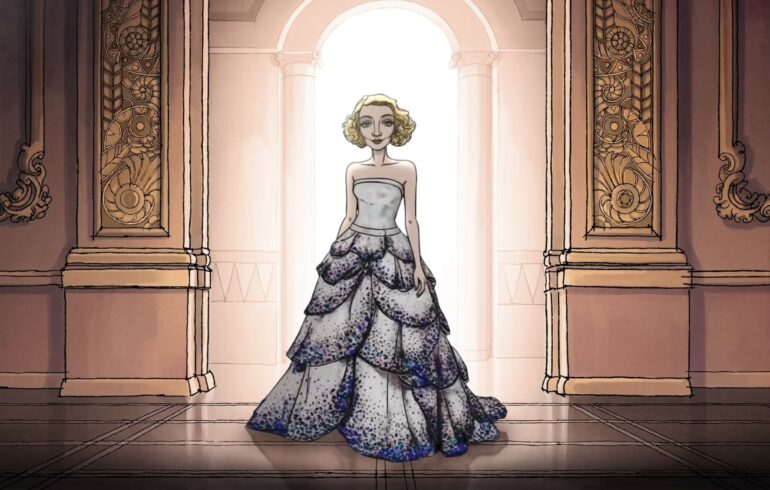
Add Texture to GoogleOne winter night, as Christmas 1949 approached, the phone rang on Avenue Montaigne. On the other end of the line, a familiar voice—deep and panicked—disrupted the tranquility of the fashion house. Marlene Dietrich was facing a major crisis on a Hollywood film set. For weeks, the cinema legend had been insisting on a strict condition during her negotiations with the master of suspense, Alfred Hitchcock, for the feature film *Stage Fright*. Her demand can be summed up in a phrase that has become one of the most famous ultimatums in the history of cinema and fashion: “No Dior, no Dietrich!” The actress got her way, but an unexpected turn of events has just undone all the preparatory work. In the script for the animated short film, the director has decided to switch from black-and-white to color. The outfits originally planned—designed to catch the light against the grayish contrasts of a bygone era—instantly lose all their relevance. We have to start all over again. Marlene Dietrich needs a new look, and time is running out. The story draws inspiration from the real-life relationship between Christian Dior and Marlene Dietrich to become the narrative framework for the Parisian fashion house’s 2026 end-of-year campaign.
Rather than opting for a traditional reenactment, the art direction team chose the path of animated allegory. Driven by the vision developed for the Jonathan Anderson era, this historical narrative is transformed into an animated short film titled *Christian Dior’s Night in Color*. To capture the frenzy of that winter night in 1949, the project was entrusted to a unique figure in the world of animation: Sylvain Chomet. The French filmmaker, whose distinctive style has earned him international acclaim for works such as *The Triplets of Belleville* and *The Illusionist*, takes this Hollywood anecdote and infuses it with a distinct visual poetry, far removed from the usual conventions of luxury advertising.
A voice cast straddling the line between the absurd and the prestigious
The project’s uniqueness lies in the contrast between the script’s historical roots and the international cast assembled to bring it to life. The film features narration by British actor Robert Pattinson, who guides the viewer through the bustling corridors of the atelier. To portray the central duo, the director turns to Louis Garrel, who lends his voice to a Christian Dior facing a crisis, while Camille Cottin takes on the role of the uncompromising and anxious Marlene Dietrich. Their telephone exchanges set the pace for a plot that quickly veers into surrealism.
Once the order is placed, the short film unfolds a bestiary and a gallery of anthropomorphic objects, fully embracing the tone of a Christmas tale. American actor LaKeith Stanfield lends his voice to the Hollywood director—the man whose technical mishap with the film triggers the panic. Even more unexpectedly, British actor Josh O’Connor slips into the skin—or rather, the wood—of a chair, adding a decidedly eccentric dimension to the home’s decor. In this animated epic, the celestial dimension is not forgotten: Rihanna makes a notable vocal appearance as The Lucky Star, the lucky star that watches over this nocturnal tale and guides the destinies of Avenue Montaigne.

The Hive on Avenue Montaigne and the Rebirth of Junon
At the heart of Sylvain Chomet’s film lies the portrayal of the creative process itself. To fulfill Dietrich’s commission, Christian Dior does not work alone. The short film offers a metaphorical portrayal of the haute couture atelier by transforming the seamstresses—traditionally known as “petites mains”—into a colony of little bees buzzing with activity. This ballet of hardworking insects, busy cutting, stitching, and assembling fabrics in the rush of the night, comes to life thanks to the voices of three actresses: the American Greta Lee, as well as the French actresses Nine d’Urso and Nadia Tereszkiewicz. Their choreographed buzzing sets the rhythm for the creation of the film’s centerpiece.
The goal of this creative, sleepless night culminates in one of the animation’s highlights: the unveiling of the new outfit designed for the California sets. The design reveals a sparkling strapless dress, tailored to withstand the demanding brilliance of color film. The aesthetic of this creation owes nothing to chance. It is directly inspired by the Junon dress, a historic piece whose richly embroidered petals caused a sensation in 1949—the very year in which the story takes place. The short film thus builds a meticulous bridge between the actual archives of the late 1940s and their reinterpretation through animation, transforming the constraints imposed by cinema into a triumph of the studio.
From Animated Film to Global Store Windows
The ambition of the Christian Dior’s Night in Color campaign extends far beyond the format of a simple short film. The world created by Sylvain Chomet was conceived as the cornerstone of the house’s overall Holiday 2026 experience, developed under the supervision of Jonathan Anderson. The characters, the wintry atmosphere, the shower of stars, and the seamstress bees step off the screen to take over the physical world.
The film’s aesthetic dictates the visual direction of the holiday displays on an international scale. The imagery of that night in 1949 is featured in store windows around the world, offering a three-dimensional interpretation of Chomet’s drawings. One of the epicenters of this scenographic display is in Asia, where the Dior Gold House in Bangkok hosts a monumental installation featuring narrative elements from the Christmas story.
This interplay between the animated story and the retail space finds its tangible extension in a series of specially designed creations. The House accompanies the film’s release with an extensive collection of seasonal gifts. The world of Marlene Dietrich, the lucky star, and the bustling atelier is brought to life through a collection featuring ready-to-wear pieces, an accessories line, and various lifestyle items. It’s a way of anchoring the memory of a Hollywood sensation from over seventy years ago in the tangible reality of a contemporary holiday season.