
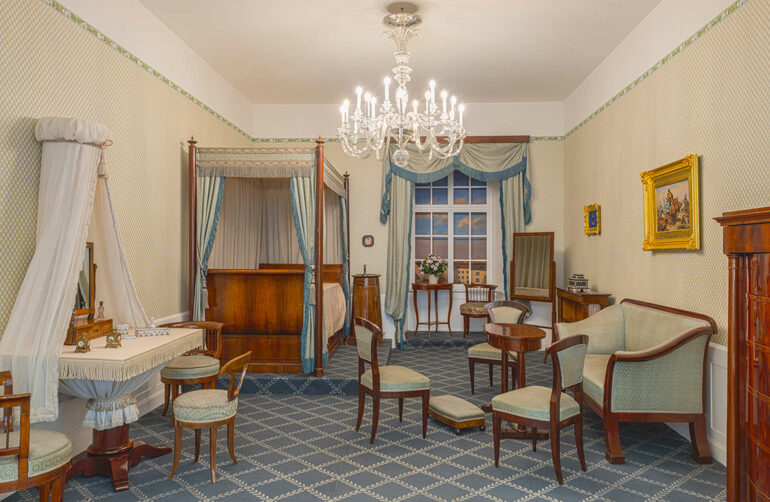
Close the door, draw the heavy curtains, light the oil lamp. In the Austrian capital of the 1820s, privacy is no longer merely a comfort: it becomes a refuge, almost a necessity for social survival. As Chancellor Metternich wove a suffocating web of censorship and secret police across post-Napoleonic Europe, the Viennese bourgeoisie turned their backs on cafés, public squares, and political debates to shut themselves away in their salons. Paradoxically, this forced internal exile gave rise to one of the most luminous, rational, and refined aesthetics in the history of the decorative arts. Far from the martial pomp, gilded eagles, and dark mahogany of the French Empire that preceded it, this movement defined the contours of an elegance born of subtraction. Art history would come to know it as Biedermeier.
The term itself bears the mark of its era. Originally, “Gottlieb Biedermeier” was a satirical character in German literature—a placid, conformist bourgeois concerned solely with his domestic comfort and his naïve poems. The cruel caricature was intended to mock the political disengagement of this emerging middle class. Yet the irony has faded over the decades. What was once merely a jest has become synonymous with a golden age of design, a period stretching from the Congress of Vienna in 1815 to the revolutions of 1848, during which furniture ceased to be an instrument of power and came to serve the human body.
The Geometry of Light Wood
The masterstroke of the Viennese cabinetmakers lay in a radical renunciation. Gone were the gilded bronzes, caryatids, sphinxes, and garish marquetry. Applied ornamentation gave way to clean lines. This approach places the highest demands on the selection and treatment of materials. With maritime imports limited following the Napoleonic Wars, artisans turned to local fruitwoods: cherry, walnut, birch, maple, and ash. These light-colored woods, sometimes blond or honey-hued, capture even the faintest glimmer of light in the confined interiors of Austrian winters.
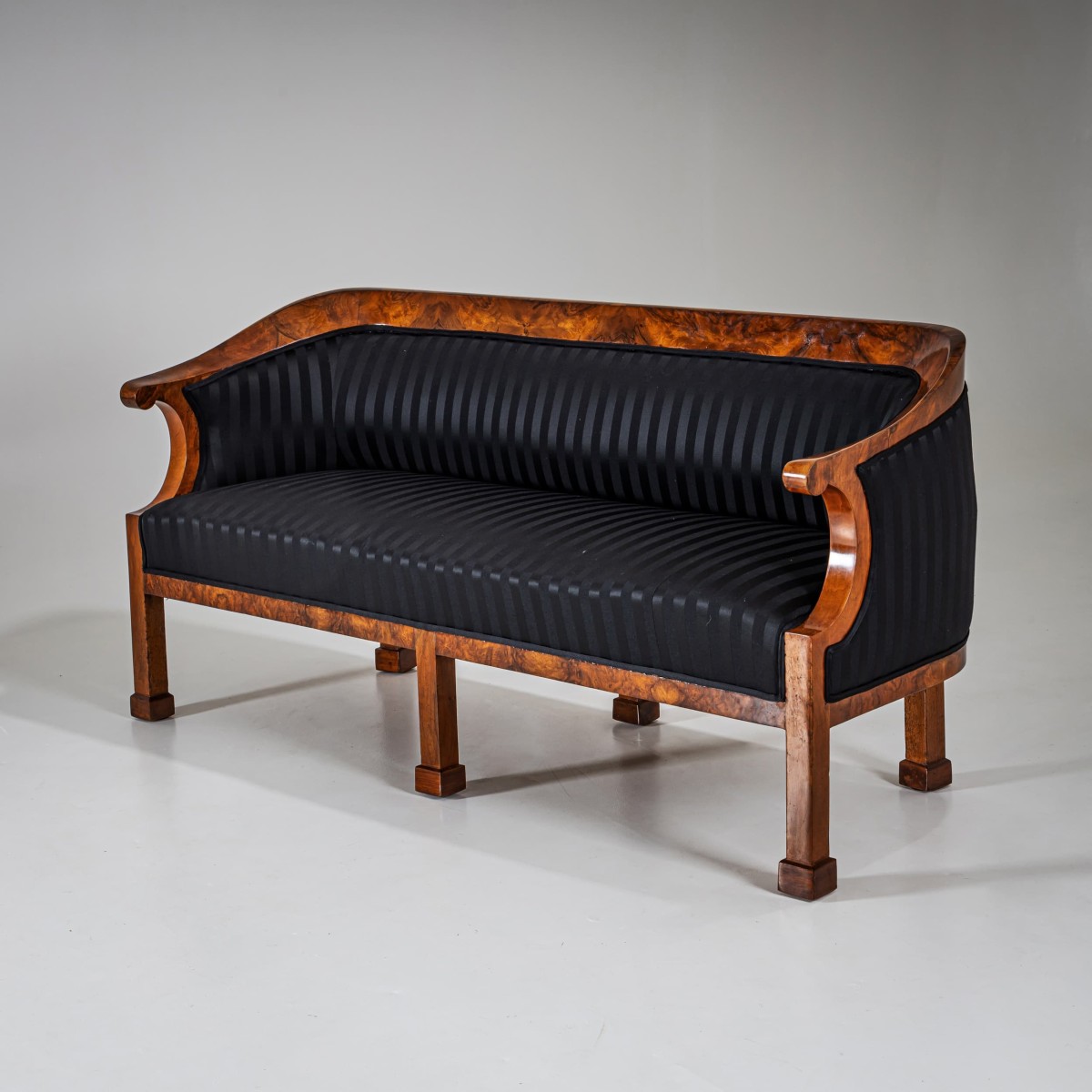
Stripped of its carved embellishments, the furniture derives its beauty from the material itself. Artisans developed a virtuoso mastery of straight-grain and burl veneers. They cut the sheets of wood and assembled them in an “open book” pattern, creating natural symmetrical motifs that served as the sole decoration. The surface became an abstract painting. The forms complement this emphasis: chair backs curve like flower petals, legs take on saber-like curves, tables become rounded, and armrests curl with a suppleness that foreshadows the organic designs of the following century. The wood appears bent, softened, and shaped to conform to a reassuring geometry.
The Invention of the Conversation Island
This formal revolution was accompanied by a topographical upheaval within the home. Before the Biedermeier period, in the aristocratic tradition, reception furniture was arranged along the walls of vast galleries to clear the center of the room. Custom dictated symmetry and representation. The Viennese bourgeoisie broke with this model. The parlor, now called the Wohnzimmer (the living room), was organized around social hubs. Round or oval tables were placed in the center of the room, surrounded by chairs and comfortable sofas. People read aloud, embroidered, and played cards there.
Above all, people made music there. These interiors served as natural resonating chambers for the “Schubertiades”—those evenings when Franz Schubert gathered his friends and family around the fortepiano. The furniture adapted to this salon lifestyle. We see the emergence of highly specialized pieces, almost like tools: reading chairs with a music stand built into the backrest, sewing tables equipped with multiple secret drawers, elegant spittoons made of bentwood, and corner shelves designed to optimize space in city apartments.
The star piece of furniture from this era remains, without a doubt, the drop-leaf desk. A monolithic block, often accented by a simple triangular pediment with architectural precision, it takes center stage in the room. When opened, its interior reveals a miniature theater, complete with small columns, mirrors, and drawers concealed by complex mechanisms. In a society where mail was monitored by the state police, the secretary served as a safe haven for private thoughts—the only space where correspondence and personal journals were shielded from the watchful eye of the authorities.
Contrasting Textiles and Indoor Nature
It would be wrong to reduce the Biedermeier style to the mere austerity of its light woods. While the structures are rigorous, the upholstery bursts with vitality. Upholsterers of the era used cottons, chintzes, and silks in saturated colors. Emerald green, royal blue, and canary yellow dominate. The patterns are bold: strict stripes or exuberant floral designs that contrast sharply with the geometric austerity of the frames.

This preference for floral patterns on fabrics finds a direct echo in another major innovation of the period: the integration of plants into the very heart of the home. Nature, considered chaotic outside, is domesticated. Ivy climbs up interior trellises, ferns take root in custom-designed freestanding planters, and cut flowers find their place on small side tables. The home becomes an autonomous microcosm, a protective greenhouse where the harshness of the outside world has no place.
The workshop led by Josef Danhauser perfectly exemplifies this professionalization of interior design. Danhauser is no longer content to simply manufacture individual pieces of furniture; he designs complete sets, coordinating woodwork, fabrics, curtains, and lighting fixtures, and delivers the first “turnkey” interior design projects to his Viennese clients. The craftsman transformed into an interior designer, conceptualizing space as a total work of art on a domestic scale.
A shockwave that reverberated into the twentieth century
The momentum of this movement came to an abrupt halt in the middle of the century. The barricades of 1848 shook Europe. The Industrial Revolution gathered pace, ushering in the era of historicism and a massive craze for the ornate and ostentatious Neo-Gothic and Neo-Renaissance styles. Biedermeier, deemed too simple and too provincial, fell into oblivion. It was relegated to attics, viewed as the outdated relic of a timid generation.
It was not until the dawn of the 20th century that its genius was rehabilitated, spurred on by the Vienna Secession. Radical figures in architecture such as Josef Hoffmann and Otto Wagner took a fresh look at these century-old pieces of furniture. In them, they recognized the very essence of what they sought to achieve: the subordination of form to function, the absence of gratuitous ornamentation, and structural rationality. The Museum of Applied Arts (MAK) in Vienna, which today houses the finest pieces from this period, bears witness to this direct lineage. The designers of the Wiener Werkstätte, and later the Bauhaus theorists and Art Deco interior designers, drew heavily on the visual vocabulary invented behind closed doors in Vienna in the 1820s.
This shift from political censorship to formal purity continues to fascinate. The contemporary collector who acquires a Biedermeier cherrywood chair is not buying a dusty antique laden with gilding from a bygone era. Instead, they are getting their hands on a chair whose ergonomic contours perfectly conform to the curve of the back. They are physically experiencing furniture designed by and for people in search of comfort, in a capital city that, in an effort to escape its own century, had unwittingly invented ours.