
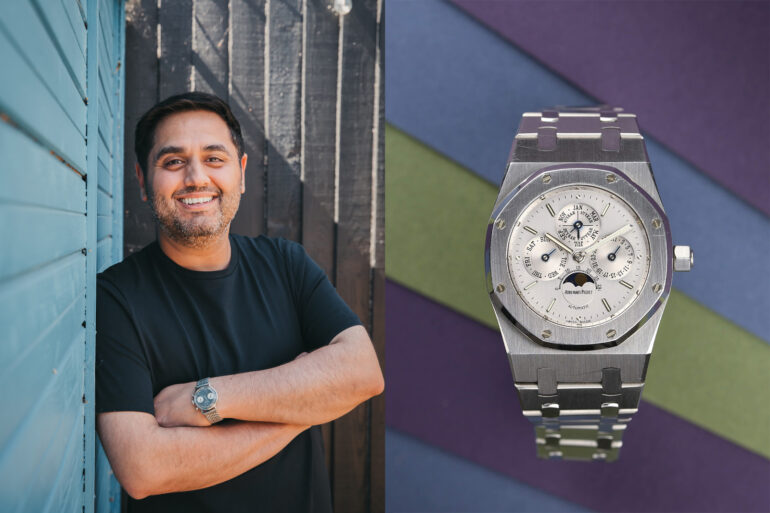
A worn-out box, papers that are sometimes impossible to definitively link to the watch they accompany, and a premium that can cloud one’s judgment: Arwind Jhand prefers to be wary of all this. For the founder of Tortoise Watches, the obsession with the “full set” has taken on excessive proportions in the vintage market. A watch is meant to be worn, admired, and perhaps opened up at the watchmaker’s; its case, on the other hand, stays in a closet. Depending on the brand, Jhand estimates that a box and papers often justify only an additional value of between 50 and 200 pounds. This is a contrarian stance in a market that has turned packaging into a selling point.
His reasoning isn’t that of a provocateur, but of a collector who became a dealer by financing his next purchase through the resale of the previous one. Above all, he reminds us of a fact that’s all too often forgotten: a branded box may have been added decades after the initial purchase, simply to make a lot more appealing. The provenance that matters is that of the specific object. A photograph of its first owner wearing the watch, for example, is worth far more than a case from the right era that was added to a piece after the fact.
The collector who had to learn how to sell
Before turning it into a business, Arwind Jhand collected watches with the enthusiasm—and sometimes the excesses—of an enthusiast. He owned several examples of the same model and readily admits that this world fueled a tendency toward compulsive collecting. The transition to becoming a dealer initially felt like a license: buying without guilt, since the pieces were officially entering inventory. He would still occasionally keep certain finds for himself.
That line has since blurred. When a rare watch—one he’s long sought—turns up, he still enjoys the pleasure of finding it and wearing it for a while. But it usually ends up behind the display cases in his shop. He buys less to build a personal collection and more to keep the pieces circulating and deepen his knowledge. This is the price of professionalization—it takes away a bit of that personal connection, while granting access to a vast number of watches that a single collector would never have the chance to see.
An Audemars Piguet Royal Oak Perpetual Calendar 25800ST epitomizes this shift. Just as he was devoting himself full-time to watches and setting up his small boutique, Jhand removed this piece from his personal collection. At the time, it was by far the most expensive watch he owned, purchased from a friend and steeped in memories. Selling it meant giving up a part of the joy he derived from collecting.
What followed validated his decision, though the regret remained. The Royal Oak found its way to a dealer friend, with whom he now maintains a strong relationship. It also caught the attention of another major London dealer, who contacted him with questions; their exchanges evolved into a regular business relationship. This steel timepiece thus became a milestone in the transformation of a very personal hobby into a structured business.
Zenith: A Field of Exploration Rather Than a Safe Haven
Jhand’s fondness for Zenith does not stem from a calculation of trends. His first significant acquisition was a 1971 Zenith G583, purchased in 2014 from a prominent collector of the brand, who has since become a friend. This encounter led him into a community where he learned as much as he bought. Watches have also provided an unexpected social outlet for someone who describes himself as the opposite of a sports enthusiast: while sports easily create opportunities to get together, watch collecting also brings people with shared interests together—sometimes over a drink.
The initial spark, however, came from Ebel. A watch he spotted on a very tucked-away shelf at Selfridges sparked a lasting passion in him: a love for good deals, followed by a desire to understand what he had just discovered. His research led him to the El Primero chronograph. At the time, he was working in finance, tied to his desk but free to use the Internet as much as he wanted. Zenith offered him a less well-trodden path than the more thoroughly documented brands. There, he could make his own discoveries rather than simply retracing the history already laid out in coffee-table books.
This curiosity explains the recurring presence of the A384, A386, De Luca, and Port Royal models in his world. It also sheds light on his perspective regarding the story of Charles Vermot, the watchmaker credited with saving the El Primero tooling, which had been hidden in an attic during the quartz crisis. It’s a compelling story, and Zenith has incorporated it extensively into its contemporary marketing. But in his view, it serves modern watches better than it does the value of vintage pieces. The discerning collector ultimately judges a watch on its own merits: its condition, its horological significance, its dial, its case, and the verifiable history of that particular example—not on a brand legend applied to an entire line of production.
The Return of the 1980s and 1990s
In the display cases, the most interesting trend doesn’t necessarily involve the usual stainless-steel sports watches. Enthusiasts are turning to precious metals, ladies’ watches, and pieces whose dials or proportions defy uniformity. Omega Speedmasters have regained momentum after hitting a low point, but only if they are in convincing condition. A similar resurgence is evident for certain Rolex Submariners, where interest is gradually returning without diminishing buyers’ exacting standards.
The so-called “neo-vintage” category—which in practice covers the late 1980s and early 2000s—is benefiting from this shift in tastes. Customers don’t necessarily use this term when they walk through the door. Instead, they ask for watches that fall into this category—often younger collectors drawn to prices that are still affordable and designs that look more expensive than their actual market value.
Jhand sees particular and enduring potential in Audemars Piguet. A simple dress watch in 18-karat gold from the brand can be found for around 5,000 pounds—a price he finds striking when compared to current prices in new watch boutiques. The 14406, a classic dress watch in 18-karat yellow gold, exemplifies this appeal for timepieces that are less immediately recognizable than the major sports models.
With a budget of 3,000 pounds, his preference leans toward Ebel’s neo-vintage chronographs equipped with El Primero movements. Between 2,000 and 3,000 pounds, there are still options available, though prices rise when looking for versions in precious metals. Their very Ebel-esque 1980s design isn’t the most sought-after today, which partly explains why they’ve fallen somewhat out of favor. However, their build quality and distinctive silhouette remain intact. The only practical precaution: check the condition of the bracelet. Its unique attachment system makes replacements both expensive and hard to find.
His personal taste sometimes leans toward even less mainstream items: pendant watches, some of which—such as certain Seiko designs from the 1980s—sell for a few hundred pounds. He acknowledges that these are pieces that take some getting used to, but they align with his fascination for the market’s blind spots.
Reissues Are No Substitute for the Original
The revival of historic lines does not necessarily overshadow the older models. Jhand appreciates Zenith’s Defy Revival collection, whose design language remains close to that of the vintage models. The use of materials not found in the originals—such as titanium—does not strike him as a betrayal of the concept: the brand is evolving certain models rather than freezing them in a literal replica.
The release of these reissues did trigger a slight increase in the prices of the corresponding vintage models, before prices returned to a more stable level. Jhand had anticipated a more sustained rise; this has not materialized over the past two years. He sees this less as a disappointment than as an opportunity that remains open for enthusiasts. There is little overlap between buyers of reissues and those of vintage watches: the former often seek a new watch inspired by the past, while the latter want the actual object that has stood the test of time.
Social media is now accelerating these shifts in interest. A watch that went unnoticed can receive several inquiries the very next day if a major influencer posts a similar model on Instagram. For buyers who have neither the time nor the desire to conduct lengthy research, these accounts serve as influencers and curators. They can also spark sudden frenzies, which underscores the value of a discerning eye that looks beyond today’s posts.
1985, the Zenith counter, and a watch impossible to find new
If he could step back in time for just a moment to stand in front of a retailer’s counter, Arwind Jhand would choose 1985. Not to buy a model considered virtually impossible to find today, but to walk away with a Zenith Port Royal 95.0102.418 in titanium, with a black dial and moon phase. It’s his favorite watch—one that has seen a lot of life on his own wrist.
There’s only one thing missing: having been its first owner. The Port Royal embodies everything he looks for in a vintage watch—a design deeply rooted in its era, a distinctive presence, and a comfort that hasn’t aged a bit. A time machine would serve less for speculation than for walking through the door of a Zenith store in 1985, paying the bill, and then walking out with this brand-new watch on his wrist.