
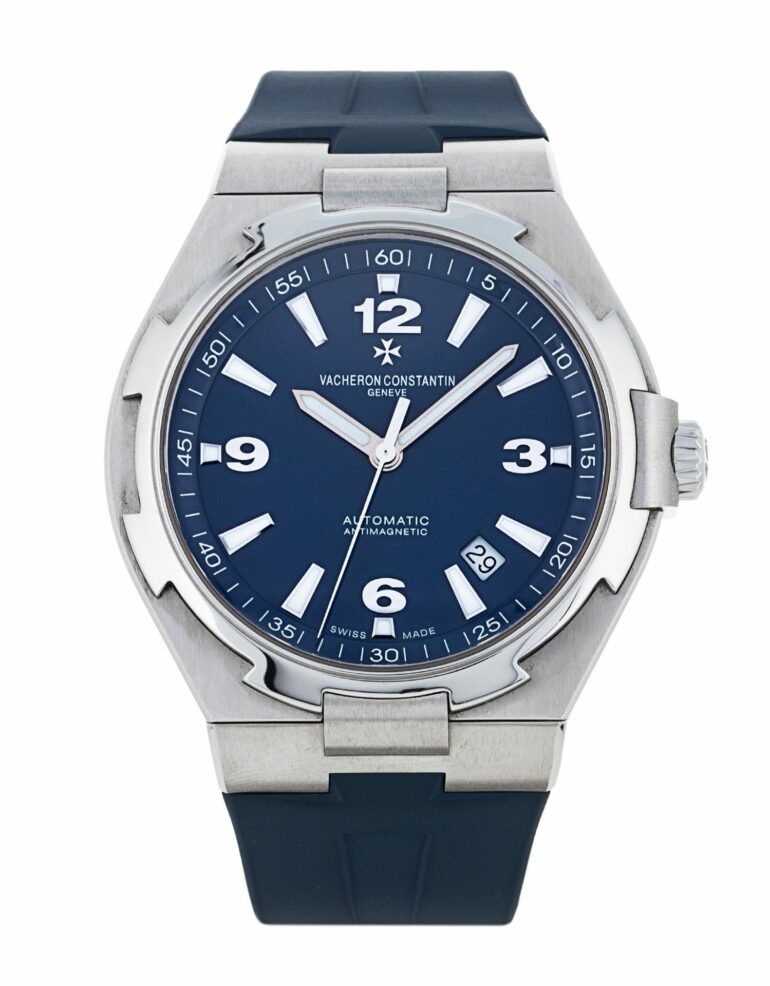
Paying the price of a high-end real estate investment just to slip onto your wrist an object thinner than a notebook: this paradox no longer surprises connoisseurs of fine watchmaking. Priced at 219,000 Australian dollars, the latest iteration of the Overseas Perpetual Calendar Ultra-Thin fully embraces this irony unique to the sector, where value is placed above all on the invisible, on subtraction, and on the infinitely small. As it celebrates the 30th anniversary of its flagship collection, Vacheron Constantin is conspicuously turning its back on spectacular one-upmanship. The Geneva-based manufacturer is releasing a strictly limited edition of 200 pieces in 18-karat white gold, opting for technical refinement rather than aesthetic upheaval.
With a case measuring 41.5 millimeters in diameter and just 8.1 millimeters thick, the timepiece follows in the strict tradition of watches that keep their true nature hidden. Complexity does not require bulk to express itself. Within this case, refined to the extreme, the brand has managed to house one of the most compact movements in the classical repertoire, proving that an abundance of functions does not necessarily result in a heavy feel on the wrist.
The Color of Restraint
The eye is first drawn to a radical shift in color palette. Historically, the Overseas has forged a visual identity centered on a deep, saturated, almost nocturnal navy blue. For this anniversary, the dial shifts to an azure hue of unusual clarity. This mineral-like hue, decidedly cooler, alters the very perception of the watch. The overtly sporty look gives way to a more cerebral approach. The timepiece loses some of its aggressiveness but gains a detached sophistication.
This deliberate paleness is not merely a designer’s whim. It addresses an ergonomic necessity. The dial of a perpetual calendar is, by its very nature, a space saturated with information. Fitting the day, date, month, leap year cycle, and moon phase onto a disc with a radius of just a few centimeters is a graphic design puzzle. Against this light background, the contrast softens and the displays breathe. Moreover, the collection’s signature geometry remains unchanged: the famous hexagonal bezel—a direct evocation of the Maltese cross, the brand’s signature—remains intact.
Taming the Calendar Chaos
Beyond the case design, the true focus of this edition remains the mechanics of self-correction. The perpetual calendar is fascinating because it is a machine designed to correct the errors of human history. Since the reform of the Julian calendar in the 16th century, the Western civil calendar has been based on a series of irregular rules, imposing months of 30 or 31 days and leap years to compensate for the astronomical discrepancy. Transforming this mathematical oddity into a ballet of autonomous gears requires a virtuosity that traditional watchmaking rightly considers the pinnacle of its art.
The automatic caliber 1120 QP/1 is responsible for this intellectual feat. Its proportions defy logic: the entire set of gears, cams, and levers required for the perpetual display fits within a movement just 4.05 millimeters thick. A feat of microscopic engineering that brings together no fewer than 276 individual components. The energy required to power this microcosm is sufficient for approximately 40 hours—a power reserve that the manufacture has managed to maintain despite the extreme space constraints.

The meticulous care taken in crafting this movement is recognized by the prestigious Geneva Seal. This independent certification guarantees that the pursuit of thinness has not come at the expense of the aesthetics of the finishes. Every bridge, every angle—even those invisible to the wearer—meets specifications whose rigor is matched only by the tradition from which they stem.
The Distant Call of the Open Sea
When the case is turned over, the sapphire crystal caseback reveals a 22-karat gold oscillating weight. The precious metal is not smooth; it is engraved with a compass rose. This specific ornamental choice serves as a reminder of the collection’s conceptual origins. The Overseas was born of dreams of sailing, distant horizons, and freedom of movement. Of course, with water resistance limited to 50 meters and such a sophisticated calendar, this ultra-thin version is better suited to shining under the subdued lights of a gallery than to braving the sea spray. But the symbolic link remains. The sculpted rotor keeps the spirit of adventure alive at the heart of an ultra-urban timepiece.
The way the watch attaches to the wrist follows the same contemporary logic. The model comes with an integrated white gold bracelet that seamlessly extends the lines of the case. Vacheron Constantin adds two interchangeable alternatives: one in white rubber, the other featuring a denim-blue texture. For several years now, the manufacture has emphasized this quick-release system, which allows the watch’s look to be transformed without the use of tools. What was once considered a mere convenience feature has become a core selling point, meeting the demand for versatility among today’s fine watch enthusiasts.
For its 30th anniversary, the Overseas is therefore not seeking any dramatic revolution. Vacheron Constantin has deliberately chosen to refine its icon with methodical caution. The brand is consolidating the achievements of the ultra-thin design, refreshing the color palette, and maintaining the excellence of the 1120 QP/1 movement. This conservative approach is by no means a compromise. On the contrary, it illustrates the full confidence of a brand that knows that a well-executed design needs only subtle adjustments over the decades to cement its legitimacy.