
The Gagosian Gallery’s new flagship location in Manhattan marks a masterful turning point. By bringing together Marcel Duchamp and Robert Rauschenberg, this inaugural exhibition celebrates the legacy of conceptual art, weaving a subtle link between art history and market forces.
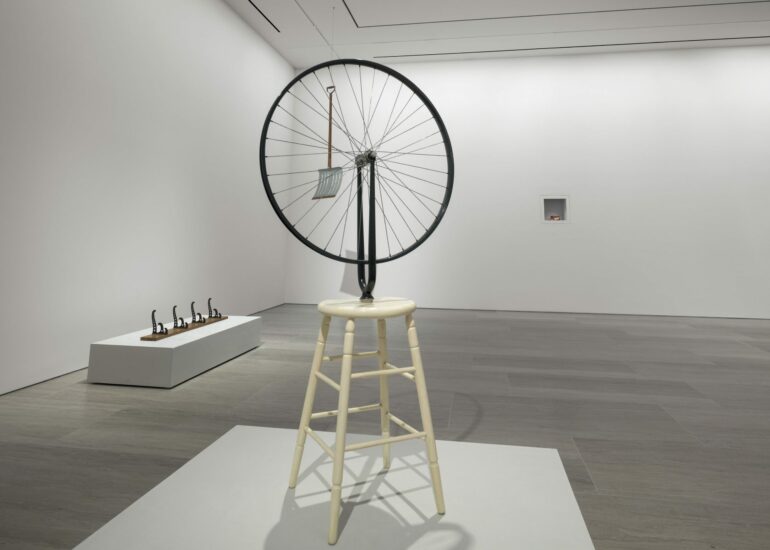
In Manhattan, Gagosian has orchestrated an opening that goes beyond a simple relocation to establish itself as a true manifesto. The gallery’s new flagship, nestled at 980 Madison Avenue and inaugurated on April 25, 2026, creates a dialogue between Marcel Duchamp and Robert Rauschenberg. The exhibition thus connects two decisive milestones in 20th-century art, crystallizing that historic shift in which everyday objects were transformed into absolute concepts.
A Historical Echo on Madison Avenue
The choice of this location is by no means coincidental. According to the gallery, these walls directly evoke the historic 1965 exhibition held at Cordier & Ekstrom, where Duchamp’s readymades were first introduced to the American public on the East Coast. The selection of this building creates a fascinating mise en abyme for the exhibition layout. The austere white of the space, with its deliberate minimalism, acts as a resonator for works that have precisely challenged the idea that aesthetic beauty can be an end in itself.
Gagosian’s message is crystal clear: to make this new venue a sanctuary for conceptual genesis. Duchamp reigns here as the absolute starting point, while Rauschenberg asserts himself as one of his most visionary heirs.
Duchamp or the Revolution of Intention
At the heart of the exhibition, *Fountain* naturally stands out as the centerpiece. The version on display, dating from 1964, was produced in collaboration with Arturo Schwarz. Although the original from 1917 has disappeared, the power of its status remains intact. This inverted urinal, signed “R. Mutt,” serves as a defiant reminder that Duchamp definitively shifted the debate from formal aesthetics to that of intention. Manual virtuosity gives way to choice, context, and, above all, the viewer’s perspective.
This logic, now at the heart of contemporary creation, was long synonymous with scandal, opening an indelible breach in the very definition of the work of art. His exhibition on Madison Avenue underscores just how much this original rupture remains the foundation of modernity, even within a market now keen on established values.
Rauschenberg: The Poetry of the Ordinary
In a room with a more intimate atmosphere, Gagosian unveils six masterful works by Robert Rauschenberg, on loan from the Cy Twombly Foundation, to mark the centennial of his birth. Here, personal history is intimately intertwined with art history. Rauschenberg and Cy Twombly met in 1951 at the Art Students League of New York, before embarking together on a formative journey through Italy, Morocco, and Spain.

These works, long kept in Twombly’s private collection, bear the mark of this unwavering bond. Among them, *Untitled* (1961) features a daring assemblage of metal, wire, a tin can, electrical cable, a light bulb, and a small stool. The piece encapsulates Rauschenberg’s fundamental contribution to postwar American art: an aesthetic of assemblage in which the trivial, far from being relegated to the scrap heap, acquires full poetic and material significance.
In Rauschenberg’s work, the ordinary does not disappear: it persists, it overflows, and it becomes art.
The Subtle Art of Institutional Narrative
The timing of this exhibition is part of a subtle strategy. The gallery is simultaneously supporting the first American retrospective dedicated to Duchamp since 1973, on view through August 22 at MoMA in New York. The approach is brilliant: while the museum enshrines Duchamp in art history, the gallery skillfully repositions him at the pinnacle of the commercial ecosystem.
This synergy illustrates the transformation of the major players in the global art market. Mega-galleries are no longer content to simply offer exceptional works: they forge narratives, claim curatorial legitimacy, and trace prestigious lineages, as exemplified by this claimed continuity between Duchamp and Rauschenberg.
The opening of this new space offers a rare immersion into the foundations of contemporary art, accessible to the public free of charge. The exhibition will run through June 27 for the space dedicated to Rauschenberg, and through July 31, 2026, for the space dedicated to Duchamp.