
Make Texture a preferred source on Google to support us
Add Texture to GoogleThe global luxury market is experiencing its sharpest decline since the pandemic, marked by a decline in the effectiveness of marketing and increased consumer awareness of authenticity and rarity, which is radically changing the strategies of major luxury brands. The most obvious explanation points to a sluggish economy and weakened Chinese consumer spending, but the reality runs deeper: buyers have become immune to traditional marketing.
A decade of celebrity endorsements, partnerships with influencers, and polished campaign imagery has largely lost its persuasive power. The brands most reliant on this model are now the ones suffering the most. The influencer model, which seemed innovative a few years ago, has become commonplace. At the same time, the flood of AI-generated images inundating social media has stripped branded content of its uniqueness. What the public now demands is simpler and impossible to fake: facts, genuine expertise, and trusted figures. In the luxury industry, this structural shift is ruthlessly reflected in the numbers.
The End of a Supercycle: The Slowdown in Numbers
According to the annual study by Bain & Company and Altagamma, the global market for personal luxury goods declined by approximately 2% in 2024, reaching roughly 364 billion euros. Forecasts for 2025 anticipate a further decline to 358 billion euros, well below analysts’ initial expectations. The KPMG report confirms this trend, noting that this is the first widespread annual decline since the pandemic, affecting all regions and categories. This situation has led Morgan Stanley to describe it as a period of major challenges, while Forbes has outright declared the end of the luxury supercycle.
The U.S. market is at the heart of this trend. Having fallen from approximately $109 billion in 2023 to nearly $99.6 billion in 2024, this decline is accompanied by an overall 5% drop in the valuations of major brands. At the same time, Chinese demand—the true driving force of the previous decade—has slowed sharply, with sales plummeting by 18 to 20% year-over-year. These shifts are deeply generational: the aspiring middle class is stepping back, and Generation Z—now a major force in consumer spending—is rejecting ostentatious status symbols in favor of a strict pursuit of authenticity.
LVMH: Size as Both a Shield and an Anchor
LVMH remains the undisputed giant of the sector, backed by its 75 prestigious brands such as Louis Vuitton, Dior, and Tiffany & Co. Despite a difficult year, the group maintained respectable revenue of approximately 80.8 billion euros for 2025, with net income nearing 10.9 billion. However, pressure is mounting: revenue for the first quarter of 2026 showed a 6% decline on a reported basis, and the stock price has fallen significantly. The group’s market capitalization has fallen to approximately 230 billion euros, far from its 2023 peak.
At Louis Vuitton, Pharrell Williams is the creative force behind the men’s collection. His impact lies in his legitimacy: he is not merely a brand ambassador; he designs, directs, and makes decisions. He is the quintessential example of a creative figure with genuine cultural stature who resonates with an audience weary of traditional advertising. LVMH’s challenge, therefore, does not lie in the authenticity of its artistic direction, but rather in its colossal scale, which inevitably ties it to an upper-middle-class clientele that is currently in sharp decline.
Kering: The Cost of a Strategy Running Out of Steam
The Kering Group, home to Gucci, Saint Laurent, and Balenciaga, is the most visible victim of this shift. Its revenue fell to approximately 14.7 billion euros in 2025, leading to a precipitous drop in its operating profit. Gucci, which accounts for a massive share of the group’s revenue, saw its sales decline by about 22%. Management cites a fragile recovery and is targeting 2027 for a potential return to growth.
While Kering’s heavy exposure to China explains part of these difficulties, the group above all illustrates the limits of “glitz and glamour” marketing. Gucci dominated the 2010s thanks to maximalist spectacle and the magnetism of celebrities. Faced with public fatigue, the brand lacked the depth to retain its audience—a failure that was harshly punished by the financial markets.
Prada and Hermès: The Exception Through Authenticity
Bucking the trend, the Prada Group stands out with revenue up by about 9% in 2025, driven in particular by the meteoric rise of Miu Miu. The brand has established itself by taking the opposite approach to formulaic marketing, prioritizing creative risk-taking and a narrative perceived as authentic by young shoppers. The recent acquisition of Versace further enhances this picture of dynamic growth.

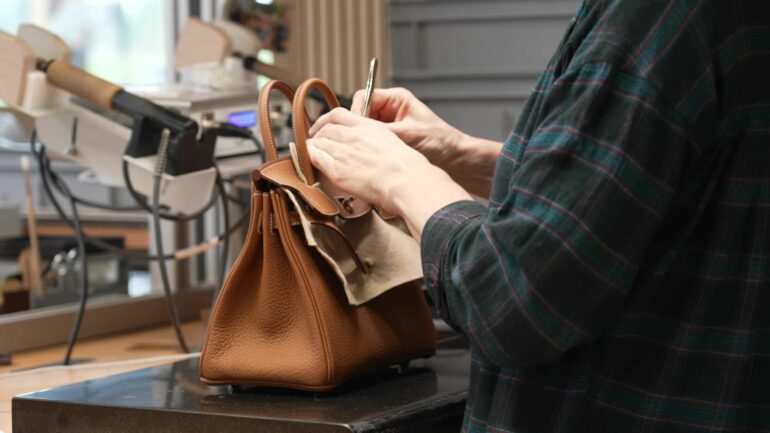
Within the select circle of independent fashion houses, Hermès and Chanel confirm this premium on authenticity. Chanel is returning to growth under the leadership of its creative director Matthieu Blazy, who is acclaimed for his creative credibility. For its part, Hermès, the sector’s leading light, has seen its sales rise by nearly 9.8%. Its business model—based on absolute rarity, artisanal craftsmanship, and ultra-controlled distribution—embodies precisely what luxury customers seek and reward today.
Creative Authority vs. the Illusion of Audience Reach
The era of transactional celebrity is coming to an end. While major fashion houses still surround themselves with renowned ambassadors, the number of followers is no longer the ultimate selling point. Christian Louboutin’s announcement of Jaden Smith as creative director for men’s wear is proof of this: beyond his social media reach, it is his credibility and his ability to challenge conventions that are valued. A trusted voice, combined with genuine creative work, now far outweighs a massive but disengaged audience. Standards have risen dramatically, and inauthenticity is now detected and rejected within a matter of hours.
The Markets’ Verdict
This ideological divide is directly reflected in stock market valuation multiples. Investors favor creative authority and scarcity: Prada is benefiting from its rapid growth, LVMH is holding its ground, and Hermès is reaping the premium of being the market’s ultimate safe-haven asset. Conversely, Kering—penalized by a business model that has for too long focused on spectacle—is now trading at multiples that reflect mistrust rather than expectations of growth. The conclusion is clear: in a world saturated with synthetic content and prefabricated narratives, the most valuable asset a luxury brand can offer is integrity that the customer can truly believe in.
Sources and references:
- Live Trading News: LVMH, Kering, and Prada: Luxury’s Reckoning as Shoppers Tune Out the Ads.
- KPMG (2025): Study “Luxury in Transition: Current Challenges and Paths for the Future.”
- Bain & Company x Altagamma: Report on the Global Market for Personal Luxury Goods.
- Vogue, Le Monde, AP News: Sector analyses and forecasts for luxury consumption in 2024 and 2025.