
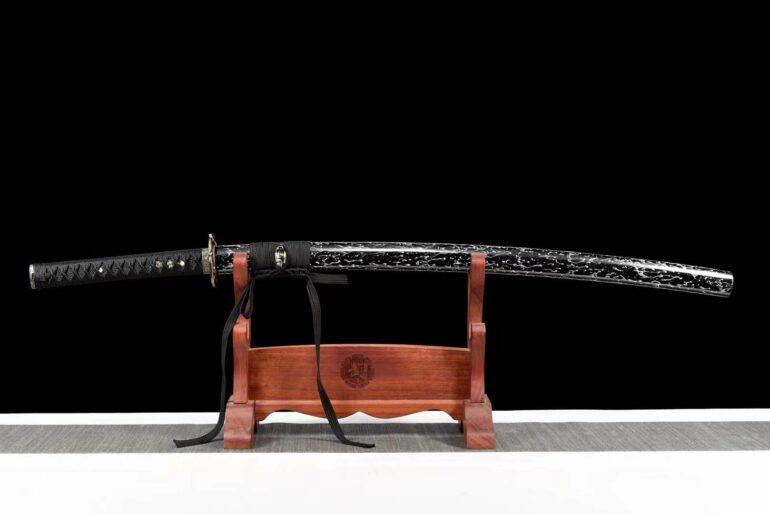
Faced with such a wide variety of choices, beginners and seasoned collectors alike must navigate the balance between tradition and modernity to acquire an authentic Japanese sword. It is a journey of discovery in which age, provenance, and condition dictate the rules of the art.
For a first purchase, the dilemma remains the same: should one opt for an antique blade, steeped in history, or choose a modern piece, crafted by a contemporary artisan? Japanese experts agree that this contrast is by no means a clash between the “real” and the “fake.” Tamahagane steel, differential tempering, and the precision of traditional forging intimately unite these two worlds. The distinction lies primarily in the patina of age, the origin, and the preservation of the object. The Agency for Cultural Affairs of Japan also notes that the creation of these artistic blades is strictly regulated by a licensing system, which ensures the continued existence of this exceptional craft (bunka.go.jp).
The Aesthetics of the Ages and the Interpretation of Steel
In the lexicon of discerning connoisseurs, historical context matters just as much as the sharpness of the blade. Historical blades are divided into distinct periods—koto, shintō, shinshintō, or gendaitō—based on historical milestones that are now undisputed. The Japan Cultural Expo emphasizes that the sword transcends its martial function to rise to the status of an object of art and design, rich in symbolism. However, to the untrained eye, this beauty often boils down to a mere play of reflections. Experts therefore advise focusing first on the temper line—the famous hamon—before succumbing to the romanticism of a bygone era. (japanculturalexpo.bunka.go.jp)
The primary pitfall is confusing age with excellence. A centuries-old piece may turn out to be worn, clumsily polished, or of uncertain authenticity. Conversely, a recent creation will offer crystal-clear traceability and be in immaculate condition. The Agency for Cultural Affairs scrupulously monitors objects classified as tangible cultural properties, strictly regulating their export. This strict framework largely explains the absolute rarity of antique and sought-after pieces on the international market. (bunka.go.jp)
The Reassuring Appeal of Contemporary Forging
Gallery owners and art dealers often share a valuable piece of advice: starting your collection with a modern blade—especially if your budget is limited—can help you avoid many disappointments. Contemporary works possess a clear identity, a recognized artisan’s signature, and impeccable provenance. The Japanese government requires today’s blacksmiths to undergo extremely rigorous training under the guidance of an established master, necessitating many years of apprenticeship before certification. This requirement instills genuine confidence in the market, without erasing the subtle hierarchy that exists among the various blacksmiths. (bunka.go.jp)
Furthermore, while the production of tamahagane steel is concentrated in historic strongholds such as the Okuizumo region, it does not claim an absolute monopoly, as noted by the JNTO. The scarcity of contemporary production stems from its confidential and highly regulated nature, which sometimes imposes lead times comparable to those in fine watchmaking. Acquiring a modern piece means embracing transparency: knowing precisely who forged the metal, when, and according to which lineage of expertise. (japan.travel)
The Inimitable Aura of Antiquity
Yet the ancient blade possesses a quality that new pieces cannot imitate: the majestic imprint of time. The Japan Cultural Expo highlights these masterpieces preserved in museums, silent witnesses to the Heian, Kamakura, and Muromachi periods. Having weathered reigns, battles, and stylistic shifts, these weapons transcend the status of mere objects of beauty to become tangible fragments of Japan’s history. (japanculturalexpo.bunka.go.jp)
This historical prestige, however, comes with real complexity in the art market: authentication requires specialized expertise, apocryphal signatures exist, and the condition of the object ultimately dictates its value. Connoisseurs urge the utmost caution when faced with overly flattering attributions. On an antique blade, the mere mention of a school in no way guarantees the hand of an absolute master—a nuance in attribution that can prove costly to a novice. (tokyo-nihonto.com)
In the discreet world of Japanese swords, a purchase must be made with full awareness. This is why experienced collectors often suggest an antique wakizashi (short sword) as a first piece. More compact and often better preserved, it reveals its mechanical vulnerabilities more clearly than an imposing katana. But the standards remain the same: the quality of the polish, the sharpness of the hamon, and the authenticity of the certificates of expertise are non-negotiable. (japanculturalexpo.bunka.go.jp)
The Method Beyond the Myth
In this exceptional market, prices fluctuate dramatically depending on the era, condition, and provenance of the blade. Market guides consulted by dealers show that authentically documented pieces, endowed with genuine heritage value, operate in a realm far removed from mere decorative objects. A historic, certified, and immaculate blade achieves a level of excellence that a replica cannot even approach. Japan’s cultural preservation system, designed to safeguard major cultural assets, naturally reinforces the value of these remarkable works. (bunka.go.jp)
Ultimately, the ideal first sword is not necessarily the most venerable or the most spectacular. It is the one that educates the eye without ever straying. Modernity offers a clear gateway into the world of the samurai, while carefully selected antiquities provide a visceral connection to history. While both approaches are noble, the only true mistake would be to succumb to the illusion of a dubious piece, sold as a treasure when it is merely an approximation. (bunka.go.jp)
Ultimately, this first acquisition intimately reveals the connoisseur who chooses it. Those seeking a historical anchor will turn to the ancient, adopting the meticulous patience of an archivist. Conversely, the connoisseur eager to grasp the material, the pure craftsmanship, and the passion of a living tradition will favor the clean lines of the modern. The soul of the Japanese sword has never disappeared: it has simply evolved, moving from battlefields to contemporary workshops, and on to the refined interiors of private collections. A fascinating continuity that far transcends folklore. (japanculturalexpo.bunka.go.jp)
The ultimate truth lies in this blade, whose authenticity, documentation, and integrity stand up to any scrutiny. In a world of luxury and heritage where history forges value, rigorous verification remains, now more than ever, the most elegant and reliable approach. (bunka.go.jp)