
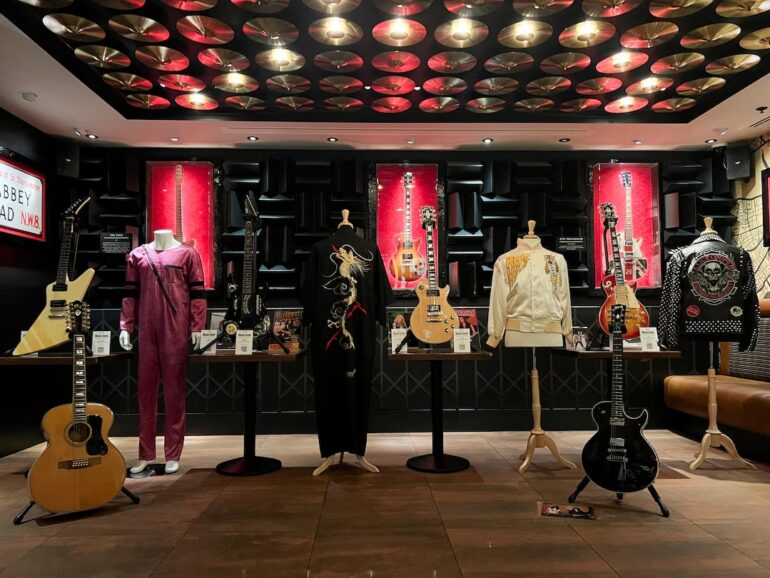
In New York, the annual Music Icons auction reveals that enthusiasm for iconic musical memorabilia shows no signs of waning. Record prices for items linked to legendary figures attest to a market that remains as passionate and lucrative as ever.
Julien’s Auctions has confirmed that rock and pop memorabilia has lost none of its luster. At this auction, held in late May at the Hard Rock Cafe Times Square, the auction house sold nearly 700 lots. Bidders came from over thirty different countries. The results show that an ecosystem relying heavily on rarity—but above all on the very history of the items—continues to run at full speed.
Relics turned into trophies
The most spectacular sales exceeded some pretty dizzying thresholds, whether for guitars or stage accessories. Ace Frehley’s 1975 Gibson Les Paul Ace 1, for example, fetched $512,000. That’s pretty impressive, isn’t it? Johnny Cash’s Martin D-18 acoustic guitar—the one he played during his debut at the Grand Ole Opry in 1956—found a buyer for $192,000. As for the Charvel Art Series, played and signed by Eddie Van Halen during his final concerts, it sold for just over $115,000.
All of this illustrates a dynamic we’re actually quite familiar with in the world of luxury and collecting. The object isn’t limited to its material composition. Its value stems above all from its intimate connection to a pivotal moment in a career, a specific live performance, or a figure who forged the legend.
The Power of Storytelling
Julien’s places heavy emphasis on the importance of provenance. The case of Johnny Cash, in this instance, speaks volumes. His guitar was directly rooted in a pivotal period of his career, which multiplies its symbolic weight tenfold. Ace Frehley’s Les Paul has a somewhat dual aura, on stage and in the studio, in a context where the visual aspect sometimes mattered just as much as the accuracy of the note.
What’s fascinating is that the market values tangible proof, of course, but also the legend surrounding it. Documented authenticity counts almost as much, if not more, than a simple signature. It’s really this standard that separates a mundane tour souvenir from a precious artifact. An authentic fragment of history, in short.
The aura of the accessory
Results for non-instrument items are just as telling. Take the belt worn by Mick Jagger in Hyde Park in 1969. It sold for $51,200, literally shattering all estimates. Prince’s custom-made boots from the 1990s reached $35,200, and Meg White’s famous dress from the Elephant album cover sold for $25,600.
Further down the catalog, a Polaroid of Madonna from the early ’80s found a buyer for $12,800. A Bible that belonged to Hank Williams Sr. went for $7,680. The auction also featured highly specialized items related to Bowie, Mercury, Elton John, and Sabrina Carpenter.
Between sentiment and financial investment
Martin Nolan, CEO of Julien’s Auctions, explains that these items inevitably attract buyers seeking rare pieces with strong cultural significance. He also touched on the current somewhat uncertain economic climate, noting that these pop culture artifacts tend to appreciate in value, functioning almost like tangible assets.
And honestly, it’s not that illogical. Recent sales show that while certain star lots break records, mid-tier pieces can also skyrocket in value quite unexpectedly. This fluctuation clearly demonstrates that passion on one hand and investment on the other often coexist without any real established rules.
The New York exhibition, following highly acclaimed stops in Tokyo and the United Kingdom, still featured over 650 artifacts. A market that, as one might suspect, thrives on industry as much as on pure nostalgia.
Ultimately, vintage rock is no longer content to merely decorate interiors. It is traded like a certified piece of history. And judging by these auctions, guitars still have a lot to say, even far from the stage.