
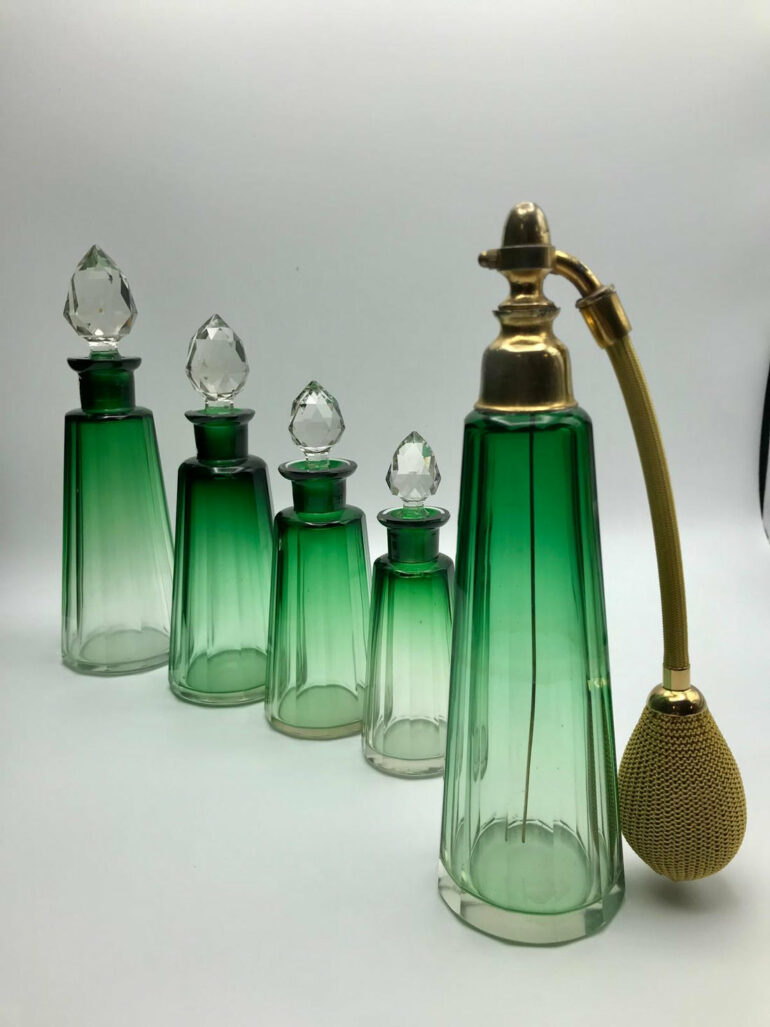
Vintage or discontinued perfume bottles are fetching record prices, reflecting a new quest for rarity and authenticity in the face of excessive media coverage and changing formulas.
Vintage perfume is no longer simply a matter of nostalgia; it has now become a true object of pursuit, study, and sometimes pure speculation. On the secondhand market, certain bottles by Guerlain, Nina Ricci, or Lancôme are fetching prices that would have seemed irrational just a few years ago. This phenomenon illustrates the spirit of our times: the more a fragrance becomes widely available and circulated, the more it risks eroding the aura of desirability that was its original essence.
A Lost Olfactory Grammar
Among the most coveted pieces is Djedi, a Guerlain creation unveiled in 1926. Its composition, which elevates vetiver and civet in a dark aesthetic, belongs to another world—a unique olfactory grammar. If this fragrance is now considered extremely rare, it is not only because of its great age, but above all because its composition no longer resonates with the current standards of department stores or with contemporary perfumery.
On the resale market, some bottles easily exceed the 3,000-euro mark. Of course, this spectacular valuation is not based solely on the physical rarity of the bottle. It reflects a genuine desire to preserve heritage, a fascination with the object itself, comparable to the enthusiasm that drives collectors of art or haute couture.
The Demand for the Original Formula
The buzz surrounding discontinued fragrances isn’t limited to formulas that have been permanently discontinued. The craze also extends to vintage editions of perfumes that are still on the market but whose formulations have been reformulated. According to industry experts, many connoisseurs are seeking out a specific era or a precise olfactory context—far more than just a brand.
The reason is purely structural: formulas change. European regulations restricting the use of certain raw materials, coupled with inevitable industrial trade-offs, have often forced fragrance houses to adjust their blends. As a result, a single fragrance may retain its name but lose part of its historic signature or its vibrant uniqueness.
Within this select circle of connoisseurs, there is fervent discussion of the original Mitsouko or the first editions of L’Air du Temps, considered infinitely richer and more nuanced than their contemporary versions. It is no longer simply a matter of scent, but a genuine effort to preserve the fragrance’s intrinsic memory.

Collectible Archives and the Tyranny of Virality
This niche market has gradually evolved into a veritable global olfactory library. Specialized platforms, such as Basenotes.net, have established themselves as indispensable guides for tracking down the elusive. On trading platforms like eBay, buyers scrutinize every detail with the precision of an archivist: batch numbers, the level of the precious liquid, and the condition of the bottle and cap.
However, the unexpected driving force behind this craze is no longer just the quest for memory; it is also a rejection of ubiquity. Spurred by social media, particularly TikTok, the search for a distinctive and stylized scent has become second nature. The paradox is cruel: as soon as a fragrance goes viral, it loses its exclusivity. Instead of serving as a marker of distinction, its meteoric success breeds the very uniformity that luxury enthusiasts strive to avoid.
Revival Through Heritage
Faced with this mass proliferation, elite buyers are taking a step back and favoring vintage fragrances—formulas preserved before they were reformulated—or seeking out forgotten historical stock. This trend is part of a broader movement sweeping the luxury industry: the primacy given to provenance, traceability, and narrative, at the expense of the immediacy of novelty.
It is no coincidence, in fact, that historic, long-dormant houses such as Bienaimé, D’Orsay, Le Galion, and L.T. Piver are now experiencing a spectacular renaissance by reviving their heritage formulations. The past is no longer seen as an outdated relic; it has emerged as a powerful driver of modernity—provided, of course, that it is rigorously sourced, documented, and authenticated.
Ultimately, a vintage fragrance goes far beyond its original purpose. It encapsulates a story, an era, and a precious, quantifiable formula. In an ecosystem saturated with images and constant new launches, this fragrant subtlety has acquired inestimable value, becoming the ultimate expression of contemporary luxury.