
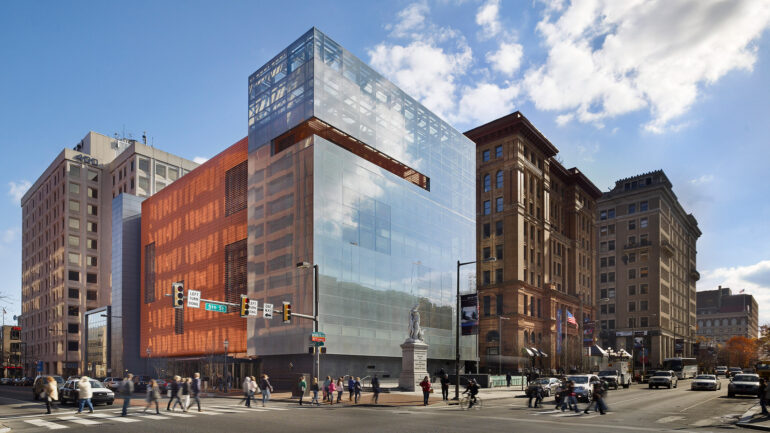
In Philadelphia, the Weitzman National Museum of American Jewish History is launching a major $100 million fundraising campaign. The goal: to modernize its exhibition design, secure its financial sustainability, and rethink its national narrative, at a time when issues of identity and the resurgence of antisemitism are reshaping the American cultural landscape.
A monumental and enduring ambition
The Weitzman National Museum of American Jewish History, located in the heart of Philadelphia, is embarking on a transition from mere survival to a true reinvention. According to the Philadelphia Inquirer, the institution has launched a fundraising campaign of unprecedented scale, aiming for the $100 million mark. Half of this endowment will be allocated to an architectural and curatorial overhaul of the exhibitions, while the remainder will go toward an endowment fund. The museum notes that it has already raised $50 million, driven by the founding patronage of designer Stuart Weitzman.
The message is crystal clear: the institution must first be stabilized before its history can be rewritten. After years of economic fragility, this initiative marks a decisive strategic turning point, prioritizing solid foundations over mere fleeting brilliance.
As early as 2021, Stuart Weitzman’s donation had helped save the institution. The museum, renamed in his honor at the end of that same year, regained much-needed financial breathing room, although its long-term financial security still needs to be consolidated. For Dan Tadmor, the museum’s director, the goal is to raise the endowment to $50 million. The interest generated would thus cover a substantial portion of the annual operating budget, estimated at between $10 and $11 million.
This rigorous management directly dictates the independence of the programming. Without a robust financial foundation, a national museum, no matter how majestic its architecture, risks being nothing more than a fragile shell.
Intellectual Overhaul and Curatorial Standards
The planned renovations go beyond simply updating the museum’s furnishings or digital displays. They require a genuine intellectual rethinking. The design of the main exhibition, which opened sixteen years ago, is based on paradigms dating from the 2000s. As Dan Tadmor pointed out, thematic museography quickly becomes outdated: narratives, technologies, and conceptual approaches are constantly evolving. This reality is all the more pressing for an institution tasked with embodying a national history.
At the same time, the museum is organizing a new permanent exhibition dedicated to contemporary antisemitism, scheduled for October. Starting in July, an immersive space designed for children and inspired by the seven days of Creation will open, succeeding the temporary exhibition "The First Salute," which opened in April as part of the 250th anniversary of the United States.

Redefining the American Narrative
This transformation inevitably raises a complex question: what should a national Jewish museum convey in today’s America? The leadership emphasizes the need to avoid scattered or purely hagiographic narratives. The curatorial debate is wide-ranging: should the narrative trace back to the ancient roots of Judaism, or begin with the arrival of the first Jews in New Amsterdam in 1654? There is also the challenge of integrating Israel, Zionism, and Jewish values with nuance and precision.
To guide this reflection, the institution has established an advisory committee bringing together experts in storytelling, marketing, and public engagement, drawn from diverse backgrounds in terms of both their origins and their religious sensibilities. In other words, the project will not be merely a museum endeavor; it will also be interpretive, almost diplomatic.
A historical landmark facing contemporary challenges
Founded in 1976 near the Mikveh Israel congregation, the museum now stands on the prestigious Independence Mall site. According to Visit Philly, it remains the only national museum exclusively dedicated to the American Jewish experience. A powerful symbol coupled with a major responsibility.
This role takes on particular significance in the current climate. When the building opened in 2010, American anti-Semitism seemed, to many, a thing of the past. An illusion swept away by recent events, as the museum’s leadership points out. The institution therefore aspires to establish itself as a sanctuary of trust within a landscape where suspicion is taking root. The integrity and reliability of its messaging, once taken for granted, are now the focus of intense scrutiny.
Ultimately, this $100 million campaign goes beyond a mere quest for visibility. It responds to a historical urgency. In a nation where the narrative of integration has long seemed sufficient, the museum reaffirms that the memory of a minority is neither secondary nor decorative. It demands to be precise, vibrant, and, above all, built to stand the test of time.