
The 82nd Whitney Museum Biennial: A Selection That Balances Restraint and Brilliance
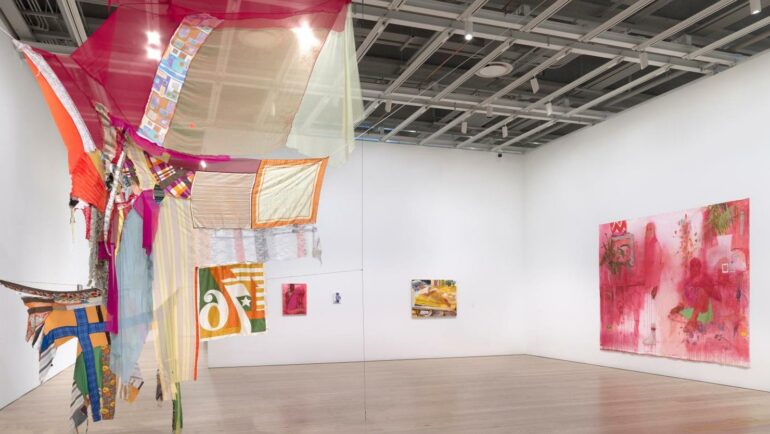
The 82nd Whitney Museum Biennial, which just opened in New York, presents a measured yet skillfully provocative selection. By prioritizing emotion and direct experience in the face of social and historical upheavals, the institution plays on the ambivalence of an openness that at times borders on vertigo, without ever losing sight of its contemporary resonance.
Opened on March 8, 2026, with the quiet confidence characteristic of major institutions, this year’s flagship event of American contemporary art does not seek to upend the status quo. Spanning levels 1, 5, 6, and 8 of its majestic Gansevoort Street venue, the exhibition brings together 56 artists, duos, and collectives under the curatorial leadership of Marcela Guerrero and Drew Sawyer. Conceived as a vessel for the “moods” of contemporary America, the exhibition design exudes a confident flexibility. This fluidity, while inviting visitors to wander, can at times result in an interpretation that’s a bit too diffuse.
The Art of Evasion: A Weightless Curatorial Approach
From the very first rooms, the approach is clear: to prioritize the interplay of aesthetics rather than the assertion of an authoritative thesis. The Whitney chooses to let individual sensibilities blossom. This curatorial freedom, while offering superb visual vistas and avoiding the pitfall of an overly dogmatic narrative, sometimes leaves a sense of emptiness hanging in the air. As critic John Vincler points out in the pages of *Cultured*, the absence of a sharp guiding thread or an obvious narrative is felt at times.
The Biennale gains in breadth what it loses in sharpness. This ambivalence punctuates the visit: some works are deeply rooted in the country’s geopolitical climate, while others take refuge in a muted abstraction—seductive but not always eloquent. An exhibition that, on the whole, seems to prefer the thrill of the surface to abyssal depth. A subtle but revealing nuance.
The Urban Imprint: New York Confronts Its Own Paradoxes
At the heart of this mosaic, Ignacio Gatica’s work stands as a manifesto. With his work centered on “Sanhattan,” the artist forces the metropolis to look at itself in the mirror. With formidable conciseness, the work reminds us that beneath the city’s glittering veneer lie layers of migration and a powerful Latin American heritage. The message takes on formidable significance within the Whitney itself, surrounded by rampant gentrification. Gatica does not merely document the displacement of populations; he forcefully reminds us that glossy images of a metropolis always silence the stories of those who have survived there.
Here, social critique is not mere rhetoric: it is the raw material of the work, which multiplies its impact tenfold. Where others merely skim the surface of urban tensions, Gatica embeds them in the very DNA of the city. The museum thus shifts from being a passive observer to an active witness to its own environment.
The Energy of the Street in the Sacred “White Cube”
Strategically positioned, Tânia H. Cruz’s work acts as an emotional buffer zone. Visible from Gansevoort Street, her panel from *I Saw the Future and It Smiled Back* radiates raw graphic energy, depicting a youthful face in greenish hues. Born in 1998, the young New Yorker infuses her work with a sense of urgency born in the public sphere—an organic vitality that the museum attempts to absorb within its immaculate walls.
Inside, her murals extend this impulse. Her lines are feverish, spontaneous, and devoid of any purely decorative naivety. This style, with its childlike accents, transforms into a visual shorthand of formidable precision. In Cruz’s work, optimism is anything but naive; it is skillfully kept at a distance by the radical nature of the artistic gesture, reminding us that the promise of a better future remains infinitely fragile.
Suspended Memories: The Inevitable Confrontation
The emotional climax of this Biennial is undoubtedly found on the top floor, with Precious Okoyomon’s masterful installation. Her monumental work, composed of hanging dolls whose nooses starkly evoke the sordid history of lynchings in the United States, takes visitors’ breath away. The stark contrast between the innocent familiarity of the childlike object and the unbearable barbarity of the motif makes the whole experience deeply visceral.
Okoyomon rejects polite metaphor. She exposes the material residue of a repressed history, proving that certain memories resist aesthetic erasure. In a Biennial that often cultivates a step back, this formal and political brilliance commands attention. Her work in no way seeks to soothe; it forces a direct confrontation.
A seismograph of an era in chiaroscuro
While the overall coherence may sometimes elude the viewer, this 82nd edition undeniably shines through its visceral points of friction. Between Cruz’s suspended future, Gatica’s critical cartography, and Okoyomon’s unsettling spectres, the Whitney offers a rich and complex X-ray of a changing world, far surpassing the sometimes nebulous framework of its artist’s statement.
International critics, moreover, confirm this balancing act, oscillating between praise for the exhibition’s emotional depth in *The Week* and *Spike Art*, and the observation of a reluctance to confront crises in *National Review*. Whether it appears as a transit zone or a true manifesto, this Biennial proves that an event of such magnitude remains an essential barometer of our collective lucidity.
On view through August 23, 2026, at the Whitney Museum of American Art, this edition ultimately reaffirms an immutable law of contemporary art: beyond the discourse, it is the most demanding works that etch themselves into the mind’s eye and ultimately leave an indelible mark.