
The Distorting Mirror of the Masters: Salvador Dalí or the Obsession with Lineage
In the collective imagination, Salvador Dalí embodies a break with tradition, a chromatic scandal, and eccentricity elevated to a system. Yet behind the waxed mustache and melting clocks lies a student deeply committed to tradition—a painter whose gaze constantly oscillated between the future of Surrealism and the deepest roots of art history. A groundbreaking museum exhibition, currently on view at the Dalí Museum in Florida, sets out to dissect this complex—and at times symbiotic—relationship that the Catalan artist maintained with his predecessors.
The project does more than simply juxtapose aesthetics; it explores how Dalí literally extracted the essence of the great masters to fuel his own obsessions. Far from being merely an early influence, art history served as a reservoir of techniques and mental frameworks that he reinterpreted to imbue his dreams with surgical precision. This journey through the centuries reveals a paradoxical artist, capable of subverting reality while drawing on the strictest rules of classical painting.
The Guiding Shadow of Leonardo da Vinci
The exhibition highlights a major spiritual and technical connection: the one linking Dalí to Leonardo da Vinci. For the Catalan artist, the Renaissance genius was not merely a painter, but an architect of visual thought. We find in Dalí this same fascination with the hidden geometry of nature, with the mathematical structures that underlie the apparent chaos of landscapes. Where Leonardo explored sfumato to create depth and mystery, Dalí used an almost aggressive clarity to emphasize the unreality of his scenes.
This connection with da Vinci goes beyond mere visual allusion. It lies in a quasi-scientific approach to composition. The Dalí Museum highlights Dalí’s determination to measure himself against the giants of history. When observing his surrealist paintings, one perceives this quest for the “divine proportion”—that Leonardo-esque balance that gives even his wildest visions an indisputable formal foundation. It is this contrast between the subject—often drawn from the depths of the unconscious—and an execution rooted in the Renaissance that creates the sense of strangeness so characteristic of his work.
Flemish precision in the service of the dream
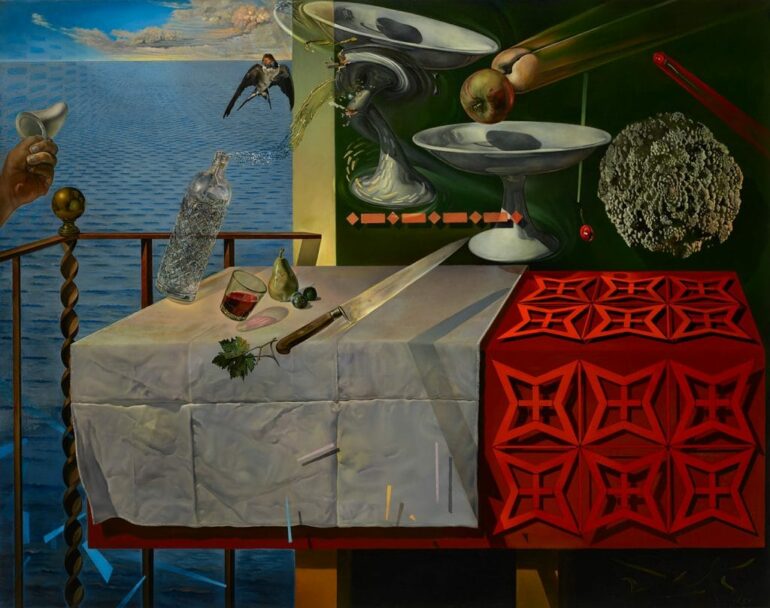
Another essential aspect of this historical reinterpretation concerns the influence of Dutch still lifes. Attention to detail, the transparency of materials, and the almost tactile rendering of objects—characteristics specific to the Flemish and Dutch masters—were fundamental tools for Dalí. He realized very early on that to make the surreal acceptable—or even terrifying—it had to be painted with the precision of a 17th-century miniaturist.
The exhibition highlights how this technical rigor allowed Dalí to lend credibility to the impossible. By borrowing the stark light and meticulous rendering of still lifes, he endowed his dreamlike objects with a unsettling physical presence. A rock, a deformed limb, or a musical instrument acquire, under his brush, the same dignity and density as a glass of wine or a loaf of bread in a painting by a Delft master. This methodical borrowing from Dutch technique allowed him to transform his hallucinations into tangible realities, proving that surrealism is never more effective than when it expresses itself through extreme realism.
The Past as a Driving Force of the Avant-Garde
By establishing this dialogue across the centuries, the Florida institution questions the very nature of modernity. Dalí never sought to make a clean break with the past, unlike some of his contemporaries. He preferred to act as a rebellious heir, using the codes of classical art in order to subvert them more effectively. His work appears here as a vast exercise in intellectual recycling, where every innovation finds its source in an old rule that has been turned on its head.
This journey through Dalí’s influences shows that his provocations were never gratuitous. They were grounded in profound erudition and immense respect for the craft of painting. By engaging with the masters of art history, he sought to secure a place alongside them. This exhibition reminds us that Dalí’s originality does not lie in inventing forms out of nothing, but in his ability to create a dialogue between eras within a single image. He knew how to transform art history into a malleable material, a building block for his own personal mythologies.
Ultimately, the analysis presented by the museum highlights a truth often obscured by the media persona: Dalí was a revolutionary conservative. His genius lay in understanding that to explore the meanderings of the human mind and the landscapes of the unconscious, he needed the crutches of tradition. For him, Leonardo da Vinci or still-life painters were not models to be copied, but geographical landmarks in an exploration that aimed, from the outset, to transcend the limits of ordinary perception. Visitors emerge from this encounter with the certainty that Dalí’s surrealism is not a break with the past, but an extension—a spectacular metamorphosis—of a heritage spanning many centuries.