
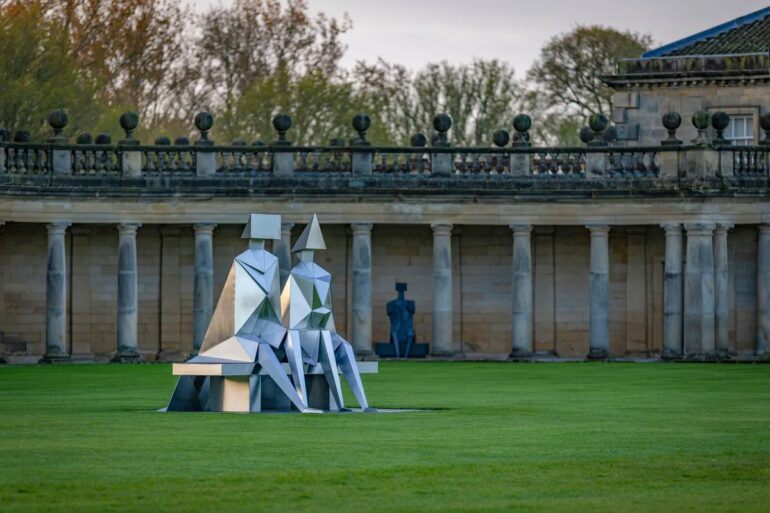
Contemporary Art Amid Ancient Stones: The Aesthetic and Financial Challenge of Historic Mansions
Along the hushed corridors lined with portraits of stern-faced ancestors, a neon glow suddenly pierces the twilight. It is no longer just the creaking of the hardwood floors or the scent of wax that greets the visitor, but the raw, almost wild clash between a frozen past and the most visceral form of creation. This summer, British and European architectural heritage is no longer content with its own glory. Out of necessity as much as audacity, it is opening itself up to interventions by major figures in contemporary art, such as Tracey Emin, or the monumental structures of the late Phyllida Barlow. Far from being a mere curatorial whim, this visual clash is emerging as a vital survival strategy for buildings whose upkeep demands ever-increasing resources.
Visual Disruption as a Draw Card
The public strolling through the English-style gardens or the reception halls of these grand estates has changed. Genealogy enthusiasts and lovers of velvet curtains are no longer enough to balance the budgets of the foundations that manage these monuments. To attract a new audience, a shock was needed. The introduction of contemporary artworks into these historic settings acts as a magnet for a new generation of visitors—urban and digitally connected—who might never have crossed the threshold of an 18th-century manor house without the promise of a radical aesthetic experience.
The goal is clear: to transform the monument into a temporary art center. By inviting artists whose fame extends far beyond the boundaries of the traditional art market, the managers of these sites capture the attention of international media and social media. An installation by Tracey Emin, featuring her handwritten messages rendered in blown-glass tubes, creates a unsettling intimacy with the surrounding architecture. This contrast between the artist’s vulnerability and the solidity of the cut-stone walls generates a tension that becomes, in itself, a travel destination.
This approach helps generate crucial direct revenue. Ticket sales are on the rise, driven by the event-driven nature of these seasonal exhibitions. But beyond the box office, the entire ecosystem of these buildings is being revitalized. The gift shops offer limited editions, the cafeterias are seeing a surge in visitors, and annual memberships are finding takers among an audience that now views these places as spaces of living culture rather than mausoleums of the gentry.
Phyllida Barlow’s Legacy: Sculpting the Void and the Full
Phyllida Barlow’s contribution to this trend is emblematic. Her sculptures, often described as “anti-monumental” despite their imposing size, use modest materials—plywood, cardboard, fabric, plaster—to challenge the authority of the spaces that house them. Where a historic residence exudes permanence and the richness of noble materials, Barlow’s works introduce a form of organized precariousness. At times they seem on the verge of collapsing; at other times, they occupy the space with such force that they compel the visitor to rediscover the dimensions of rooms they thought they knew.
The impact of these installations on the perception of heritage is profound. They are not simply objects placed in a room, but interventions that engage in a dialogue with the building’s history. Barlow’s work, documented and supported by institutions such as the Hauser & Wirth gallery, demonstrates that contemporary art can enhance the old without overwhelming it. On the contrary, it highlights the majesty of the ceilings or the perspective of the long, interconnected rooms through a play of distorting mirrors and raw textures.
For the owners of these buildings—whether private families or public agencies—hosting such works presents an immense logistical challenge. They must bring in tons of steel or wood into fragile structures, protect the historic floors, and ensure the safety of the artworks without detracting from the public’s experience. Yet the investment is well worth it. The venue’s image is revitalized, placing it on the global map of contemporary art, just like a biennial or an international art fair.
Tracey Emin and the Invasion of the Intimate
In contrast to Barlow’s tectonic structures, Tracey Emin brings a raw, almost confessional emotional dimension. Her work, often centered on the body, desire, and loss, finds a particular resonance within the rigid framework of historic residences where emotions have often been contained behind strict protocols. Exhibiting her paintings or bronze sculptures in these settings means allowing the human element—and its fragility—to return to the heart of the immutable stone.
This artistic programming is also a way to diversify visitor demographics. The audience that follows the Tracey Emin Foundation is often younger, more diverse, and more politically or socially engaged than the typical heritage visitor. By opening their doors to these perspectives, historic buildings become part of current social debates, proving that they can be places for reflection on the present—not just the past.

The financial aspect cannot be ignored. The presence of artists of this caliber attracts patrons and sponsors who wish to associate their names with this alliance between tradition and the avant-garde. A new economic model is taking shape: that of hybrid patronage, where support for heritage is achieved through the funding of contemporary art. Public subsidies, which are often declining, are thus supplemented by private funds drawn to the prestige and visibility of these artistic collaborations.
A Sustainable Development Model for Cultural Heritage
The use of art to support historic buildings is not merely a passing fad. It is a structural response to the crisis in traditional cultural tourism. By offering exhibitions that change every summer, these sites encourage repeat visits. People no longer visit “the castle” just once in a lifetime; they return every year to discover how a new artist has transformed the space.
This dynamic also boosts the local economy. Hotels, restaurants, and local businesses benefit from this influx of tourists drawn by big names in the art world. In some rural areas, these exhibitions have become the main driver of summer activity. Institutions such as the National Trust in the United Kingdom or private foundations in France have understood this well: a historic monument should no longer be a burden, but a dynamic asset capable of generating its own wealth through culture.
However, maintaining this balance remains a delicate task. The goal is to avoid turning these historic homes into amusement parks or betraying the spirit of the place with interventions that are too out of touch. The success of these initiatives depends on the relevance of the artists chosen and the quality of cultural mediation. Visitors must understand why a particular work is there, what it brings to the building, and what the building brings to the work.
The future of heritage will undoubtedly involve this constant hybridization. By agreeing to become laboratories for the art of tomorrow, the stone witnesses of yesterday secure a place in the hearts of a public that demands more than mere history lessons. Far from desecrating ancient walls, contemporary art offers them a new lease on life and the financial means to withstand the centuries to come. Summer is coming to an end, but the traces left by these installations will remain etched in the memory of these places, proving that beauty—whether centuries-old or newly emerging—always thrives on contrast.