
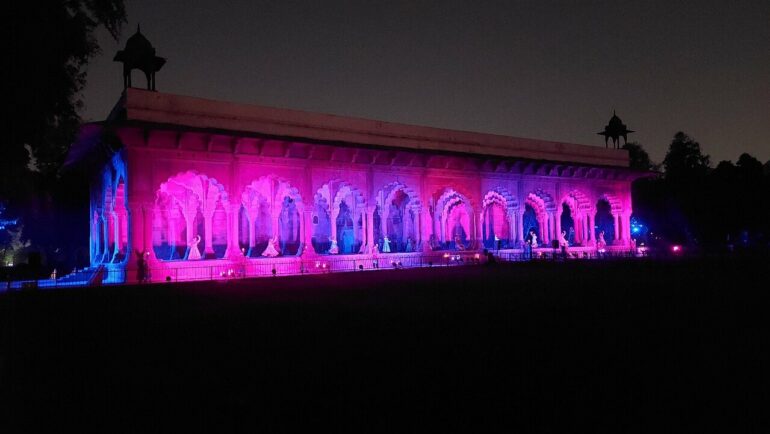
In Defence Colony, art galleries are joining forces to offer an informal and accessible experience that fosters connection, diversity, and cultural exchange in the heart of a popular residential neighborhood in Delhi.
A New Nightlife Map
In Delhi, the Friday-night ritual has long followed an unchanging routine: elegant dinners, mixology, music, and even a few hours at a club. Yet, in the narrow streets of Defence Colony, this tradition has now taken on a more intimate—but equally vibrant—flavor. Once a month, several galleries in the neighborhood extend their hours and invite art lovers and the curious to wander from one to the next, as part of a special nighttime journey. The goal is no longer simply to get together for a drink—though a warm sense of hospitality certainly plays a part—but to put the artwork back at the center of the conversation.
Art on a Human Scale
Def Col Art Night is akin to an intimate celebration, concentrated across more than a dozen exhibition spaces within a carefully defined area. Open until 9 p.m., with no reservations or admission tickets required, these venues foster a deliberately relaxed atmosphere. The concept offers great freedom: everyone starts their tour wherever they like and charts their own urban journey. The absence of rigid protocol is part of the event’s charm, dispelling the solemnity that often surrounds contemporary art and infusing it with the playful spirit of a scavenger hunt.
The concept appeals for its simplicity: art is more captivating when it breaks free from traditional barriers to entry. In these galleries, savvy collectors, fashion professionals, students, designers, and working people simply looking for inspiration after work all come together. This fascinating mix transforms the aesthetic experience into a genuine opportunity for interaction, sometimes laying the groundwork for lasting relationships. What emerges here is a sincere desire to make encounters with art more accessible to everyone.
The Elegance of a Stroll Through a Residential Neighborhood
The charm of Defence Colony undoubtedly lies in the proximity of its galleries, particularly within Blocks B and D. While gallery hopping already animates neighborhoods such as Lado Sarai, Hauz Khas, and Okhla, the experience takes on a whole new dimension here. Historically, Mandi House and its institutions served as a hub for art lovers in Delhi. Today, this strolling experience is being reinvented in a residential setting, infusing the event with a unique, almost village-like atmosphere that is infinitely warmer.
The galleries themselves cultivate the art of hospitality. While some offer tastings of wine, gin, or carefully crafted cocktails, others opt for the simplicity of lemon water or delicate canapés. This attention to detail transforms the visit into an experience of pure hospitality, avoiding the pitfall of mere socializing. Although the line is fine—and there’s a real risk of seeing an art space reduced to a decorative showcase—the very essence of engaging with the artworks remains intact and deeply reassuring.
Breaking Down the Barriers of the Inner Circle
For Arjun Butani, co-founder of Pristine Contemporary, this initiative stems from a natural synergy among the neighborhood’s gallery owners, who are eager to break down the invisible barriers of the art world. The ambition is clear: to make the contemporary art scene more spontaneous and open. Launched on the eve of the India Art Fair in January 2026, the first edition benefited from an exceptionally fertile ground for cultural vibrancy. Since then, agility has been the order of the day: the synchronized timing of the openings sets the pace for these evenings, in an instinctive choreography that has proven highly effective.
Bhavna Kakar, director of Latitude 28, observes that these events attract a diverse mix of people from the fields of architecture, design, publishing, music, and entrepreneurship. This diversity shatters the image of a milieu traditionally perceived as a closed sphere, reserved for a select few who master the prevailing codes.
The goal is not to simplify the artistic discourse, but rather to make it more accessible—a fundamental distinction. While the gallery does not become a purely festive space, it does serve as a stage for impromptu conversations: pausing in front of a painting, reflecting on the artist’s approach, and continuing on one’s way in the company of a new acquaintance propels art far beyond mere contemplation.
Creative Dialogues and Urban Resonances
The eclectic nature of the programming reflects this commitment. The Vadehra Art Gallery recently brought together thirty artists under the age of thirty, showcasing the local avant-garde, while Akar Prakar celebrated the legacy of masters such as M.F. Husain or F.N. Souza—figures typically found in museums or prestigious auction houses. At Latitude 28, the focus was on memory, the Partition, and the complex dynamics between craftsmanship and economic forces.
The blending of disciplines was also a key feature of the program. The inclusion of sound performances, as seen in the Method space, helped bring together audiences from diverse backgrounds. This breaking down of barriers evokes the energy of certain creative hubs—from East London to Berlin’s neighborhoods, often held up as models—where one moves seamlessly from one world to another without hierarchy.
While Delhi already boasts a vibrant cultural ecosystem, driven by institutions such as the Delhi Art Gallery, Nature Morte, and the Dhoomimal Art Center, access to its contemporary scene is becoming increasingly seamless. Without seeking to replace major institutional art fairs, these events act as bridges that are redrawing the city’s cultural map. Admittedly, taking in all that’s on offer in just a few hours is a challenge, but the appeal lies in the art of aesthetic wandering. In a metropolis dominated by frenzy, this way of discreetly navigating from one showcase to the next, with an almost subversive elegance, stands out as a truly contemporary luxury.