
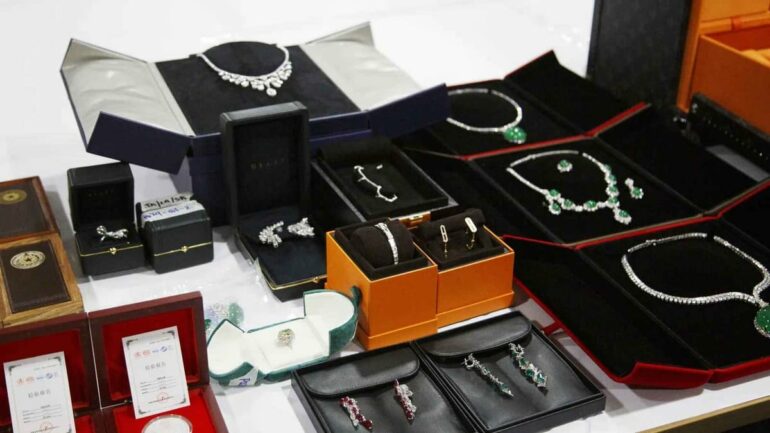
Behind the blank walls and ultra-secure architecture of Singapore’s Freeport, right next to the runways at Changi Airport, the justice system has taken on the air of an auction house. For nearly a quarter, the vaults of this free port have housed not only treasures in transit, but also the proceeds of a criminal seizure of staggering proportions. In these spaces shielded from daylight, the auction house Hotlotz has set up an operation worthy of the greatest museums. A gemmology laboratory has been built from scratch, adjacent to a high-definition photography studio. Under the clinical scrutiny of experts, a mountain of evidence has been identified, numbered, photographed, and packaged. What they all have in common: they all stem from a single money-laundering case valued at 3 billion Singapore dollars. Today, this dirty money is undergoing its final transformation, converted into numbered lots on auction screens.
The handling of this sprawling haul goes far beyond a simple auction hammer strike. In July 2025, management of this inventory was entrusted to Deloitte, which was commissioned by the Singapore police to orchestrate the liquidation of non-monetary assets. The figures are staggering: the case involves 1.4 billion Singapore dollars in cash and 1.25 billion in tangible assets. This is not a matter of clearing out a run-of-the-mill closet, but of dispersing more than a thousand luxury items and over eighty real estate properties. The opening of the auctions this Monday, September 7, at 10 a.m. is therefore only the first movement in a long bureaucratic and commercial symphony. Fifteen successive auction sessions are already scheduled between September 2026 and mid-2027.
Death as a Market Catalyst
At the heart of this first wave of sales, one item captures the spotlight and illustrates the blurred line between contemporary art and the most abrupt form of financial speculation. It is the “Pumpkin Bag,” the result of a collaboration between Louis Vuitton and Yayoi Kusama. The piece already holds a special place in the world of leather goods, but its auction trajectory is shaped by a purely biographical reality: the death of the Japanese artist on August 14, 2026, at the age of 97.
In both the art market and the secondhand luxury market, the death of a designer causes an immediate shockwave in prices. This specific model is offered in “full set” condition—a criterion that collectors are obsessed with—meaning it comes with its original box, packaging, and all of its accessories. While bidding in Singapore starts at $10,000 for this lot, attention is turning to a recent precedent. In September 2024, an identical piece sold at Christie’s in New York for $151,200, equivalent to 192,200 Singapore dollars. The gap between the starting price and the potential final price promises a fierce bidding war.
Extravagant Leather Goods and Architecturally Designed Trunks
This Kusama bag is just one of the 338 lots in the catalog for this first session titled “Luxury Handbags & Accessories,” with the online auction set to close on September 20 at 4:00 p.m. The selection paints a picture of frenzied collecting, spanning the spectrum of historic French fashion houses. Chanel, Christian Dior, and Louis Vuitton reign supreme here.
Among the curiosities in this collection, a Louis Vuitton jewelry trunk stands out. The piece moves beyond the simple Monogram canvas to feature floral motifs interwoven with an image of the Eiffel Tower, elevating this utilitarian item to the status of a work of art. The House of Dior, for its part, is represented by one of its most coveted styles: a Mini Lady Dior crafted from matte white Himalayan crocodile leather, a material whose rarity dictates its own pricing on the gray market. At Chanel, recent history takes center stage with the “Success Story” collection, a collection conceived in 2020 to celebrate the stylistic legacy of Karl Lagerfeld, offered here with a starting price also set at 10,000 Singapore dollars.
Carats, white gold, and price contrasts
The second phase of this sales campaign, titled “Fine Jewellery, Part One,” features 286 pieces. The auctions, which opened simultaneously on September 7, will run until September 27 at 4:00 p.m. Here, the abundance of pieces gives way to much higher valuations. The combined estimates for the two catalogs range from 2.9 to 3.9 million Singapore dollars.

One stone is the center of attention: a ring set with a “fancy yellow” diamond weighing a massive 15.02 carats. With a starting bid of 180,000 Singapore dollars, this piece commands the highest estimate in the sale, with experts predicting a final hammer price between 200,000 and 300,000 dollars. European fine jewelry craftsmanship is hot on its heels. A Hermès bracelet—a precious variation on the Kelly clasp crafted in white gold and set with 263 diamonds—awaits buyers with an estimated price range of $150,000 to $200,000. Bulgari’s reptilian aesthetic is also featured in the catalog, embodied by a Serpenti necklace valued between $60,000 and $80,000.
Yet the opulence of these six-figure auctions coexists with much more modest lots. The catalog reveals a myriad of Chanel accessories and small jewelry pieces whose estimates barely exceed a few hundred dollars, revealing the compulsive nature of how this collection was built, where impulse purchases go hand in hand with pure investment.
The state treasury as the beneficiary
The proceeds from these sales will not benefit any heir or private foundation. All funds raised will be directly deposited into the Consolidated Fund, the Singaporean government’s main account. The city-state’s justice system demonstrates here its ability to complete a full cycle: identifying fraud, physically seizing the assets, and then returning them in liquid form to the public coffers. As for the dozens of seized properties, the procedure will be adapted, leaving the door open for direct transactions or other disposal mechanisms parallel to the auctions.
On September 27, when the final jewelry auctions conclude, the inventory process will resume in full force. In bonded storage facilities, the next waves of items await their moment in the spotlight. The auction house has already outlined the highlights of upcoming sales: new Hermès leather goods, but above all a flood of fine timepieces featuring dials by Rolex, Patek Philippe, and Richard Mille. The conversion of proceeds from crime into legal tender has found its stride.