
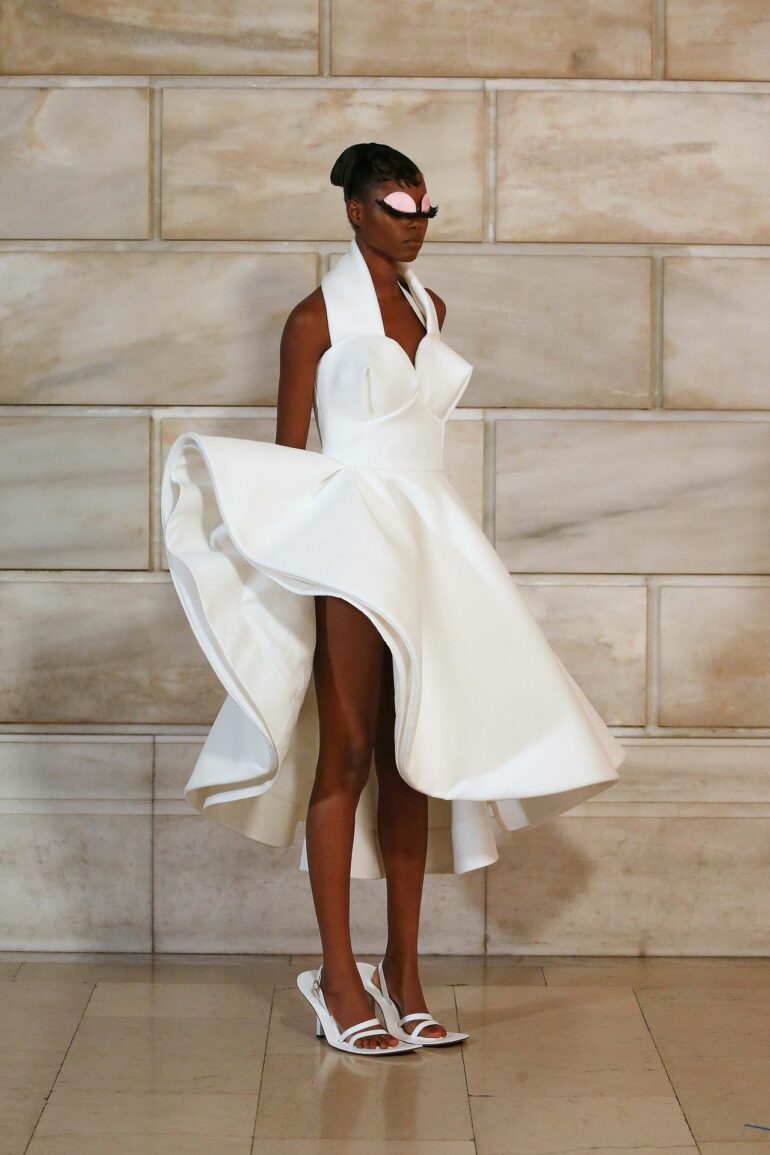
At the New York Public Library, Marc Jacobs has chosen to keep things low-key and limit the number of guests. Since June 2021, following the hiatus forced by the pandemic, his fashion shows have been held outside the official calendar, almost always at this library, in front of a small audience. The creative vision, however, is anything but timid. This contrast between avant-garde fashion and a scaled-back setting sheds light on the brand’s change in ownership: how can a brand—largely driven by its handbags—be developed without diminishing the role of the designer whose name it bears?
Two Expressions of the Same Brand
Today, there are two ways to experience Marc Jacobs. The first is through the runway collections, with their formal freedom and limited distribution. These pieces are available exclusively in the brand’s boutiques and at Bergdorf Goodman. The second takes place in the realm of handbags and small leather goods, where the brand competes with Michael Michael Kors, Kate Spade New York, and Coach. The name is the same; the way the brand connects with the public is very different.
This duality is the real challenge of the transition from LVMH to WHP Global and G-III. The buyers state that they want to maintain Marc Jacobs’ positioning in high fashion while developing licensing and sales through multi-brand retailers. In other words, to expand the business without trivializing what makes it unique. The intention seems feasible on paper. In practice, however, it requires maintaining a runway show whose impact is not measured solely by the number of retail locations.
The “see now-buy now” model, adopted for the presentations since the takeover, does, however, directly link the runway to the point of purchase. But it does not transform these collections into a widely distributed offering. At Jacobs, immediate availability can therefore coexist with the scarcity of locations where the clothing can be found. It is this unique structure that the new shareholders will have to either evolve or preserve.
$925 million and a division of roles
The transaction is valued at $925 million—approximately 800 million euros—down from the $850 million initially cited at the time of the announcement. Beyond this revaluation, the chosen structure merits attention: WHP Global and G-III each hold a 50% stake in a joint venture that owns the brand. However, equal ownership does not mean that the two partners will perform the same functions.
WHP Global will manage the entity that owns the brand. G-III has also acquired its operational business, which is primarily based in the United States and Europe, with a network of more than 100 stores. G-III will be responsible for managing sales to retailers, boutiques, and e-commerce. Ownership of the brand name and commercial operations are thus divided between two levels, with distinct responsibilities.
This organizational structure places sales channels at the center of the project. The new owners are not merely taking on a creative brand; they also have an established physical retail network and intend to expand Marc Jacobs’ presence among retailers. For G-III, the challenge will be to build upon this existing foundation. For WHP Global, the focus will be on supporting the brand’s expansion through new licensing agreements.
The end of a chapter that began in 1997
LVMH acquired Marc Jacobs in 1997, the year the designer became Louis Vuitton’s first creative director. These two events had tied the fate of his own brand to his arrival at Vuitton. The sale now severs this longstanding capital tie with the French group, whose portfolio includes Dior, Fendi, Loewe, and Loro Piana, among others.
The change also reflects a shift in the economic landscape. Marc Jacobs is leaving this group of luxury houses to join two companies whose portfolios and business models place a strong emphasis on the commercial exploitation of brands. This does not prejudge the fate of the collections. However, the priorities expressed by the buyers are clear: new licensing deals, more multi-brand sales, and business growth.
G-III is already familiar with acquisitions from LVMH. The group purchased Donna Karan and DKNY from the French conglomerate in 2016. This precedent places Marc Jacobs in a business relationship that did not begin with this transaction, even though each brand strikes its own balance between design, products, and distribution.

Owners Well-Versed in Managing Multiple Portfolios
At WHP Global, Marc Jacobs will join Vera Wang—which became part of the group in 2024—as well as Rag & Bone and G-Star. Lotto and Express are also part of the group, as is the toy retailer Toys’R’Us. This diversity speaks volumes about the fact that the acquirer is not defined by a single product category or by a common aesthetic across all its holdings.
According to projections released at the time of the acquisition, the addition of Marc Jacobs is expected to boost global retail sales associated with WHP Global’s portfolio to over $9.5 billion. This is indeed a retail sales metric at the brand level, not the acquisition price. This figure illustrates the scale of the business ecosystem into which the brand will be integrated.
G-III, for its part, combines two roles: owner and licensee. In addition to Donna Karan and DKNY, it owns Karl Lagerfeld, Sonia Rykiel, and Vilebrequin. Its licensing portfolio includes, notably, Converse, Halston, Calvin Klein, Tommy Hilfiger, and Levi’s. This dual role gives the company expertise in both its own brands and those operated under license. The announced expansion for Marc Jacobs will therefore draw on skills already present among its acquirers.
The Fashion Show: A Commitment Rather Than a Guarantee
There remains the issue that Marc Jacobs himself brought up: continuing to present his collections. In an interview with Vanity Fair US, the designer explained that he had clearly expressed this wish to Shmidman and Goldfarb. His stance reflects a cautious confidence: his counterparts say they want to continue the fashion shows, and he is trying to believe in their commitment.
Morris Goldfarb confirmed that the shows will continue in the near future, without making a definitive promise. The nuance matters. He also dismissed the idea of a strategy involving cutting design talent and marketing expenses to run the company on a reduced budget. The stated ambition appears to be the opposite. These statements leave room for creativity, but they do not establish sustainable conditions for its funding or visibility.
Marc Jacobs’ next strategic balance will therefore be reflected as much in distribution choices as in statements of principle. Increasing sales at multi-brand retailers does not necessarily mean offering runway pieces there. For now, those pieces remain exclusive to the brand’s boutiques and Bergdorf Goodman. Future commercial agreements will reveal what portion of the Jacobs universe the new owners actually intend to bring to market.