
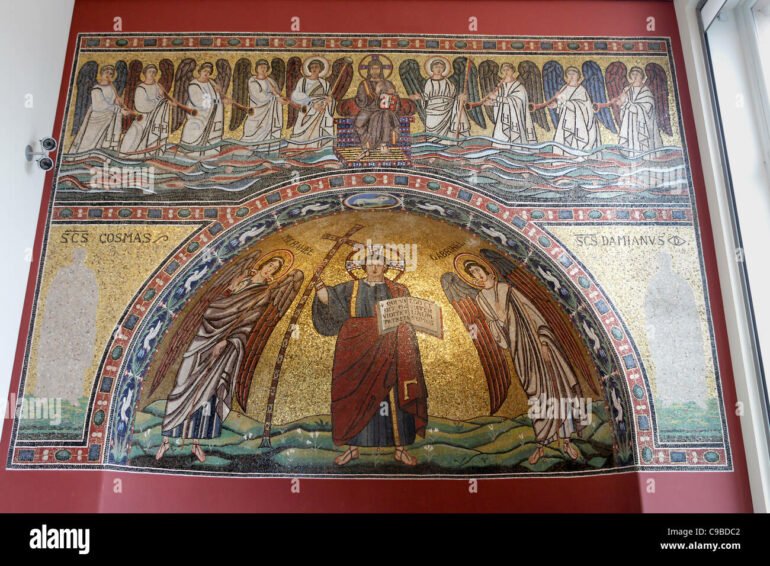
Within the new LEIZA venue in Mainz, the sculptural installation featuring reproductions of Byzantine mosaics from Ravenna marks the prelude to a major cultural project, whose official opening is still pending.
Ravenna’s Majestic Legacy
In the vast spaces of the future Leibniz Center for Archaeology (LEIZA) museum in Mainz, the layout of the permanent collection comes to life with the addition of its first masterpieces. These are masterful reproductions of two mosaics originally from Ravenna, an Italian gem inextricably linked to Byzantine aesthetics and the splendor of the Eastern Empire.
Each monumental work measures four meters by three and weighs nearly a metric ton. One depicts Emperor Justinian at the center of his court; the other, Empress Theodora holding a liturgical chalice. By choosing to open its exhibition with these iconic figures from art history, the museum makes a powerful statement: a sensitive and majestic evocation of the complex process of cultural transmission.
A highly precise museum curatorial arrangement
Dating from 1967, these exceptional pieces have belonged since the 1960s to LEIZA’s predecessor institution, the RGZM (Römisch-Germanisches Zentralmuseum). Their integration into this new architecture required cutting-edge engineering. During their transfer, the mosaics were divided into six load-bearing panels before finding their permanent home in an elegant steel frame, directly embedded in the building’s walls.
The process was akin to fine craftsmanship: nearly 4,000 tesserae had to be meticulously removed and then reinserted. Given the hundreds of thousands of fragments that make up the surface, this number might seem insignificant, but it illustrates the absolute precision and formal perfection that guide the design of this future exhibition.
The Art of Anticipation
The major permanent exhibition, titled “Zusammen leben,” still shrouds its opening date in mystery. LEIZA, which moved into its new home in 2023, continues its mission to explore human evolution through material remains spanning nearly three million years of history.
While the architecture is ready to reveal its secrets, the doors remain closed for now. The institution’s schedule still wavers between 2026 and spring 2027. This delay is typical of museum projects of this scale, where the promise of the architectural vision often moves faster than the demanding timeline for installing the works.
The commanding presence of Justinian and Theodora thus transcends mere spatial ornamentation. By presenting this heritage to the public through the lens of perfect reconstruction rather than the pursuit of an illusory authenticity, the museum asserts a confident stance. The LEIZA is preparing a spectacular introduction, elegantly illustrating a stage inherent to great cultural sanctuaries: the setting is complete, the works are already coming to life, but the visitor must still cultivate the art of patience.