
In 1987, the Ferrari F40 made history by breaking the 200 mph (approximately 322 km/h) barrier, which was considered unattainable at the time. What was once a one-off feat has, over the course of four decades, become the starting point for an unprecedented technological arms race. Today, as the automotive industry embarks on its most radical transformation, the quest for pure speed has never seemed more obsessive. For manufacturers of extreme performance vehicles, every kilometer per hour gained on a knife’s edge is a demonstration of raw power and aerodynamic mastery. This race toward the horizon is no longer limited to engine power; it now incorporates artificial intelligence, 3D printing, and electric propulsion.
The Bugatti Dynasty and the Legacy of Molsheim
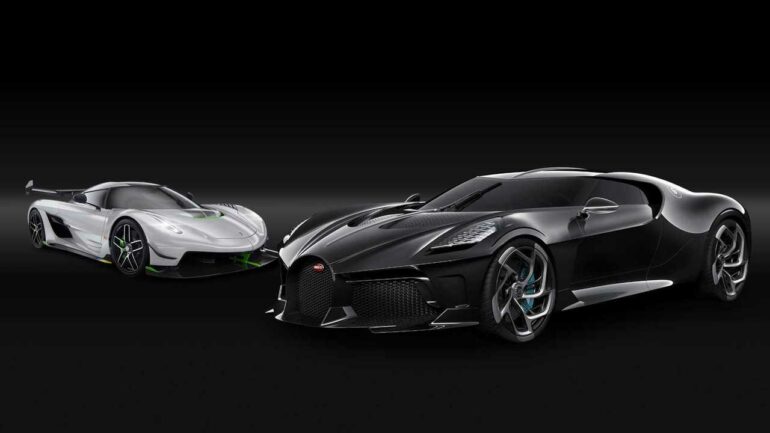
It’s hard to talk about speed without placing the Alsatian company at the top of the pyramid. Bugatti redefined the standards as early as 2005 with the Veyron, but it was with the Chiron Super Sport that the brand truly blew the competition away. In 2019, driver Andy Wallace reached 304.7 mph (490.4 km/h) on the Ehra-Lessien test track. This record required meticulous preparation: a body extended by 25 centimeters to stabilize airflow, a redesigned exhaust system, and Michelin Pilot Sport Cup 2 tires that were X-rayed before installation to ensure their structural integrity under immense centrifugal forces.
The adventure continues with the Bugatti Mistral, a roadster that defies the laws of physics by reaching 282 mph without a roof. For track purists, the Bolide pushes the limits of the quad-turbo W-16 engine even further, boasting a theoretical top speed of 311 mph. Even models geared more toward driving, such as the Chiron Pur Sport—electronically limited to 217 mph—or the venerable Veyron Super Sport with its 267.8 mph, bear witness to an era when the number of cylinders ruled the road.
Scandinavian Craftsmanship According to Koenigsegg
Standing opposite the Bugatti giant is Christian von Koenigsegg, a visionary engineer who prefers agility and radical innovation to excessive engine displacement. His current masterpiece, the Koenigsegg Jesko Absolut, is designed with a single goal in mind: to reach 330 mph (531 km/h). To achieve this, the Swedish manufacturer relies on an extremely low drag coefficient and a “Light Speed” transmission capable of handling the 1,600 chevaux produced by the V-8 when running on E85 biofuel.
Koenigsegg’s history is marked by spectacular feats. In 2017, a customer-owned Agera RS stunned the world by averaging 277.8 mph on a closed public road in Nevada. Earlier, the CCXR had already broken the 249 mph barrier. Today, the brand is exploring new segments with the Gemera, a four-seat “Mega GT.” Despite its ability to accommodate four adults and their carry-on luggage, this 1,700-horsepower beast promises to reach 249 mph, accelerating from 0 to 100 km/h in just 1.9 seconds.
Electric Lightning and China’s Rise
The era of fossil fuels is no longer the sole force setting the pace. The emergence of electric hypercars has shaken up the global hierarchy. The most resounding surprise comes from Asia with the Yangwang U9 Xtreme. On the Papenburg circuit in Germany, this machine reached 308.4 mph, establishing itself as the fastest electric production car on the planet, even surpassing the certified performance of many legendary internal-combustion cars.
Europe is responding with the Rimac Nevera. More than just a display of power with its 1,914 chevaux (twice the power of a Formula 1 car), it’s designed to be a grand tourer suitable for everyday use. Yet, once it gets going, it roars with its 1.4 megawatts of power to reach 258 mph. In a similar vein, the Pininfarina Battista—a technical cousin of the Rimac but styled by the famous Italian coachbuilder—has a top speed of 218 mph, prioritizing elegant styling and exceptional lateral acceleration. Finally, the Tesla Roadster, though still eagerly awaited, promises a top speed exceeding 250 mph thanks to its three-motor configuration.
The American Obsession: Hennessey and SSC
Across the Atlantic, speed is a national pastime. John Hennessey, after spending many years tuning other people’s cars, eventually built his own. The Venom F5, named after the most devastating category of tornadoes, claims a top speed of over 300 mph thanks to a 6.6-liter V-8 engine producing 1,817 chevaux. It succeeds the Venom GT, which in 2014 reached 270.4 mph on the track at the Kennedy Space Center.
SSC North America, for its part, has a complicated relationship with numbers. After setting the Guinness World Record in 2007 with the Ultimate Aero TT (256.1 mph), the brand launched the Tuatara. Following controversy over data from an initial test at 316 mph, a new certified attempt in 2021 confirmed a speed of 282.9 mph (with a peak of 295 mph). These boutique manufacturers prove that, far from the major industrial conglomerates, pure passion and raw engineering can still shake up the giants.

Aerodynamics in the Service of Excitement
Beyond sheer power, it is the management of airflow that distinguishes a race car from an uncontrollable projectile. Gordon Murray, the father of the legendary McLaren F1 (which remains the gold standard for naturally aspirated engines with its 240.1 mph set in 1998), is back in the spotlight with the T.50. What makes it unique? A 40-centimeter fan at the rear that literally “sucks” the car down to the ground, allowing it to reach 230 mph despite a more modest 4.0-liter engine displacement.
McLaren continues to hone this aerodynamic expertise with the Speedtail. Its streamlined silhouette and ultra-light carbon-fiber structure allow it to reach speeds of up to 250 mph, joining the Woking elite that also includes the P1 (217 mph). For its part, the Mercedes-AMG One brings Formula 1 hybrid technology to the road, with a record at the Nürburgring and a top speed of 219 mph. Finally, the Aston Martin Valkyrie, the result of a collaboration with Red Bull Racing, uses a 1,160-horsepower Cosworth V-12 to propel its occupants to 250 mph in a fighter jet-style cockpit.
The Guardians of the Temple and the New Alchemists
Among these technological behemoths, a few names continue to inspire dreams simply through their aura. The Ferrari Enzo, launched in 2002, serves as a reminder that Maranello was already capable of extracting 651 chevaux from a V-12 to reach speeds nearing 218 mph—a performance that remains relevant even when compared to modern hybrids. The Aston Martin One-77, limited to just 77 units, remains one of the most beautiful expressions of speed with its 220 mph top speed and its chassis combining carbon fiber and aluminum.
The next generation, however, is already here, embodied by Czinger and its 21C V Max. This California-based manufacturer uses artificial intelligence to design structures optimized down to the gram, produced via 3D printing. The result is a hypercar capable of reaching 253 mph. At Pagani, the Huayra and its BC Roadster variant (estimated at 240 mph) transform speed into a form of baroque art, where every mechanical part is finished like a timepiece, powered by an AMG-built twin-turbo V-12.
The race for speed records seems to be reaching a physical limit imposed by the strength of materials and the configuration of global infrastructure. Yet as long as there remains a hundredth of a second to gain or a mile per hour to conquer, engineers will continue to defy reason. For beyond the numbers, it is the human aspiration to push beyond one’s own limits that finds expression on the asphalt.