
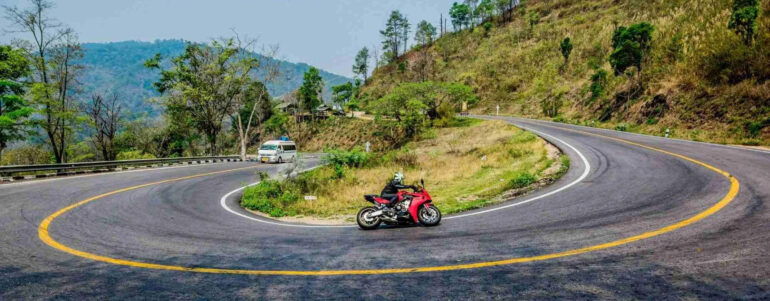
Immersing yourself in a foreign culture usually takes time, a genuine desire to learn the language, and the good fortune to have a reliable guide—whether that’s your spouse or a close friend. To this essential trio, I would gladly add a fourth pillar: getting your local driver’s license and hitting the road. I’ve been driving my own car on Thai roads for over a year now, and the experience has been a real eye-opener.
The paradox of local driving: courtesy and organized chaos
Contrary to expectations, the road infrastructure here is excellent. Even Bangkok’s infamous traffic jams can be bypassed with a little ingenuity and local knowledge. But what stands out most amid the capital’s apparent chaos is the incredible courtesy of drivers. It’s a dream come true for anyone who loves getting behind the wheel. Aggression has no place here: drivers let you merge with a smile, and silence is golden. No one honks. Really, no one. One day, completely disoriented by a flashing yellow light, I sat motionless for several long minutes before the driver behind me finally decided to give a very timid honk. I’d almost start to believe that the horn on my peaceful SUV was modified by a monk to produce nothing but the gentle chime of a Buddhist temple bell.
This wonderful absence of rudeness more than makes up for certain driving habits that are surprising, to say the least. As soon as a local gets behind the wheel—especially if it’s a pickup truck—a sense of absolute urgency seems to take hold of them. Lanes merge, passing maneuvers happen in a flash, and the slightest gap in traffic is immediately filled. It takes a little time to adjust, but every country has its own road quirks (I remember coming across a tractor driving the wrong way on a highway in China), and that’s undeniably part of the adventure.
From city-dweller to road enthusiast
To be perfectly honest, I’ve never been much of a car enthusiast. For years, I spent happy days as a pedestrian in London, Hong Kong, and Bangkok, relying on the excellent public transit systems. It was the arrival of my children that triggered this 180-degree shift in my daily life. Buying a car was initially just a purely logistical compromise: I had to ensure safe trips to soccer practice, swimming lessons, and boxing classes. Yet what was supposed to be a utilitarian chore turned into a true passion. And the irony of the story is that the timing of this new mobility couldn’t have been better.
The Call of the Great Outdoors: From Bangkok to the Northern Mountains
Having your own means of transportation is absolutely key to truly experiencing the country’s diversity in an authentic way. Getting behind the wheel pushed me to embark on more and more expeditions to every corner of the country. If you have the chance, I highly recommend the legendary journey from the capital to Chiang Mai, taking the time to stop at the majestic ruins of the ancient royal cities of Ayutthaya and Sukhothai. I had the chance to cover the return trip in one go: an eleven-hour epic during which I felt deeply local, punctuating my journey with essential stops at gas stations to stock up on iced coffee and neon-colored energy drinks.

Having a vehicle in the mountainous regions offers invaluable freedom to explore the surrounding countryside. It allows you to venture off the beaten path to discover fascinating artisan workshops tucked away in the middle of nowhere or drive up to the stunning high-altitude tea plantations, which are well worth the detour.
The road is also the setting for inspiring encounters. As you chat with other travelers or expats, you realize that many have used the car as a starting point for a new life, sometimes leaving the southern coastal resorts to head inland and set up thriving eco-friendly projects on the other side of the country.
The steering wheel as a tool for mindfulness
Curiously, driving has become a true oasis of well-being in my routine. It’s one of the few moments of the week when I’m forced to focus on the present moment, away from screens. I used to be the first to jump into the back of a taxi and spend the entire ride with my nose buried in my inbox, completely ignoring the bustling life on the other side of the window. Being in control of my own vehicle forces me to look up, observe the scenery, and, paradoxically, better understand the world around me.
Of course, advocating for long car trips in this day and age may seem frivolous. But the good news is that the charging network for electric vehicles is expanding in Southeast Asia at the speed of a pickup truck flying down the highway. The potential for road trips there is immense. All it would take is a little inspiration from other countries that have successfully transformed their coastlines into legendary routes. Think of the highway that races south along the coast toward Hua Hin, Phang Nga, Krabi, and Koh Lanta: this is a route that has all the makings of a world-renowned epic expedition. One thing is certain: this will be the setting for my next great road trip.