
Make Texture a preferred source on Google to support us
Add Texture to GoogleThe Architecture of the Nighttime Environment: Beyond the Building Envelope
Sleep is no longer simply a matter of turning off the lights. In our contemporary homes, the bedroom has become a laboratory of sensations where textile technology takes a back seat to pure sensory experience. We no longer seek merely to cover ourselves, but to create a personal microclimate—a thermal bubble capable of adapting to the whims of the thermostat and the cycles of our own metabolism. This quest for the ideal bedding has moved beyond industrial standards to focus on the science of fibers, whether they come from the peaks of the Alps or from botanical innovation labs.
Investing in a high-end comforter or sheets is driven by a desire for sensory sustainability. We’re moving away from frenetic replacement cycles to favor materials that breathe, age with a certain nobility, and, above all, uphold that promise of “loft”—that airy fullness once found only in the suites of grand hotels. Choosing a filling or weave thus becomes an almost architectural decision, dictated by the search for a balance between weight, warmth, and moisture wicking.
Down: The Enduring Legacy of Natural Engineering
Despite the emergence of synthetic alternatives, down remains the gold standard for thermal comfort. Its superiority is no accident, but rather the result of its unique three-dimensional structure. Unlike feathers, down is a flake without a quill, capable of trapping an impressive volume of air relative to its own weight. This is where the concept of “fill power” comes into play. A rating exceeding 700 or 800—as found in products from specialists of Parachute’s caliber—guarantees exceptional insulation without the physical weight of a heavy blanket.
This lightness radically transforms the nighttime experience. Rather than feeling constant pressure on their limbs, the sleeper finds themselves enveloped in a cloud whose density passively regulates temperature. Duck or goose down, when carefully processed, has an innate ability to absorb water vapor emitted by the body and release it outward. It is this natural porosity that prevents the feeling of dampness often associated with low-quality polyester fillings. The most discerning brands now ensure the traceability of these materials, making sure that one person’s comfort does not come at the expense of animal welfare—an ethical standard that has become as crucial a selection criterion as thread count.
The Quiet Revolution of Lyocell and Plant-Based Fibers
While down dominates the winter season, a new generation of textiles is shaking up conventions for milder nights or sleepers prone to hot flashes. Lyocell, often marketed under the Tencel brand, is emerging as the most sophisticated alternative available today. Derived from eucalyptus pulp, this fiber is the result of a closed-loop manufacturing process that is particularly water-efficient. But beyond its eco-friendly credentials, it’s its technical performance that wins people over. Brands like Cozy Earth have made lyocell their signature, offering sets that feel like silk while retaining the durability of cotton.
Lyocell has a molecular structure that manages moisture far more effectively than traditional natural fibers. By wicking away sweat instantly, it keeps the skin dry and cool. Visually, these fabrics are distinguished by a fluid, almost liquid drape that hugs the body’s contours without ever clinging. It’s a material that doesn’t wrinkle as much as linen and retains a certain sheen, even after multiple washes. For those who view bedding as an extension of their luxury wardrobe, Lyocell offers this impeccable, smooth, and structured aesthetic while meeting the physiological requirements for uninterrupted sleep without temperature fluctuations.
Cotton and Linen: The Quest for the Perfect Weave
Cotton remains the cornerstone of the bedroom, but the discerning consumer now knows how to distinguish percale from satin. Percale, with its tight, matte weave, offers that crisp, cool feel—ideal for those who prefer “tightly made” beds. In contrast, cotton sateen—favored by brands like Brooklinen and Boll & Branch—features a looser weave that offers a silky softness and slightly greater warmth. The choice between these two finishes depends less on prestige than on each person’s nighttime body temperature.

At the same time, linen continues to gain ground in the high-end market. Long confined to a rustic aesthetic, it has been reinterpreted with greater refinement. European linen, grown with patience, becomes softer with each wash. Its greatest strength lies in its hollow structure, which makes it a natural insulator: cool in summer, it retains body heat in winter. Its naturally crinkled appearance brings an organic and relaxed feel to the bedroom, breaking up the stiffness of overly formal decor. It is a luxury that is understated, felt in the fiber’s irregular texture and its ability to last for decades without losing its splendor.
The Ergonomics of the Cover: The Role of Covers and Quilting
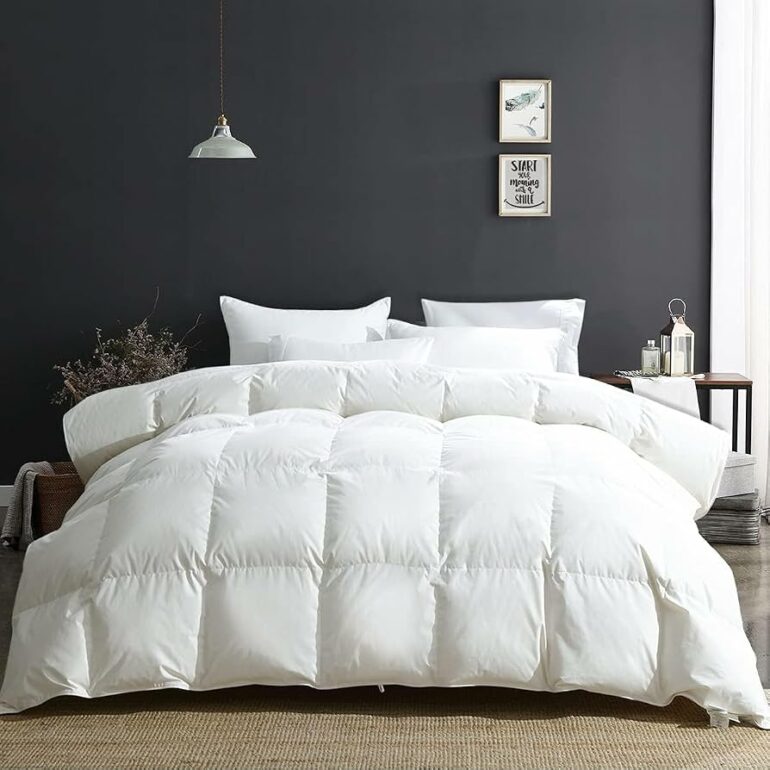
A high-performance comforter would be nothing without a cover capable of retaining its warmth. The quilting—the way the filling is distributed within the cover—is a technical detail that is often underestimated. Compartments are the standard for exceptional products. Unlike traditional through-stitching, compartmentalized quilting uses thin internal fabric partitions to keep the down evenly distributed across the entire surface. This prevents the formation of “cold spots” where the filling would accumulate in the corners, leaving entire sections of the comforter uninsulated.
The choice of duvet cover also acts as a filter. A cover that is too heavy or too dense can stifle the properties of high-end down. It’s best to stick with natural fibers to avoid creating a greenhouse effect. The interaction between the comforter and its cover must allow for smooth air circulation. It is in this synergy that lies the secret to a bed you’ll delight in slipping into, no matter the season. Bedding thus becomes an investment in your health—an optimized interface between your resting body and the external environment.
Beyond the initial purchase, proper care of these essential items determines their longevity. Down needs to be aired out regularly, while fibers like lyocell require washing at low temperatures to preserve the integrity of their filaments. Taking care of your bed means prolonging that daily moment of respite when comfort is no longer a concept, but an immediate physical reality. Ultimately, the best bedding is the kind you forget about once your eyes are closed, giving way to a sensation of perfect thermal weightlessness.